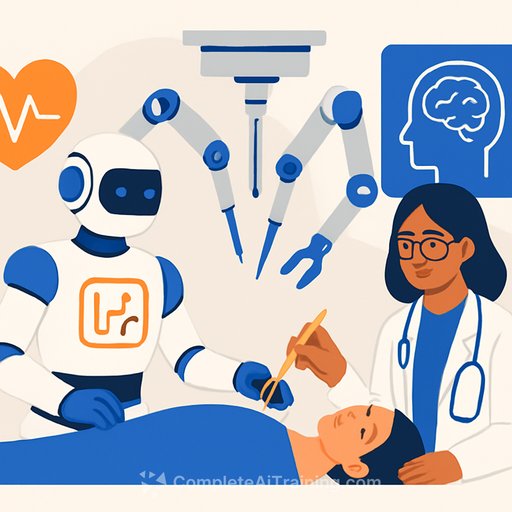
AI in Healthcare 2025: From Triage to the OR
AI is now embedded across the care pathway. It screens, triages, assists in diagnosis, guides treatment, and even helps operate. The opportunity is large: Precedence Research projects the global medical AI market to grow from 38 trillion won last year to 876 trillion won by 2034.
Big tech has moved in, and results are getting hard to ignore. For clinicians and administrators, the question isn't "if," but "where does AI create safe, measurable value in our setting?"
Diagnostic AI: signal through the hype
In August, Microsoft reported that its medical AI, MAI-DxO, achieved 85.5% diagnostic accuracy when tested on 304 patient cases from the New England Journal of Medicine (NEJM). In that comparison against 21 clinicians with 5-20 years of experience, the AI outperformed a portion of the physicians and did so at an average 20% lower expense.
Google shared results for Med Gemini on chest X-ray interpretation. When clinicians were blinded to the source, 72% rated Gemini's reads as similar to or better than physicians. Google is also working with NASA on AI that can support medical consultations for astronauts-high-stakes decision support in low-resource environments.
Apple is pushing continuous risk detection. On Apple Watch in the U.S. and Europe, AI analyzes vascular response and pulse data over 30 days to flag hypertension risk-without using a cuff. The aim: earlier intervention, fewer downstream complications.
New England Journal of Medicine and U.S. FDA medical devices remain reference points for study methods, regulatory context, and safety guardrails.
AI in the OR: from assistance to autonomy (carefully)
At Johns Hopkins, a surgical robot guided by an in-house AI (SRT-H) cleanly performed eight pig gallbladder removals, published in Science Robotics. The same group previously trained the da Vinci system to suture like seasoned surgeons using only machine learning on surgical videos.
These are controlled studies-not plug-and-play clinical replacements. But they show where automation can reduce variability, increase precision, and extend expert technique across teams.
Korea's momentum: tools you can deploy now
Hospitals are already adopting domestic solutions:
- Naver Cloud: Smart Survey converts free-text notes into standardized terminology and saves to EMR; Patient Summary analyzes prior results to recommend next tests.
- Noul: AI microscopy detects malaria from blood smear images and screens for cervical cancer by analyzing stained cell morphology-built for low-infrastructure settings.
- VUNO DeepCARS: Uses blood pressure, pulse, respiration, and temperature to alert clinicians to cardiac arrest risk within 24 hours; in clinical use since 2022.
- Koh Young Technology: Genius Cranial surgical robot assists procedures for epilepsy and brain tumors; FDA-cleared and entering overseas markets.
Risk prediction that changes care plans
A team at Kyunghee University's School of Medicine developed an AI model that predicts which patients with type 2 diabetes will develop chronic kidney disease within five years. Published in July in Diabetes Care, the model supports earlier nephrology referral, medication choices, and tighter follow-up.
What to do next: practical steps for clinical leaders
- Start with one high-yield workflow: ED triage, CXR reads, inpatient deterioration alerts, or automated documentation. Measure turnaround time, sensitivity/specificity, and cost per case.
- Run a silent trial: Let the AI produce outputs while clinicians work as usual. Compare performance head-to-head before activation.
- Stand up governance: Define approval criteria, bias checks, model update cadence, and escalation pathways when AI and clinician disagree.
- Integrate, don't bolt on: Deliver AI insights inside the EMR, with zero extra clicks. If it adds friction, adoption will stall.
- Train the team: Short, case-based sessions beat long lectures. Focus on indications, limits, and failure modes.
- Close the loop: Track outcomes and recalibrate. Sunset tools that don't meet thresholds.
Healthcare Innovation Forum 2025: where to see what's next
HIF 2025 will gather clinicians, industry, and regulators to show real deployments and discuss what's coming. Details below.
- Event name: Healthcare Innovation Forum 2025
- Date and time: Nov. 6, 2025 (Thu.) 9 a.m.-4:20 p.m.
- Venue: The Westin Chosun Seoul, Grand Ballroom, Sogong-dong, Seoul
- Theme: AI and advanced regeneration: crossing the boundaries of healthcare
- Hosts: Korea Health Industry Development Institute (KHIDI), ChosunBiz
- Sponsor: Ministry of Health and Welfare
- Registration and fees: https://e.chosunbiz.com
- Inquiries: 02-724-6157, event@chosunbiz.com
Speakers: Yoo Han-ju (Naver Cloud Digital Healthcare LAB), Lim Chan-yang (Nooul CEO), Jung Kyu-hwan (Samsung Advanced Institute for Health Sciences and Technology, Sungkyunkwan University; VUNO founder), and Ko Kyung-chul (Koh Young Technology).
Upskilling for clinicians and health IT teams
If your organization is building an AI roadmap, a structured way to find training by role can speed things up. Explore curated options by job function here: AI courses by job.
Your membership also unlocks: