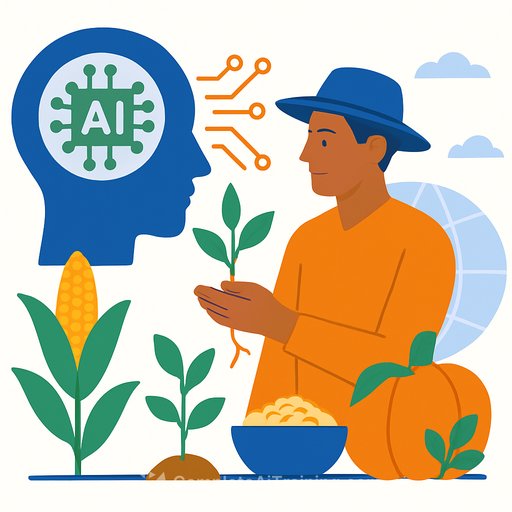
AI-driven breeding strategy aims to boost orphan crops for food security
Global demand is rising while climate stress tightens the margin for error in agriculture. Despite more than 12,000 edible plant species, roughly 30 crops still provide 95% of the world's calories-an efficient system, but fragile and highly uniform. A new Perspective in Nature Communications lays out a practical route to diversify the food base by upgrading orphan crops through an AI-empowered breeding strategy.
Why orphan crops matter
Orphan crops-such as fonio, tef, and cowpea-tend to handle heat, drought, and marginal soils better than global staples. They also offer dense nutrition and wide species diversity. Bringing these crops into mainstream production can widen dietary options, improve regional resilience, and strengthen agro-biodiversity.
The obstacle: limited research funding and a lack of modern breeding pipelines. Many orphan crops still lack high-yielding, high-quality, stable varieties that can compete in markets or national programs.
The DSAP framework: an integrated playbook
The proposed DSAP strategy combines three levers to close that gap and shorten time-to-variety:
- De novo domestication: Use genome editing to introduce key domestication and quality traits while keeping stress tolerance intact.
- Speed breeding: Run extended photoperiods and controlled environments to compress generation time and multiply cycles per year.
- AI-empowered phenomics: Apply high-throughput sensing with AI models to select elite lines precisely and at scale.
Together, these steps accelerate germplasm innovation, generation turnover, and variety evaluation. The goal is fewer bottlenecks, clearer decisions, and faster delivery of improved orphan crop lines. For additional resources on AI-driven breeding and phenomics, see Research.
What this looks like in practice
- Define the target product profile: Trait stack by region and use-case (yield stability, micronutrients, cooking quality, storage, pest/disease profile).
- Map/edit domestication loci: Prioritize edit targets guided by comparative genomics with well-studied crops; validate edits quickly via speed breeding.
- Build a phenomics loop: Pair imaging/sensing (field, greenhouse) with AI models for growth, stress, and quality predictions; integrate with genomic and environmental data.
- Run iterative selection: Short cycles, clear thresholds, and staged multi-environment testing to confirm stability and farmer relevance.
- Plan seed system early: Engage local partners for seed multiplication, extension, and feedback on trait priorities.
Implications for food security
Upgrading orphan crops is a direct path to diversify calories and micronutrients, especially in regions facing heat and water stress. It also spreads production risk across more species and environments. With sustained support, these crops can move from niche use to meaningful contributions in national and regional food systems.
What needs funding and policy support
- Shared infrastructure: Controlled environments, field phenotyping networks, and compute for AI model training.
- Open data standards: Interoperable formats for phenomics, genomics, and environmental data to speed cross-crop learning.
- Capacity building: Training programs for genome editing, phenotyping, and AI workflows in national breeding programs.
- Regulatory clarity: Timely, science-based pathways for edited crops and seed distribution.
None of this replaces staples. It complements them-adding diversity, resilience, and nutrition where it's most needed.
Reference
Perspective: Revitalizing orphan crops to combat food insecurity, Nature Communications (2025). DOI: 10.1038/s41467-025-66020-3.
Your membership also unlocks: