AI is speeding up paper writing - and flooding the pipeline
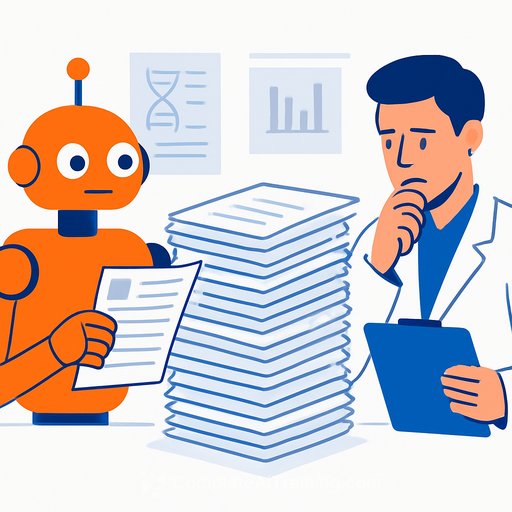
Generative AI has lowered the barrier to drafting academic papers. That's good for productivity, but it's also creating a backlog for editors and reviewers.
A recent analysis found traces of machine-generated text in over 13% of biomedical abstracts submitted in 2024. Volume is up, review capacity isn't, and weak work can slip through - which raises the risk of false claims spreading through citations and press coverage.
Why this matters for researchers and science writers
When noise grows faster than signal, strong studies get buried and weak studies get cited. Writers covering new findings face more polished text that hides shallow methods.
The result: more retractions, more "consensus" built on shaky references, and more time wasted separating solid results from padded manuscripts.
Common signs of low-quality, AI-assisted manuscripts
- Generic phrasing and broad claims with few concrete numbers, effect sizes, or confidence intervals.
- Methods that read like a template: neat headings, vague protocols, missing parameters, or absent preregistration.
- Inconsistent stats: p-values that don't match test choices, sample sizes shifting between sections, or perfect-looking tables with no raw data link.
- References that look plausible but don't support the claim, are outdated, or are oddly clustered around certain journals.
- Reused figures or stock-style diagrams without underlying data or code.
- Speed and volume red flags: many submissions from the same group with minor topic shifts and thin novelty.
Use AI without sinking your credibility
- Be explicit: Add an AI-use statement covering where tools were used (e.g., language editing, summarizing, brainstorming), and confirm that authors take responsibility for all content.
- Keep an audit trail: Save prompts, model names, and versions. Track edits. This protects you during peer review.
- Verify everything: Treat AI output as a rough draft. Check every claim against primary sources. Recreate numbers and regenerate plots from raw data.
- Handle citations carefully: Do not let AI invent references. Validate DOIs, titles, and quotes. Skim full texts, not just abstracts.
- Own the prose: Rewrite for specificity. Replace generic statements with concrete details: datasets, parameter values, code repos, and limitations.
- Disclose limits: Note model use in limitations. Clarify that AI did not perform analysis or decide inclusion/exclusion criteria.
Fast triage tactics for editors and reviewers
- Structured intake: Require checkable fields (data links, code links, preregistration IDs, ethics approvals, reagent IDs).
- Automated screens (as signals, not verdicts): plagiarism checks, reference validation, image manipulation screening, and basic stat checks.
- Data and code availability: Mandate accessible repositories before review. No links, no review.
- Registered reports and replication tracks: Reduce perverse incentives and filter speculation from results.
- Spot-check numbers: Recompute simple stats from provided data. Look for copy-paste tables that don't reconcile with text.
- Right-size reviews: Short-desk reject when novelty is weak, claims are broad, and data access is missing.
For science writers: reporting safeguards
- Favor studies with data/code links, preregistration, and transparent methods.
- Call an outside expert for a 2-minute read on methods before running a headline.
- Trace one key claim back to the raw data or primary figure. If it's not clearly supported, hold the story.
- Watch for boilerplate intros and over-polished language masking vague results.
Practical author workflow (fast and clean)
- Outline your research question, hypothesis, and key metrics first. Then use AI to challenge your design (ask for failure modes and confounders).
- Draft with AI for structure and clarity, but insert your exact methods, parameter values, and caveats immediately.
- Build a claims-evidence table: each claim, its figure/table, dataset, and reference. Delete any claim without support.
- Run a citation integrity pass: verify DOIs, reference relevance, and quotes against full texts.
- Post a preprint with data/code. Invite quick feedback before journal submission to catch weak spots early.
Policy moves that raise quality fast
- Require an AI-use disclosure and accountability statement with submissions.
- Adopt clear authorship and contribution criteria like the ICMJE recommendations.
- Align editorial ethics with COPE guidelines and enforce data/code availability.
- Fund reviewer time or offer credits to improve review depth and speed.
What to do this week
- Create a one-page lab or newsroom SOP: AI-use rules, verification steps, and a final pre-submission or pre-publication checklist.
- Set up lightweight triage: auto-check references, require data links, and run a quick stats sanity check.
- Train your team on prompt hygiene for research tasks and on spotting weak evidence. A practical starting point: prompt-engineering workflows.
The signal is still there. It just takes clearer standards, better prompts, and a habit of verifying what looks polished. Write fast if you want - verify faster.
Your membership also unlocks: