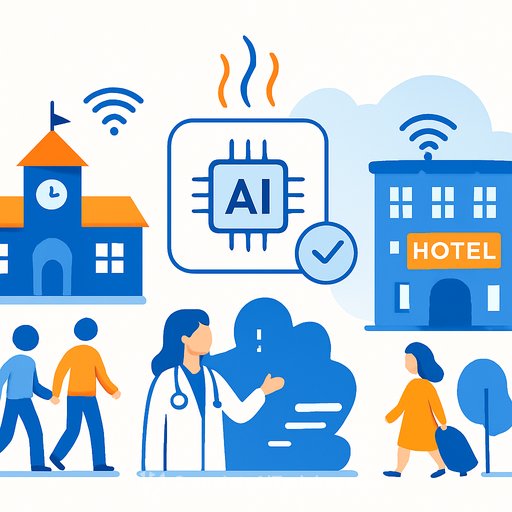
AI sensors are reshaping safety in schools, hospitals and hotels
Nearly 90% of organisations now use AI to support at least one business function. While most focus on workflow automation and data analysis, AI is also transforming physical spaces through intelligent sensor networks deployed in schools, hospitals and hotels.
AI-driven sensors differ fundamentally from traditional monitoring devices. Instead of simply collecting data for human operators to review, these sensors analyse information in real time, detect patterns and anomalies, and trigger automated responses to safety risks.
How these sensors work
An AI-driven sensor follows a three-stage process. First, it collects environmental data-sound, motion, light, air quality or a combination-and converts it into electrical signals. Second, built-in software filters noise and corrects errors to ensure clean data. Third, machine learning models analyse the processed data to identify patterns and flag anomalies.
More than 30% of all new IoT devices now use AI-powered sensing. The technology is spreading fastest in high-traffic, highly-regulated environments where safety requirements are strict.
Schools: detecting substance misuse and threats
Schools deploy multi-sensor devices throughout buildings to monitor air quality, occupancy and dangerous behaviours. Vape detectors identify aerosols, tobacco smoke and THC in bathrooms and stairwells-areas where traditional cameras are inappropriate. Sound and motion sensors detect bullying indicators like shouting and rapid movements. Some sensors can recognise specific sounds such as gunshots or calls for help, triggering automatic lockdowns when linked to security systems.
Hospitals: patient care and infection control
Hospitals use AI sensors in patient rooms to detect air quality issues, suspicious motion and unusual sounds. The technology helps staff identify smoking, falls, physical altercations and medical emergencies without continuous video or audio recording.
For infection control, sensors monitor sanitisation compliance and air quality, then automatically activate doors and light switches to enable low-touch movement through restricted areas. Security teams use sensor data to flag suspicious activity in secure zones and trigger facility-wide lockdowns when needed.
Hotels: energy management and guest safety
Hotel operators use AI sensors to automate heating, ventilation and lighting based on occupancy and air quality. Motion-activated lighting and temperature-controlled systems reduce energy consumption while improving guest comfort.
Occupancy data helps staff adjust schedules during peak and low-traffic periods, improving resource efficiency. Like schools and hospitals, hotels deploy sensors in guest rooms to detect smoking and violence-safety risks that surveillance cameras cannot lawfully monitor.
For more on AI applications in your sector, see AI for Hospitality & Events.
Your membership also unlocks: