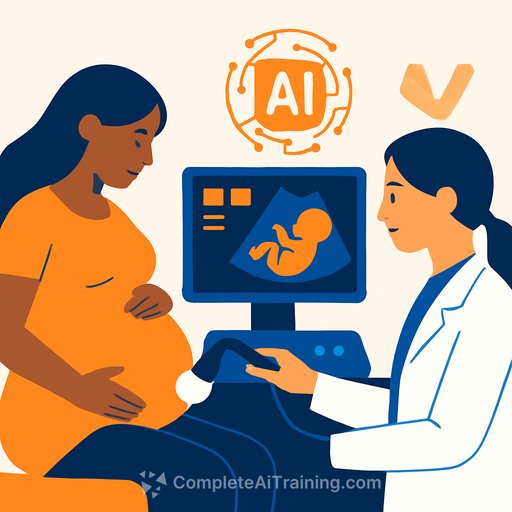
Using AI to Improve Detection of High-Risk Pregnancy
AI models analysing ultrasound images can identify up to 35% more high-risk pregnancies compared to traditional scans without AI support. This improvement offers the potential to prevent premature births and related complications. Prenaital, a spin-out from the Technical University of Denmark (DTU) and the University of Copenhagen, has developed AI technology through years of collaboration involving engineers, computer scientists, and clinicians.
Ultrasound images contain extensive data beyond what the human eye can interpret, providing valuable insights into fetal health.
Aasa Feragen, co-founder of Prenaital and professor at DTU, explains: “Ultrasound images hold information on fetal brain structures, fat percentage, and tissue composition that traditional measurements don’t capture. While healthcare professionals typically assess head circumference, abdominal circumference, and femur length, our AI model leverages the full image data to predict fetal development more accurately.”
Currently, ultrasound scans detect only about half of all high-risk pregnancies. In Copenhagen’s Capital Region, where 22,000 women give birth annually, approximately 1,500 experience premature delivery, costing society DKK 800 million. Early diagnosis allows preventive treatment, but less than 20% of cases are identified in time.
Development and Clinical Validation
Prenaital’s AI models are in development, with the first product—an AI tool for growth scanning that identifies up to 35% of fetuses at risk of abnormal growth—expected to launch in 2026. The technology is trained on over 10,000 ultrasound images from Danish hospitals, developed closely with sonographers, midwives, and doctors from Rigshospitalet, ensuring it addresses clinical needs.
Co-founder and senior physician Martin G. Tolsgaard from Rigshospitalet has led research into how AI support affects diagnostic safety since 2019. Ongoing studies are validating the technology with 200 pregnant women monitored throughout their pregnancies.
“It’s frustrating when we have data that could prevent premature births, but our tools fail to catch the risk in time,” says Tolsgaard. “For instance, a recent case involved a woman who went into labor at week 29 with a baby too small to be born safely. Our current scans missed the warning signs.”
How the AI Works
Prenaital’s analysis uses deep neural networks—layers of interconnected “neurons” trained on vast ultrasound data sets. After training, the AI identifies fetal structures such as the head, heart, and organs, comparing them with normal values to spot abnormalities early. The AI also generates reports that support clinicians in diagnosis and treatment planning.
Business Growth and Future Plans
In 2024, Prenaital secured patent rights for its AI methods and received funding to expand its team. The company operates from The BioInnovation Institute Foundation (BII), which supports life science startups with resources and expertise.
Tanja Danner, CEO and founder of Prenaital, highlights BII’s role: “Their support and accelerator program helped us establish the company, hire staff, and translate research into products. Access to their network accelerated our progress towards delivering technology that benefits pregnant women and babies.”
Over the next year, Prenaital will focus on developing workflows for medical product approvals while finalizing their first high-risk pregnancy assessment tools. These products will be marketed in the US, EU, and Denmark starting in 2026. Their risk models are unique with no direct competitors.
Additional Reading
Your membership also unlocks: