
AI news ·
AI drives rising layoffs at Oracle, Meta, and Amazon as experts call for managed workforce transitions
Oracle laid off 10,000 employees on April 1 while ramping up AI spending. Meta and Amazon have announced similar cuts, with U.S. job losses tied to AI rising 25% in March.
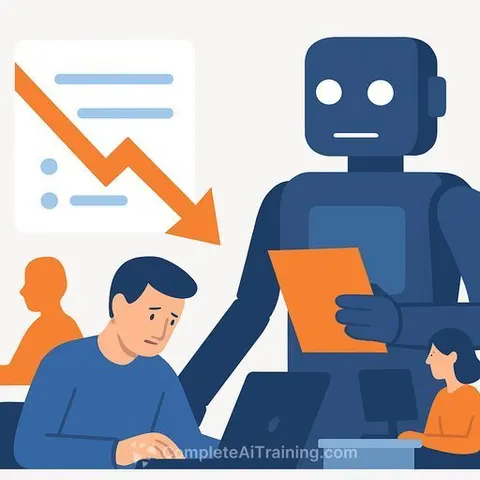
Oracle cuts 10,000 jobs as AI adoption accelerates across tech
Oracle laid off approximately 10,000 employees worldwide on April 1, cutting senior engineers, architects, operations leaders, program managers, and technical specialists. The company is simultaneously increasing spending on AI tools that allow fewer staff to handle the same workload.
Oracle is not alone. Meta is considering a 20% workforce reduction, and Amazon has announced 16,000 layoffs. Job cuts in the US rose about 25% in March, with a quarter of those losses tied to AI.
JPMorgan Chase CEO Jamie Dimon recently warned that AI could cause widespread job losses in the US and called on government and business to prepare. The bank, which has a $20 billion technology budget and has doubled its use of generative AI in customer service and technical roles, is developing "huge redeployment" plans to help affected employees move into new positions.
The case for managed transition, not abrupt displacement
Asma Derja, an AI ethics expert and founder of the Ethical AI Alliance, said the goal should be "a managed transition, not an abrupt displacement." She emphasized that workforce impact must be treated as a core design constraint during development, not addressed afterward.
Derja said workers should not bear responsibility for systemic shifts beyond their control. She pointed to China, which is framing AI around job creation, job quality, and social stability rather than treating displacement as inevitable.
Mounir Hijazi, CEO at GCC TP, said the real value of AI lies in boosting productivity and improving customer experiences, not simply cutting costs. He said responsible AI adoption requires strong leadership and employee preparation. "Technology alone doesn't transform organizations; people do," he said.
Companies need governance around AI deployment and a clear commitment to reskilling employees to work alongside it, Hijazi added.
Transparency about job displacement remains contentious
Derja said organizations should clearly state which roles are at risk, provide timelines, and explain how transitions will occur. She noted that most current layoffs are driven by AI expectations rather than actual capability.
A deeper issue exists: workers often train the systems that replace them without compensation or protection. Derja called this a "transfer of value" and said the principle of reciprocity should apply. If workers contribute to building AI systems, they should share in the benefits.
Others argue transparency must be balanced to avoid unnecessary fear among employees. Fiona Robson, head of Edinburgh Business School and School of Social Sciences at Heriot-Watt University Dubai, said the optimal approach is to involve employees at every stage and outline opportunities to work alongside AI technology.
Cosmin Ivan, CEO at Platinumlist, said transparency builds trust. His company has focused on building a shared AI culture where adoption feels additive. "When employees see AI being used in real workflows around them, they start to get it on their own," he said.
New jobs emerge, but often with lower quality
While AI creates new types of work, many of these positions are unstable, low-paid, and scattered. Training, labeling, evaluation, and oversight roles do not offer real advancement opportunities, Derja said.
Skills are not easily transferable between roles, and transitions often mean downskilling or worse job quality. Only 24% of at-risk workers have viable transition pathways based on existing skill overlap, according to reports Derja cited.
Hijazi said organizations that see AI as both a technology and workforce shift-and invest in ongoing learning-will be more successful. New roles like automation oversight, AI-assisted decision-making, and workflow optimization are emerging, allowing existing employees to focus on higher-value work.
Ivan said people do not need to reinvent themselves entirely. "They need to take what they already know and enhance it with AI," he said.
Reskilling works under specific conditions
Derja said adaptation is possible for some workers, but only under the right conditions. Transitions work best when they stay within the same domain, training is funded and embedded in jobs, and AI is used to augment rather than replace workers.
Without these conditions, expecting mid-career workers to simply reskill is unrealistic. Most workers face structural barriers, not just motivation gaps. Transitions often require significant reskilling across occupations, which many mid-career employees cannot do without institutional support.
Derja suggested several steps to address the issue: creating new jobs, strengthening labor protections, stabilizing incomes, shortening workweeks to share productivity gains instead of cutting jobs, and designing technology that supports workers rather than replacing them.
Companies should report AI-related job losses to government quarterly and help develop laws that support workers during the AI transition, experts said.
Current AI can handle only about 2.5% of real-world tasks, which limits its capabilities and supports a gradual approach. "The focus should be on transforming and enhancing jobs, not cutting them," Derja said.
Responsibility falls on multiple parties
Robson said all stakeholders must ensure displaced employees have opportunities to remain employable. Organizations should cover reskilling costs, support transitions to new roles, and provide fair compensation.
Governments need to create labor protections, invest in education and workforce programs, and plan for long-term job market changes. They can support talent-building programs to reduce unemployment.
Ivan said instead of blaming employers for job losses, the focus should be helping workers grow with AI. "Employers have to lead here," he said. This means embedding AI into daily workflows, offering practical upskilling tied to actual roles, and framing AI as an enhancement rather than a threat.
For managers, understanding these dynamics is essential. AI for Management and AI for Human Resources resources can help leaders navigate workforce transitions and build sustainable AI adoption strategies.