
AI news ·
AI facility management software shifts data center cooling from reactive to predictive as GPU density rises
GPU clusters now draw four to eight times the power of older server racks, overwhelming cooling systems built for lighter workloads. AI facility management software reads job queues ahead of time and adjusts cooling before heat builds.
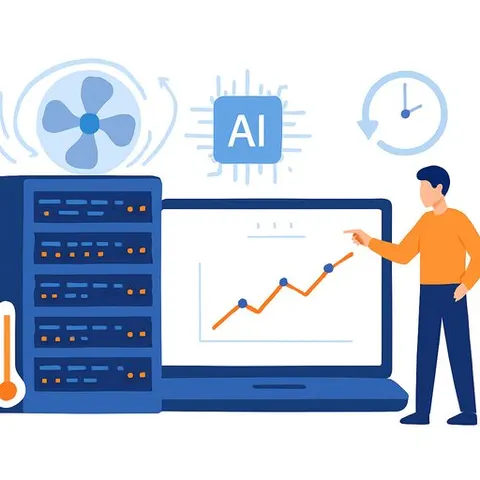
GPU Heat Is Breaking Your Data Center. Software Can Fix It.
Your server racks now pull four to eight times the power they did five years ago. The cooling systems and power infrastructure your facilities team built for the old workload profile cannot keep pace with what GPU clusters demand.
The problem creates a vicious cycle. More GPUs generate more heat. More heat requires more cooling. More cooling draws more power, and that power consumption adds heat back into the facility. Your HVAC system was never designed to manage that feedback loop.
AI Facility Management software puts your cooling systems ahead of the problem instead of behind it. The software reads your upcoming workload queue and adjusts facility conditions before the heat arrives.
Your Physical Infrastructure Has Hard Limits
You approve a new GPU cluster. Your facilities team starts planning and hits a wall that has nothing to do with budget.
Your power connection to the utility grid has a ceiling. AI workloads push facilities to that ceiling faster than any previous server generation did. Upgrading grid capacity takes months of coordination with your utility provider.
Your floor structure carries a weight limit. Modern GPU hardware is significantly denser than standard server equipment. Older facilities hit weight limits before power limits. Raised floor space runs out before demand does, which means workload efficiency matters more than physical expansion at a certain point.
How the Software Actually Controls Your Environment
AI Facility Management connects your building management systems to a software layer that reads real-time data from across your entire facility. Sensors on racks, cooling units, power distribution boards, and network equipment feed data into a central model continuously.
The software learns your facility's thermal patterns over time. It knows which rack rows heat up first during a morning workload surge. It knows how long your HVAC units take to bring temperatures down after a GPU spike. It uses that knowledge to adjust before your facilities team would even notice a problem developing.
Your operations team shifts from responding to alerts to reviewing decisions the system has already made. That change alone significantly reduces the manual overhead of running a high-density facility.
Predictive Cooling Stops Thermal Throttling
Traditional building automation waits for a temperature sensor to exceed a threshold, then triggers a cooling response. By that point, your hardware is already thermal throttling.
Predictive cooling works differently:
- The system reads your job scheduler and identifies GPU-intensive workloads queued to run in the next few minutes.
- Cooling output increases ahead of the workload rather than after heat arrives at the sensor level.
- Your GPUs run at full capacity without thermal throttling because the environment is already prepared for the load spike.
- Energy use stays lower overall because gradual pre-cooling is more efficient than aggressive reactive cooling after temperatures peak.
Route Workloads to Cheaper Power Regions
Your organization likely runs infrastructure across multiple geographic locations. AI Facility Management uses that distributed footprint to reduce energy costs by routing workloads based on real-time grid pricing.
Electricity costs fluctuate throughout the day and vary significantly between regions. When grid prices rise at your primary site, the system identifies equivalent capacity at a secondary location where energy is currently cheaper. Non-urgent workloads are automatically moved, and your primary facility runs at lower utilization during peak pricing windows.
This approach reduces your energy bill without reducing your compute output. You run the same workloads at a lower cost by letting the software decide where and when each job runs based on live energy data.
Sustainability Targets Become Achievable
Your sustainability commitments likely include carbon-reduction goals tied to your data center's energy consumption. AI Facility Management gives you a practical path to hit those targets without slowing your AI infrastructure growth:
- The system prioritizes routing workloads to facilities powered by renewable energy sources when grid carbon intensity data is available.
- Cooling efficiency improvements directly reduce your power usage effectiveness ratio, which is the primary metric most sustainability frameworks measure.
- Predictive load management reduces peak demand charges, which lowers both your energy cost and your reported consumption figures.
Infrastructure Requirements for This Level of Control
The software only works as well as the sensor infrastructure feeding it data. Your facility needs dense sensor coverage for power, temperature, airflow, and humidity at the individual rack level, not just at the room level.
Liquid cooling infrastructure becomes a practical requirement at GPU densities above 40 kilowatts per rack. Direct liquid cooling systems remove heat more efficiently than air and give the management software finer control over thermal conditions at the hardware level.
The combination of dense sensing, liquid cooling, and AI Agents & Automation makes it possible to run modern AI workloads sustainably in a physical facility that was never built for this scale.
For AI for Management professionals overseeing data center operations, this represents a shift from managing physical constraints to managing software decisions that optimize those constraints in real time.