Artificial Intelligence Struggles with Basic Time and Calendar Tasks, Study Finds
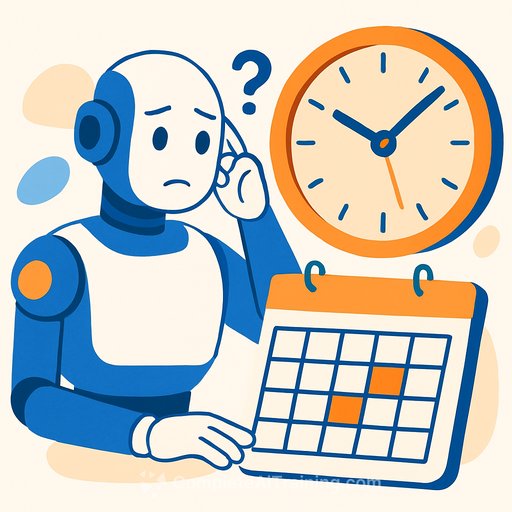
Artificial intelligence continues to impress with its ability to generate text, create images, and even write code. Yet, a recent study highlights a surprising weakness: AI models struggle to read analogue clocks and determine the day of the week for given dates. Tasks that most people handle effortlessly remain a challenge for many AI systems.
This research was presented at the 2025 International Conference on Learning Representations (ICLR) and published as a preprint on arXiv, though it has not undergone peer review yet. The study exposes a significant gap in AI's ability to perform simple time-related tasks, which has practical implications for applications that rely on accurate scheduling and automation.
How Was AI Tested on Timekeeping?
Researchers tested multimodal large language models (MLLMs) capable of processing images and text. The models evaluated include Meta's Llama 3.2-Vision, Anthropic's Claude-3.5 Sonnet, Google's Gemini 2.0, and OpenAI's GPT-4o. They were given custom datasets featuring clock faces and calendar images to interpret.
Results showed that these models often failed to correctly identify the time from analogue clocks or calculate the correct day of the week for specific dates. Accuracy rates were low, with only 38.7% success in reading clocks and 26.3% for calendar date tasks.
Why Does AI Struggle with These Tasks?
- Spatial reasoning challenges: Reading a clock involves detecting overlapping hands, measuring angles, and interpreting various dial styles, including Roman numerals. AI models usually excel at recognizing objects, but understanding spatial relationships to tell time is more complex.
- Non-algorithmic arithmetic: Unlike traditional computers that perform precise arithmetic calculations, many large language models generate answers by predicting patterns learned during training. This means their math skills can be inconsistent, especially when applied to calendar calculations like determining the day of the 153rd day of the year.
- Limited training examples: Rare calendar events such as leap years or unusual date computations are underrepresented in training data, further reducing AI's reliability in these scenarios.
Implications for AI in Real-World Applications
The study underlines the need to improve AI's logical and spatial reasoning abilities, especially for time-sensitive tasks. Applications such as scheduling assistants, automation workflows, and assistive technologies require dependable handling of clocks and calendars.
Until these shortcomings are addressed, relying solely on AI for tasks that combine perception and precise reasoning can be risky. The researchers emphasize the importance of rigorous testing, fallback mechanisms, and maintaining human oversight in critical systems.
What This Means for AI Development
This research highlights that AI's "understanding" is fundamentally different from human cognition. While AI performs well with familiar patterns and abundant examples, it struggles with abstract reasoning and novel situations. Recognizing these limitations is key to developing more reliable AI tools.
For professionals interested in advancing AI skills and applications, exploring targeted training can provide valuable insights into how to address these gaps. Resources such as Complete AI Training’s latest courses offer structured learning paths to deepen expertise in AI capabilities and limitations.
Your membership also unlocks: