AI vs. AI: Hospitals and Insurers Escalate the Payment War
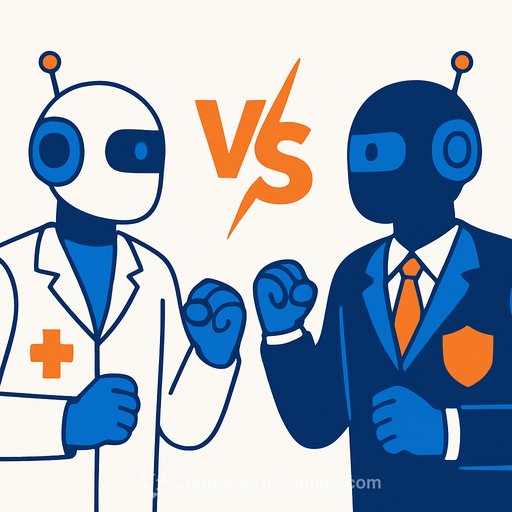
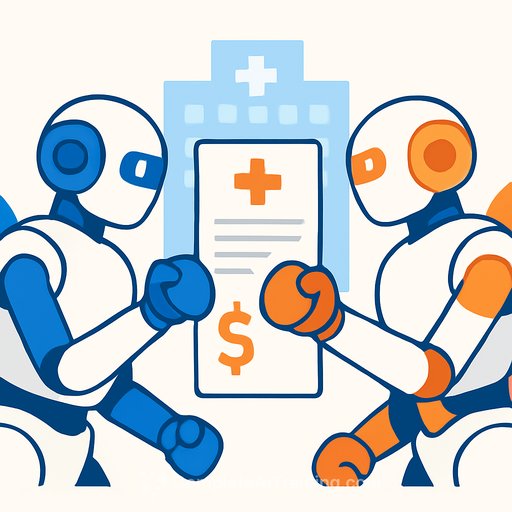
Across the country, providers and payers are using artificial intelligence to push opposite ends of the same claim. Hospitals are leaning on AI-driven coding and revenue tools to increase reimbursement, while insurers are deploying models to question necessity and deny what doesn't hold up.
Recent reports point to the scope. A Blue Cross Blue Shield analysis tied roughly $663 million in inpatient spend and at least $1.67 billion in outpatient spend to more aggressive, AI-enabled coding. One large system, HCA Healthcare, said it expects about $400 million in savings this year from AI programs aimed at denials and underpayments.
What providers are doing
Payer leaders have flagged sudden spikes in high-acuity diagnoses. Centene's CEO, Sarah London, pointed to emergency department visits where a simple fever is increasingly labeled as sepsis-an expensive diagnosis-related group that can tilt reimbursement. Reuters captured the tension well: "AI fighting AI."
HCA's CFO Michael Marks framed their AI push as a counter to growing denials. Maulin Shah, HCA's chief health information officer, said both sides will have to recalibrate how they work together because the technology is already changing the ground rules.
What this means for insurers: practical moves now
- Stand up coding-shift surveillance. Track DRG/HCPCS/ICD-10 mix shifts by facility and service line. Flag clusters in CC/MCC capture (e.g., sepsis, acute respiratory failure) and compare to peers and historical baselines.
- Tighten clinical validation. Use NLP to cross-check documentation against accepted clinical criteria (vitals, lactate, cultures, pressors, organ dysfunction) before paying high-acuity codes like sepsis. Align with Sepsis-3 where appropriate.
- Balance prepay edits with focused post-pay audits. Avoid blanket denials; target providers showing abrupt acuity jumps, short lengths of stay for high-severity DRGs, or repeat add-on codes lacking supporting notes.
- Enforce model governance. Document training data, features, thresholds, and override logic for any claims or prior-authorization tools. Keep humans in the loop for adverse coverage decisions and track overturn rates on appeal.
- Refresh contract language. Require disclosure when AI-assisted coding tools are used, clinical-validation cooperation, audit rights for model outputs, and clawbacks for unsupported upcoding. Define turnaround times and data-sharing formats.
- Coordinate with SIU and provider relations. Separate pattern education from suspected fraud. Share evidence packs (timelines, vitals, note excerpts) to speed resolution and reduce noise.
- Modernize prior auth. Codify criteria, publish them, and ensure decisions aren't based solely on black-box scores. Keep criteria consistent with Medicare coverage standards and state regulations. See CMS guidance: Medicare Advantage Final Rule.
- Monitor member impact. Track denial rates, appeal overturns, grievance signals, and time-to-decision. High overturns usually indicate model drift or criteria gaps.
- Lock down PHI with vendors. Ensure HIPAA BAAs cover AI training, data retention, and inference logging. Require reproducibility for every automated decision.
How to measure whether it's working
- Net cost trend after risk-adjusting for case mix and seasonality.
- DRG/ERA variance explained by documentation strength vs. coding patterns.
- Prepay edit precision and recall (false positive/negative rates).
- Appeals and external review overturn rates by edit/model.
- Provider abrasion: average days to resolution and rework per claim.
Guardrails over perfection
Healthcare will never be error-free-humans miss things, and so will algorithms. As Marschall Runge noted, demanding flawless AI sets an impossible bar. The real standard is certification, auditability, and guardrails. For payers, that means documented criteria, explainable decisions, and fast remediation when models misfire.
Next steps and resources
- Insurer-focused training and tools: AI for Insurance
- Understand provider-side tactics and tech: AI Learning Path for Medical Billers
Bottom line: Hospitals will keep using AI to stretch documentation and capture severity. Insurers need disciplined analytics, clear rules, and collaborative enforcement. Build the system now, or you'll pay for it later-one "sepsis" claim at a time.
Your membership also unlocks: