
AI news ·
AI film festival draws crowds and copyright concerns to Cannes
Cannes hosted two rival film festivals this week: one banning AI from its top prize, the other drawing 5,000 AI film submissions. The split lays bare a fight over whether artificial intelligence belongs in cinema at all.
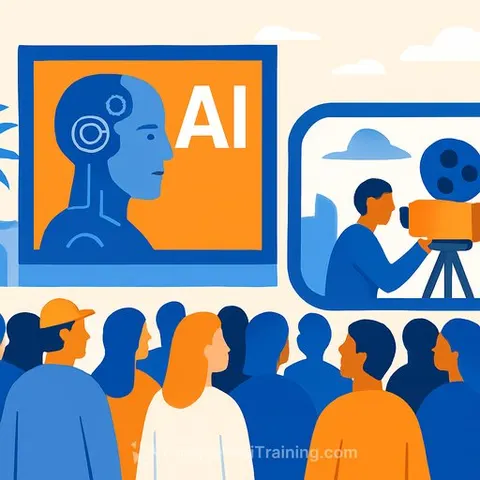
Cannes launches AI film festival as traditional cinema draws the line
The inaugural World AI Film Festival opened in Cannes this week with 5,000 submissions-five times the number from its previous edition-while the main Cannes Film Festival explicitly banned AI from its Palme d'Or competition. The split reflects a widening divide over whether artificial intelligence belongs in cinema.
The WAIFF showcased films with AI-generated imagery: fish-scaled men, women with external hearts, sprawling armies of identical soldiers. Many felt technically precise but narratively hollow. Directors prioritized hyper-realistic textures over storytelling. A recurring motif of photorealistic animals in human situations-bears on sunbeds, pigs on golf carts-prompted one filmmaker to propose a rule against the latter.
One submission, a short film featuring characters remarkably similar to Wallace and Gromit, was shortlisted for an award before festival organizers noticed "a strong resemblance to an existing work" and withdrew it from competition. Director Mathieu Kassovitz, attending the festival, responded bluntly. The incident underscored the unresolved question of consent and compensation: the AI models generating these films were trained on millions of hours of human creative work.
Hollywood sees opportunity in lower-budget production
Major studios are paying attention. Paramount, under the ownership of tech billionaire Larry Ellison's son David, has stated AI will affect every aspect of its business. Ron Howard, James Cameron, and Matthew McConaughey have invested in the technology.
Studios view AI as a way to produce multiple lower-budget films instead of betting everything on one expensive project. "More shots on goal," as one LA film executive described it-making several $50 million AI or hybrid films rather than a single $200 million conventional production.
Val Kilmer, who died a year ago, appeared in a film trailer through AI-generated performance. The technology is moving from festival curiosity to industry tool.
The paradox facing filmmakers
Directors and actors at WAIFF found themselves in an uncomfortable position. They wanted to use AI to make filmmaking faster, cheaper, and more expressive. Yet many also demanded protection from the same Silicon Valley companies accused of stealing their intellectual property to train the models.
Kassovitz exemplified the contradiction. He is making his next feature with AI and opening an AI studio in Paris. When asked about AI stealing artists' work, he said: "Fuck copyright." But he also said he would sue if anyone used AI to create "stupid shit" with his film La Haine.
Agnès Jaoui, a celebrated French actor who chaired the competition jury, said everyone had been "yelling" at her about whether she was validating AI by accepting the role.
Traditional cinema holds the line-for now
The main Cannes Film Festival, in its 76th year, banned AI from its Palme d'Or competition. Its president, Iris Knobloc, said: "A film is not an assembly of data; it is a personal vision." Films were made by people who had suffered, loved, and doubted.
The WAIFF founder Marco Landi, a former Apple executive in Europe, dismissed this stance. "There's a wave mounting and becoming big," he said. "You have two solutions: stay there and the wave will destroy you or start to ask what can I do with this wave."
Some genuine work emerged
Not all submissions were exercises in technical excess. A 22-year-old Swiss-Italian filmmaker, Dario Cirrincione, made a poignant short exploiting AI's uncanny, disassociated quality to express what dementia might feel like. The AI sequences cost €500. Conventional special effects would have cost €20,000.
Claude Lelouch, the 88-year-old Oscar-winning director, announced he is using AI to make his 52nd film. After working with 8mm, 16mm, 35mm, 70mm, and other formats across decades, he said: "I've got my childhood back."
The festival's slogan was "New waves of creation." One attendee suggested a more honest tagline: "Just because you can, doesn't mean you should."
The most compelling moment at WAIFF may have been the opening ceremony: an 80-piece human orchestra playing Ravel's Boléro in front of human dancers. After hours of AI films, it seemed to serve as notice that human art is not finished yet.