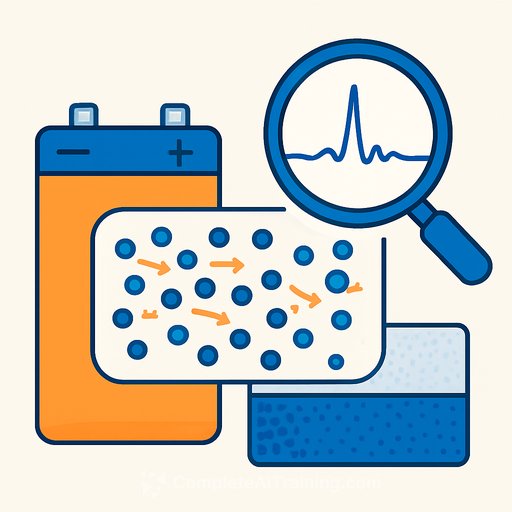
AI finds the hidden Raman signal of liquid-like ion flow in solid electrolytes
All-solid-state batteries promise higher energy density and better safety, but the bottleneck is still fast ion transport through solids. A new machine learning workflow predicts Raman spectra and flags a distinctive low-frequency signal tied to liquid-like ion motion inside crystals. That single cue gives researchers a fast way to spot superionic behavior without exhaustive trial-and-error.
What the team built
The workflow couples ML force fields with tensorial ML models to simulate finite-temperature vibrational dynamics and their Raman response at near ab initio accuracy, but at a fraction of the cost. It captures the disorder and anharmonicity that standard harmonic approaches miss, especially at elevated temperatures where ions start to flow.
Applied to sodium-ion conductors such as Na3SbS4, the pipeline produced pronounced low-frequency Raman intensity. Those features directly track with high ionic mobility in the simulations.
Why low-frequency Raman intensity matters
When ions move through a crystal in a fluid-like way, their rapid motion temporarily breaks lattice symmetry. That symmetry breaking relaxes the usual Raman selection rules, creating strong low-frequency scattering that is otherwise suppressed. In short: intense low-frequency Raman features are a spectroscopic fingerprint of liquid-like ionic conduction.
Materials where ions mainly hop between fixed sites do not show these signatures. The spectrum itself reveals the transport mechanism.
From signal to screening
This result turns Raman into a practical discovery tool for solid electrolytes. If a candidate shows strong low-frequency Raman intensity in simulation (or experiment), it's a strong indicator of fast-ion conduction worth pursuing. That makes high-throughput screening of complex chemistries far more tractable.
Equally important, the method links atomistic dynamics to a directly measurable observable. It gives experimental groups a clear target and theory groups a fast, testable proxy for ionic mobility.
How researchers can put this to work
- Use an ML force field to run finite-temperature dynamics on candidate solid electrolytes and capture dynamic disorder.
- Predict Raman spectra with a tensorial ML model and quantify low-frequency intensity.
- Prioritize compositions and phases showing strong low-frequency features for synthesis and impedance/NMR validation.
- Build calibration sets aligning low-frequency Raman intensity with measured diffusivity to refine screening thresholds.
Scope and generality
The breakdown of Raman selection rules extends beyond a few well-known superionic systems. The same logic applies across chemistries where diffusive ion motion perturbs symmetry, offering a common lens to interpret diffusive Raman scattering. That enables broader, cross-material comparisons of transport mechanisms.
Why it matters now
ASSB research needs faster feedback loops between simulation and experiment. This ML-accelerated Raman pipeline delivers that, making it feasible to study realistic temperatures, disorder, and complex structures without overwhelming compute budgets. It's a direct path to focusing lab time on the right materials.
Practical notes
- Temperature and phase matter: evaluate spectra under conditions where ionic motion is activated.
- Instrument baselines can obscure the low-frequency window; align preprocessing between simulation and experiment.
- Consider interfaces and defects separately-this signal tracks bulk-like, liquid-like transport inside the lattice.
Published: March 7, 2026 (AI for Science)
Background reading: Raman spectroscopy, superionic conductors.
For teams building ML-accelerated spectroscopy and materials pipelines, see the AI Learning Path for Research Scientists.
Your membership also unlocks: