
AI news ·
AI finds hidden GPCR-like protein that helps cells exchange material and manage stress
AI identified a human protein, TM184C, by comparing 3D shapes of over 214 million predicted proteins rather than genetic sequences. The protein helps cells exchange materials through intercellular bridges and may play a role in cancer cell survival under stress.
Researchers at Sylvester Comprehensive Cancer Center have used AI to identify a previously unknown human protein that helps cells exchange materials and manage stress. The study, published September 11 in Nature, compared the three-dimensional shapes of more than 214 million predicted proteins rather than their genetic sequences, revealing what the team describes as a hidden layer of biology.
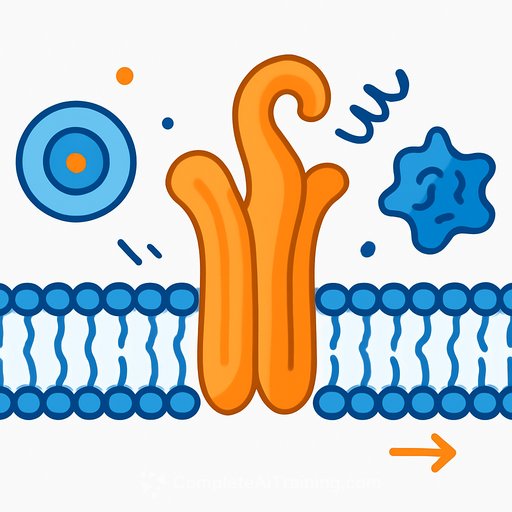
The protein, called TM184C, belongs to the G protein-coupled receptor (GPCR) family but behaves unlike typical members of that group. Instead of sitting on the cell surface, TM184C resides inside cells within the membranes of intracellular vesicles. Those vesicles travel along microtubules and gather in thin projections that connect neighboring cells.
Cell bridges and cargo exchange
Those projections act as conduits. Through them, cells exchange metabolites, vesicles, and organelles, including mitochondria. When researchers disrupted TM184C, cells formed fewer connections and showed changes in shape and vesicle organization - evidence that the protein helps build and manage these intercellular bridges.
"When we saw TM184C-positive vesicles moving through connections between cells, we realized these structures could be routes for substantial material exchange," said Jenniffer Arcuri, Ph.D., a senior scientist with Sylvester and lead author. "That completely changed how we thought about TM184C and made us consider how cells might use these connections to cooperate and compete for resources."
The finding raises questions about who benefits from resource sharing. In healthy tissue, the exchange may help cells survive stress by moving fuel or damaged components where they are needed. But an unequal exchange could let one cell gain at another's expense. "I think cells coordinate until they have to compete," said Shraddha Chandthakuri, a Cancer Biology graduate student in the Isom lab.
A conserved role in stress response
TM184C also appears to regulate autophagy, the process cells use to break down and recycle old or damaged parts. When the team reduced TM184C levels, autophagy markers increased, suggesting the protein helps tune the recycling system under stress.
The evolutionary staying power of this function surprised the researchers. They studied a yeast protein called Hfl1, which is similar to TM184C. Removing Hfl1 caused problems in yeast cells, but adding the human TM184C protein fixed those problems. That result indicates the function has remained conserved across roughly a billion years of evolution.
"For decades, we have largely explored protein biology using sequence as our guide," said senior author Daniel G. Isom, Ph.D. "We wanted to know what biology we might be missing if we searched by three-dimensional structure instead. What we found suggests there is another layer of biology that has been hiding in plain sight."
Isom stressed that AI cannot replace experimental validation. "AI cannot be blindly trusted, but can lead to really big things in the hands of experts and prepared minds," he said. The team's approach pairs computational shape-matching with laboratory work, including the yeast rescue experiments that confirmed TM184C's function.
For researchers applying AI to molecular biology, this study offers a concrete template: use structure-based search to surface candidates, then validate function experimentally. Professionals building skills in this area can find relevant training through AI for Science & Research resources or a dedicated AI Learning Path for Research Scientists.
Why this matters for science and research professionals
The study demonstrates a workflow that research teams can adapt: AI-driven structural comparison at scale, followed by targeted functional assays to confirm what the algorithm surfaces. The dark proteome - proteins that exist but remain uncharacterized - represents a large, unmapped territory. TM184C is one example of what structure-based search can pull from it. For cancer researchers specifically, the discovery that tumor cells may use intercellular bridges to share resources under low-oxygen or low-nutrient conditions suggests new angles for studying glioblastoma and other aggressive cancers.