AI-First Hotels Are Pulling Ahead: What Operators Need to Do Now
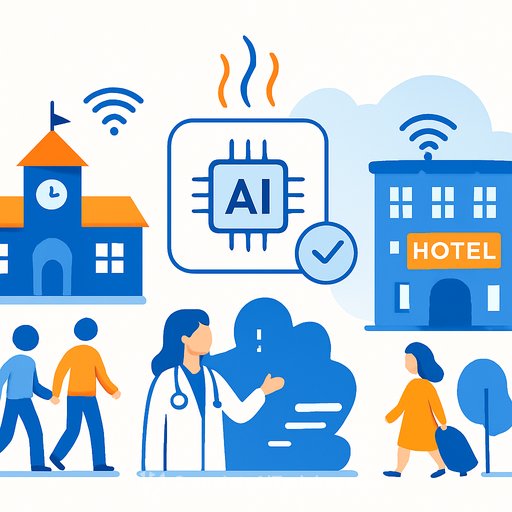
A new analysis from Boston Consulting Group, developed with New York University experts, lays it out clearly: hotels built around AI from the start are outpacing peers in visibility, revenue, and efficiency. This isn't about adding a chatbot to a legacy stack. It's a full reset of how you attract demand, run operations, and even design properties.
Three shifts define the leaders: AI-optimized distribution, lower costs through automation and intelligent resource orchestration, and design decisions driven by generative tools. If you run a hospitality business and you're still "testing" AI on the side, you're already behind.
Distribution Has Flipped: Be Discoverable or Disappear
Discoverability now depends on whether your content is machine-readable by large language models-not just ad spend or SEO rank. BCG estimates 37% of travelers already plan or book through LLMs embedded in travel platforms. If your property data isn't structured, you risk becoming a "digital ghost," missing from the top three recommendations.
That shift ties to a bigger number: in 2024, digital direct bookings almost matched OTAs-$262B vs. $266B-fueled by loyalty and personalized offers. Operators who treat first-party data like an asset are seeing more traffic come straight to owned channels.
- Make your content machine-readable: accurate schema, up-to-date amenities, policies, imagery, and room types.
- Embed real-time rates and availability in your site and app; keep parity tight and value adds exclusive to direct.
- Train LLM-ready FAQs and property guides so assistants can "read" your hotel the way a guest advisor would.
Revenue Engine: Dynamic Pricing and Always-On Service
Pricing is now truly dynamic-reacting in seconds to demand, weather, events, air capacity, and even social sentiment. BCG cites AI optimizers adding 15%+ revenue per available room. That's margin you can't squeeze out with manual rules.
On property, multilingual concierges and chatbots absorb routine requests while IoT and automation streamline inventory, energy, and staff allocation. Use cases called out: a 20% acceleration in room cleaning at The Ritz-Carlton, San Francisco, predictive models at IHG, and roughly a 50% reduction in food waste at Four Seasons Peninsula Papagayo.
- Deploy an RMS that ingests event feeds, flight capacity, and local signals-test price elasticity daily, not quarterly.
- Route guest intents automatically: pre-arrival, in-stay, and post-stay across WhatsApp, SMS, and web chat.
- Connect IoT with housekeeping and maintenance queues to cut energy spend and turn rooms faster.
Design Earlier, Build Smarter
Generative tools can stress-test multiple layouts before you break ground-people flow, sunlight exposure, energy performance, and projected carbon footprint. Upstream, geo-intelligence can score sites by flows, demographics, and access to shorten time to breakeven.
- Prototype multiple room/floor concepts, then validate with simulated occupancy, cleaning routes, and MEP impacts.
- Use site scoring to align concept mix (F&B, meeting space, wellness) with real local demand, not gut feel.
The Real Barrier Isn't Tools. It's Structure.
Less than 10% of hospitality professionals are running with an AI-centered mindset. Most are trialing features in isolation. That won't move the P&L.
BCG flags the core blockers: siloed PMS, CRM, F&B, and sales systems, plus fragmented data that models can't learn from. The fix is an operating rethink, not another integration. Data has to be unified, cleaned, and governed-or your models will keep guessing.
90-Day Plan to Get Out of Pilot Mode
- Weeks 0-2: Map your data layer. Identify every system of record and where guest/product data lives. Pick one property as the pilot.
- Weeks 3-6: Stand up a unified guest and product profile. Refresh web/app content with structured data. Launch LLM-ready FAQs.
- Weeks 7-10: Switch on dynamic pricing with clear guardrails. Add messaging automation for top five intents (arrival, Wi-Fi, late checkout, amenities, billing).
- Weeks 11-12: Connect housekeeping, maintenance, and energy data; pilot automated room turn and outage alerts. Review results and lock SOPs.
Metrics That Matter
- Demand and visibility: share of LLM-driven referrals, direct share of bookings, rank in assistant recommendations.
- Revenue: RevPAR lift vs. control, price change latency, conversion on personalized offers.
- Ops: room turn time, labor hours per occupied room, energy cost per available room, food waste per cover.
- Guest: resolution time, CSAT by channel, repeat rate through first-party channels.
Budget Shift: Make the Invisible Work Visible
It's tempting to fund a lobby refresh over data plumbing. But the "invisible" investment is where the comp set is pulling ahead. The window to catch up won't stay open long.
Pick one asset, prove the lift across distribution, pricing, and ops, then scale. Failure here won't be a tech failure-it will be an operating choice.
Further Reading
Your membership also unlocks: