The AI Fluency Index: What Educators Need to Know Now
AI is showing up in daily work faster than most of us expected. Adoption is high, but the real question for schools is fluency: are students and staff building the skills to use AI well?
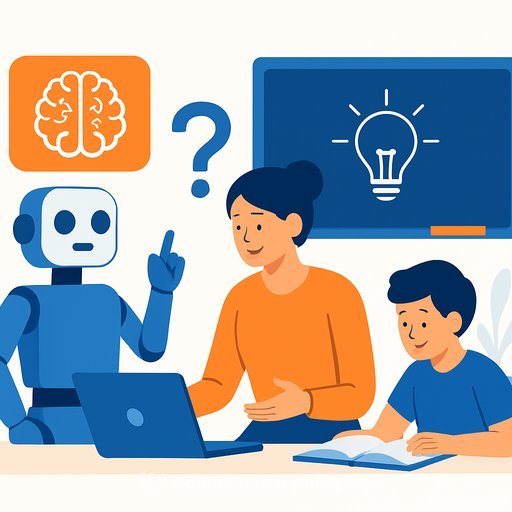
A recent study analyzed thousands of multi-turn chats to baseline "AI fluency" in real use. The standout trend: people get better outcomes when they treat AI as a thought partner and iterate, not as a vending machine for answers.
What the study measured
The analysis used a 4D AI Fluency Framework that defines 24 behaviors for safe, effective human-AI collaboration. Eleven of those behaviors show up directly in chat, so the team focused there.
They reviewed 9,830 multi-turn conversations from a one-week window in January, using a privacy-preserving method. Patterns held steady across days of the week and multiple languages, giving us a reliable baseline for how people actually work with AI.
Fast takeaways for schools
- Iteration matters: 85.7% of conversations showed iteration and refinement, and those chats displayed roughly double the number of other fluency behaviors (2.67 vs. 1.33).
- Critical thinking spikes with iteration: users were 5.6x more likely to question reasoning and 4x more likely to spot missing context when they kept the conversation going.
- Artifacts change behavior: in 12.3% of chats where AI produced code, documents, or tools, users gave clearer directions upfront but evaluated less afterward.
- Directive behaviors rose in artifact chats: clarify goal (+14.7pp), specify format (+14.5pp), provide examples (+13.4pp), iterate (+9.7pp).
- Discernment dropped in artifact chats: identify missing context (-5.2pp), check facts (-3.7pp), question reasoning (-3.1pp).
Key finding 1: Iteration drives fluency
When users refine across multiple turns, every other fluency behavior increases. On average, iterative chats show 2.67 additional indicators versus 1.33 in non-iterative ones.
This is where the real value lives for classrooms and PD. The habit of "ask, inspect, refine" builds stronger thinking, cleaner outputs, and better learning.
Key finding 2: Polished outputs can hide weak thinking
When AI produces something tangible-apps, code, lesson docs-people get more directive at the start and less critical at the end. That's a problem.
The output looks finished, so evaluation slips. In education, that's where errors sneak into lesson content, grading aids, or student submissions. Build in checks so polish doesn't pass for proof.
What this means for teaching and learning
- Teach the loop: goal → context → constraints → example → generate → critique → refine. Make iteration graded, not optional.
- Require a critique pass before acceptance: "Explain your reasoning," "What assumptions did you make?" "What's missing for accuracy or fairness?"
- Bake in verification: cite sources, run spot-checks, compare with a second method, or test code against cases.
- Set collaboration norms: tell the model how to engage you-"Push back if my assumptions are off," "Ask clarifying questions," "Flag uncertainty before final answers."
- Assess process, not just product: review chat transcripts, ask for reflection on where students iterated, questioned, or corrected the model.
- Scaffold for novices: provide prompt templates and evaluation checklists; fade support as fluency grows.
Classroom and staff development activities
- 20-minute iteration drill: generate, critique, refine (three rounds). Score the quality jump across rounds.
- Artifact + critique cycle: produce a draft (lesson plan, rubric, code), run verification or tests, annotate gaps, then revise. Accept only after two critique passes.
- Assumption hunt: ask the model to list its assumptions, then challenge each one. Have learners propose counterexamples or missing context.
- Fluency rubric: include "asks for rationale," "identifies missing context," "specifies constraints," "verifies claims." Grade what students and staff actually do, not what they say they did.
- Portfolio reflection: keep a short "fluency log" with screenshots of key moves (iteration steps, fact-checks, pushbacks) across the term.
If you want a structured path to build these habits, see the AI Learning Path for Teachers. For platform-specific tips and workflows, explore resources on Claude.
How to implement without adding workload
- Start with one behavior per unit (e.g., "always ask for the model's reasoning before accepting an answer").
- Use lightweight templates: a one-page prompt brief (goal, audience, constraints, format) and a one-page critique checklist.
- Timebox: two refinement rounds per task; five-minute verification pass before submission.
- Track a single metric: percent of tasks with a documented critique pass. Improve it by 10-20% each month.
Limitations to keep in mind
- Sample bias: one week of multi-turn chats from users likely ahead of the curve. Treat it as a baseline for early adopters, not everyone.
- Partial view: only 11 of 24 behaviors are visible in chat; ethical and attribution practices outside the chat aren't captured.
- Binary labels: behaviors were marked present/absent, which loses nuance.
- Silent checks: users may evaluate outside the chat (testing code, comparing sources) without saying so.
- Correlations, not causes: iteration and discernment move together here, but we don't yet know what drives what.
What's next
Expect follow-ups that compare new vs. experienced users, study off-platform behaviors qualitatively, and test whether prompts that demand iteration actually increase discernment. There's also interest in developer workflows, where code can be tested directly and feedback loops are tighter.
For schools, the signal is clear. Fluency beats novelty. Teach students and staff to iterate, question, verify, and set collaboration terms-and you'll get better thinking and better work from AI, consistently.
Your membership also unlocks: