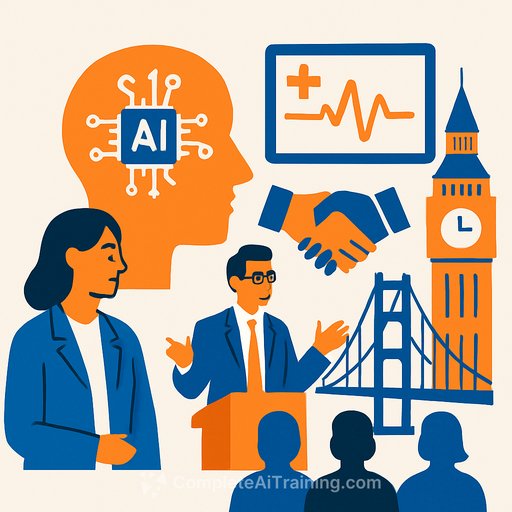
AI in Healthcare: Innovations and Transatlantic Collaborations
At a recent Imperial Global USA event held in San Francisco, AI researchers, clinicians, and entrepreneurs gathered to discuss the practical applications of AI in healthcare. The event featured experts from Imperial, Stanford, UCSF, and the pharmaceutical sector sharing insights on challenges and opportunities, with a focus on fostering partnerships between the US and the UK.
Imperial professors Aldo Faisal (AI and Neuroscience) and Anthony Gordon (Anaesthesia and Critical Care) presented two significant initiatives. The first is Nightingale AI, a next-generation foundation model built using UK healthcare data. The second is the AI Clinician, the first semi-autonomous AI designed to support intensive care treatment. Given the Bay Area's tech innovation environment, the event highlighted opportunities for collaboration that combine London’s strong scientific talent and the extensive datasets from the UK’s National Health Service (NHS).
Expert Perspectives on AI’s Role in Healthcare
Participants explored how AI can improve fields such as epidemiology, drug discovery, and clinical decision-making. Professor Marina Sirota from UCSF discussed using electronic health records to predict Alzheimer’s risk and implementing AI-powered automated medical notetaking to improve patient-clinician interactions.
Despite these advances, AI adoption in healthcare remains limited. Stanford’s Nigam Shah pointed out that although thousands of AI tools are licensed in the US, very few have translated into better patient care. He emphasized the need for AI solutions to become truly “patient-ready.”
Jared Josleyn from Sanofi highlighted the “Turing trap,” where AI developers focus on mimicking human cognition instead of creating novel capabilities. The panel agreed innovation should focus on new approaches rather than replicating existing human processes. Josleyn also noted that since healthy individuals spend only about 84 minutes per year in clinical settings, and with a global shortage of clinicians, preventive medicine deserves more investment — an area where the UK has been a pioneer.
Strengths of UK Healthcare Research
Professor Aldo Faisal pointed out the UK’s advantage in healthcare AI thanks to its vast, linked healthcare datasets. The NHS serves over 65 million people with centralized management, enabling data that connects primary and secondary care records across a patient’s lifetime.
This extensive dataset allows researchers to track long-term outcomes and improve AI model training quality. Initiatives in London and Wales provide secure access to anonymized health data for research, supporting the development of trustworthy AI tools at Imperial’s Digital Health Testbed.
Nightingale AI will be trained on these large datasets, with the capability to analyze x-rays, ECGs, genetic data, health records, doctors’ notes, wearable data, and clinical trial results. This model aims to assist medical research, clinical decision-making, and drug discovery.
Building Transatlantic Partnerships
The event also focused on strengthening collaborations between the US and UK, combining US healthcare innovation with the UK’s unique datasets and research assets. Imperial has an established history of partnerships, such as with Heartflow in California to improve heart disease diagnosis and with the Children’s Hospital of Orange County to adapt the AI Clinician for pediatric care.
Supporting Innovation and Entrepreneurship
Imperial’s innovation ecosystem supports transforming research into practical healthcare solutions. The event featured startups working on medical technology and digital health, including Nanograb, Steward.ai, Surgery AI, Beyond Blood Diagnostics, and Ethomix.
Debesh Mandal, founder of Nanograb and Imperial student, reflected on San Francisco’s energy and its role as a hub for new technologies, which aligns with Nanograb’s strategy of combining internal research with partnerships in pharma.
Imperial Enterprise Lab provides resources for students, staff, and alumni to develop entrepreneurial skills and networks, helping turn ideas into market-ready healthcare products and services.
For healthcare professionals looking to deepen their AI knowledge and skills, exploring specialized AI training can be valuable. Resources like Complete AI Training’s healthcare-focused courses offer practical pathways to apply AI in clinical and research settings.
Your membership also unlocks: