Artificial Intelligence for Quantum Computing: What Dev and IT Teams Should Do Next
AI is moving from hype to hands-on value in quantum computing. A recent review published in Nature Communications (Dec 2, 2025) argues that tight integration of fault-tolerant quantum hardware with accelerated supercomputers will be the backbone of "accelerated quantum supercomputers" capable of tackling currently intractable problems. The core message: AI won't replace quantum hardware, but it can remove friction across the entire workflow.
Why AI matters (and where it doesn't)
AI's sweet spot is learning from high-dimensional data. Quantum systems create plenty of it: calibration traces, pulse shapes, error syndromes, compiler logs, and measurement outcomes. That's where AI helps-pattern discovery, control, search, and fast heuristics.
But AI is still classical. It cannot efficiently simulate quantum systems in the general case. GroverGPT-2 is a good reminder: use an LLM to emulate Grover's algorithm and you just shift the bottleneck to context length and generalization.
Hybrid architecture: quantum + accelerated supercomputers
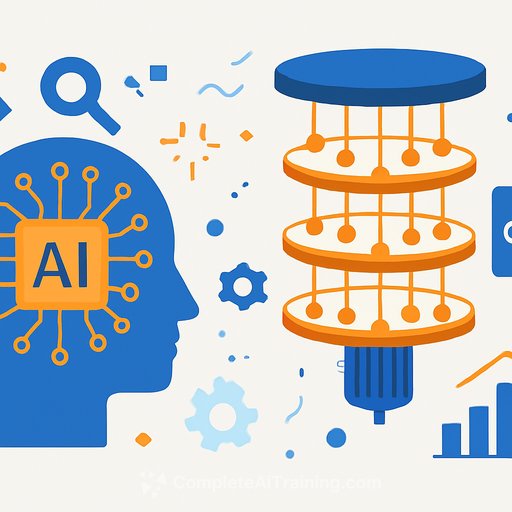
The path forward is a heterogeneous stack: fault-tolerant QPUs tightly coupled to GPU/AI clusters for compilation, routing, decoding, and scheduling. Low-latency links, shared runtimes, and streaming interfaces matter more than glossy demos. Treat the QPU as a specialized coprocessor with strict throughput and fidelity budgets.
- Co-schedule quantum jobs with AI-driven compilers and decoders running on GPUs.
- Keep error-syndrome streams on-node for real-time decoding; avoid unnecessary I/O.
- Use feedback loops: device telemetry → AI models → pulse/control updates.
AI across the quantum workflow
- Preprocessing: denoise datasets, align experiments, generate synthetic training data, and estimate priors for parameter scans.
- Device control & optimization: Bayesian/RL tuning for pulse schedules, drift tracking, and auto-calibration with confidence intervals.
- Quantum error correction (QEC): learned decoders, layout-aware routing, and code discovery for lower overheads and faster cycles.
- Postprocessing: error mitigation, surrogate models for expensive estimators, and uncertainty quantification for results.
Example: GPT-QE for circuit synthesis
Generative models are being tested to speed up circuit design and search. GPT-QE is one approach that maps quantum building blocks to a token space and learns to propose circuits that satisfy a target objective.
- Extract Hermitian operators (e.g., Pauli strings) from an ansatz (UCCSD, QAOA) and form a unitary pool with discrete coefficients.
- Tokenize these unitaries, train a transformer; evaluate generated sequences with a physics-aware loss and update the model.
- Use the trained model to propose circuits, then validate with simulators or small hardware runs.
Upside: faster exploration and fewer expensive evaluations. Caveat: generalization beyond training distributions is fragile; physics checks are mandatory.
Limits you must plan around
- Exponential scaling: classical AI cannot break it; use AI where it trims constants and guides search.
- LLM constraints: GroverGPT-2 shows context-length and size limits; bigger models don't fix physics.
- Distribution shift: lab hardware drifts; retraining, online learning, and monitoring are required.
- Verification: AI suggestions need physics-grounded validation and uncertainty estimates.
QEC is the make-or-break layer
Every modality still fights noise. Getting below threshold requires efficient codes, fast decoders, and better qubit architectures. AI helps by searching code families, learning decoders that meet latency budgets, and co-optimizing layout, routing, and scheduling.
Background refresher: Quantum error correction.
Action plan for IT and development teams
- Build the data backbone: standardize experiment schemas, version datasets, and log all control parameters and outcomes.
- Stand up hybrid pipelines: couple simulators/hardware with GPU nodes for compilation, decoding, and auto-calibration.
- Operationalize models: CI/CD for models, feature stores for lab signals, drift detection, and rollback strategies.
- Latency budgets: keep decoding and control loops on the same cluster; profile end-to-end loop times continuously.
- Metrics that matter: logical error rates, decoder latency, calibration time to stability, and wall-clock to solution.
- Tooling: vendor-neutral interfaces, containerized runtimes, and reproducible notebooks for experiment-to-model handoffs.
- Security & compliance: isolate lab control networks, audit model decisions, and track data lineage.
Research and engineering to watch
- Learned decoders that meet microsecond targets on GPUs or custom ASICs.
- AI-assisted compilers: layout, routing, and noise-aware transpilation at scale.
- Physics-informed neural nets for pulse-level control and drift compensation.
- Generative circuit design (e.g., GPT-QE) with built-in physics constraints.
- Surrogate models that replace expensive inner loops in VQE/QAOA workflows.
Bottom line
AI won't simulate big quantum systems end-to-end. It will, however, shorten the path to fault tolerance by accelerating calibration, decoding, compilation, and design. Treat AI as part of the control plane for a hybrid stack, and measure progress in fewer errors, lower latency, and faster iteration-not just better benchmarks.
Level up your team
If you're building this capability, a structured curriculum can speed up onboarding and standardize best practices for your engineers and data teams. See our developer-focused tracks: Complete AI Training - Courses by Job.
Your membership also unlocks: