
AI news ·
AI-generated books flood Amazon as authors warn of Orwell's novel-writing machines made real
Anthropic agreed to pay up to $1.5 billion in a 2025 copyright settlement after training its AI on authors' work without permission. Thousands of AI-written books are now selling on Amazon as publishers struggle to keep up.
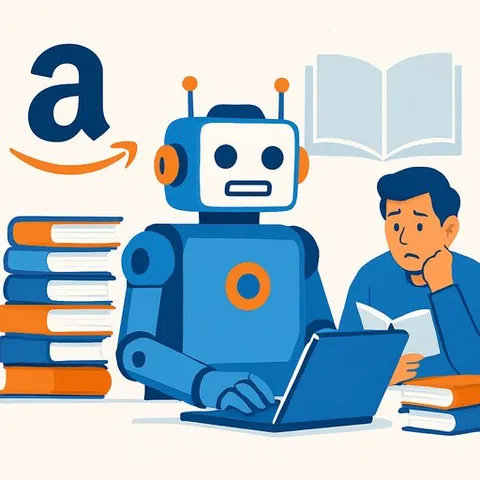
Thousands of AI-Written Books Flood Amazon as Publishers Struggle With Imitations
Anthropic agreed to pay up to $1.5 billion in a copyright settlement with authors in 2025 after a judge ruled the company trained its Claude chatbot on copyrighted works without permission. The settlement signals a broader problem: AI systems can now mimic not just what authors write about, but how they write.
A new lawsuit filed in March 2026 against Grammarly alleges the company used writers' identities to build an "Expert Review" tool that offers editorial feedback in the voices of various authors, living and dead. The case highlights that AI companies are extracting more than subject matter from training data-they're capturing authorial voice itself.
Machine-Made Literature Is Already Selling
Thousands of books on Amazon have been written in whole or in part using AI, according to industry estimates. Some are entirely machine-generated. Squibler, an AI writing tool, promises to produce "full-length novels in seconds" from a single prompt.
Others are partially AI-made. Sudowrite advertises its ability to "polish" prose, offering multiple AI-suggested revisions while keeping the author's style intact. This mirrors the "Rewrite Squad" in George Orwell's 1984, where government workers touched up machine-produced content for mass consumption.
The economics are straightforward: AI-generated content is cheap to produce and profitable. As language models improve, readers already struggle to distinguish machine-written work from human-authored prose.
The Orwell Problem
In 1984, Orwell imagined "novel-writing machines" mass-producing literature for the masses-entertainment designed to distract rather than challenge. The Ministry of Truth churned out "rubbishy newspapers" and cheap fiction while suppressing independent thought.
Today's AI replicates this scenario. A test prompting Claude to write an essay in Orwell's style produced prose with some recognizable Orwellian touches but also clear mechanical failures. The final sentence about "a statistical average of all the human minds that came before it" sounded more algorithmic than literary.
Yet the quality threshold for commercial success may be lower than artistic merit. Franchise sequels like Fast & Furious will likely sell regardless of whether a human or machine wrote them, as one screenwriter observed.
What's at Stake for Writers
The settlement with Anthropic affects thousands of authors whose work was used without consent. But the broader issue extends beyond copyright: AI systems are now extracting and replicating individual writing voices as intellectual property.
For professional writers, this creates two problems. First, AI tools trained on copyrighted work can generate content that substitutes for human-written material. Second, those same tools can mimic specific authorial styles, potentially flooding markets with convincing imitations.
Whether AI will produce the next significant literary work remains uncertain. What seems certain is that it will produce increasing volumes of functional, profitable content-books, screenplays, and articles that satisfy commercial demand without requiring human creativity.
For more on how AI affects writing professionals, see AI for Writers and Generative AI and LLM.