AI-Generated Podcasts from Scientific Articles: A New Approach to Research Communication
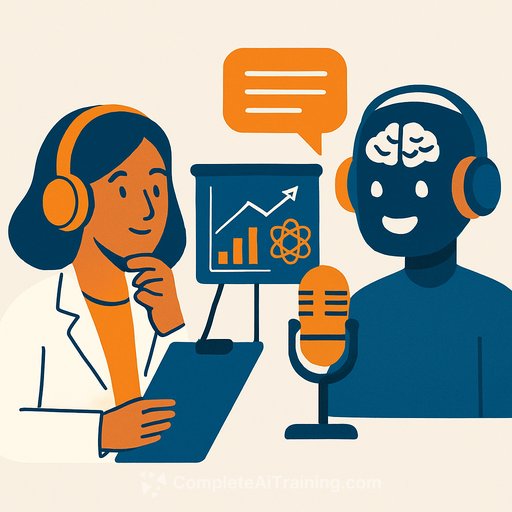
For the first time, researchers have tested artificial intelligence (AI) to create podcasts based on peer-reviewed scientific articles. Using Google’s NotebookLM, a team produced podcast scripts drawn from studies published in the European Journal of Cardiovascular Nursing (EJCN). The goal was to see if AI could simulate a natural scientific dialogue between two speakers discussing research findings.
The results were surprising: half of the study authors did not realize the podcast hosts were AI-generated. These findings were shared at the Annual Congress of the Association of Cardiovascular Nursing and Allied Professions and published simultaneously in EJCN.
Too Polished to Be Human?
The AI-generated podcasts averaged about 10 minutes in length. Without knowing the source, most authors felt their research was summarized clearly and simply, with a well-organized delivery. Some even thought the “hosts” had clinical or nursing expertise based on their tone and vocabulary.
However, feedback was mixed. Several authors noted the delivery was unnaturally smooth, lacking typical human speech patterns like hesitation or repetition. This raised suspicion about AI involvement. There were also mispronunciations of medical terms and factual inaccuracies. For instance, one podcast focused on heart failure diagnosis rather than management, and another discussed only women even though the study included men.
Some authors were distracted by the overly enthusiastic, American-style narration, which used superlatives to describe modest results. They recommended a more academic tone, especially if the podcasts are intended for scientific audiences.
Promise for Science Communication
Philip Moons, PhD, and his team at KU Leuven, Belgium, created 10 podcasts from EJCN articles. Despite some flaws, they concluded that AI-generated podcasts can summarize key findings in an accessible and engaging way. The podcasts seem most suitable for patients and the general public but could also serve researchers and healthcare professionals if adapted appropriately.
Moons shared that the podcasts were generally accurate and expects quality to improve rapidly as AI technology advances. He conceived the idea after testing NotebookLM on one of his own papers shortly after its release in September 2024. “I was flabbergasted by the high quality and how natural it sounded,” he said.
After generating the podcasts—which ranged from 5 to 17 minutes—the team gathered feedback through questionnaires and 30-minute video interviews with the authors.
Missing Context but Strong Engagement
All authors agreed the podcasts conveyed their research findings clearly and in accessible language. The conversational format between two hosts made the content more engaging, with several noting the professionalism of the speakers.
One author commented, “I was curious about their background — it really seemed like they had medical or nursing training.” Yet, some authors were unsettled by the absence of introductory context. The podcasts did not reveal the identities of the speakers or disclose that the audio was AI-produced, leaving listeners unsure about the source.
While most found the content reliable, a few pointed out factual errors. For example, obesity was described as a “habit,” which could mislead listeners by oversimplifying the condition. Despite these shortcomings, half of the authors—including an AI expert—did not realize the podcasts were machine-generated. Many expressed amazement at the quality, and even those who suspected AI involvement were impressed by the natural flow.
Expanding Research Reach
Authors agreed that future AI-generated podcasts should clearly disclose AI involvement. They recommended adopting a more academic tone for scientific audiences and including more detail on study methods and limitations.
While patients and the general public remain the primary audience, the researchers noted that AI podcasts could offer a cost-effective and scalable way for healthcare professionals to stay updated with new research. This format could also broaden the visibility and impact of scientific publications.
“This could be a sustainable model to get the message out to people who do not typically read scientific journals,” said Moons. However, he emphasized the importance of human oversight to provide nuance and context. He envisions a hybrid approach where AI-generated content is supplemented by human input.
Some of this vision is already in development. The beta version of Google’s NotebookLM now allows real-time interaction with the AI. After launching a podcast, users can ask questions directly to one of the “hosts,” who then generate spoken responses, creating a seamless human-machine dialogue.
As AI tools evolve, this approach may become an effective channel for disseminating scientific knowledge beyond traditional formats.
Your membership also unlocks: