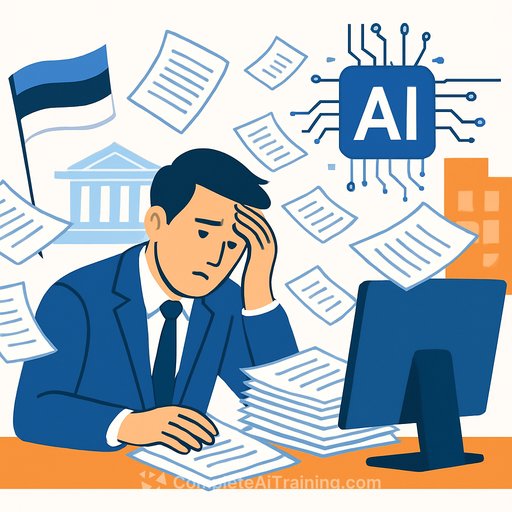
Courts and municipalities struggle with AI-generated submissions that clog their systems
Courts, prosecutors, and local governments across Estonia are drowning in artificially generated documents that officials say waste time rather than save it. The submissions-often dozens of pages long-force staff to fact-check references, verify claims, and sift through padding that serves no legal purpose.
A Tartu Circuit Court case in February exposed the problem directly. A state-appointed defense attorney submitted an appeal citing several Supreme Court rulings that either did not exist or contradicted the claims made about them. The court concluded the text was AI-generated and cut the lawyer's fee by two-thirds.
Length becomes a liability
State Prosecutor General Astrid Asi said AI is leaving visible marks across the judicial system. "AI is being used to draft procedural documents, with the outcome that these documents are simply getting much longer," Asi said. "Since it is so easy to generate volume and to add various references and justifications, this is unfortunately being used. It is not uncommon for courts to receive applications that are 50 or 60 pages long."
The problem extends beyond courts. When Põhja-Pärnumaa Municipality reviewed wind farm planning applications a year ago, suddenly extensive submissions began arriving that stalled the entire approval process. Municipality head Madis Koit said the flood of AI-generated text violated basic fairness. "Planning processes have their deadlines, but we cannot go ahead if we haven't responded to people's opinions. If someone's goal is to derail something or to flood us with submissions, then it is no longer a fair fight," he said.
Officials spot the patterns
Experienced municipal staff can recognize AI-generated letters by their formatting, unusual punctuation, and structure. Rae Municipality head Gerli Lehe said officials must now verify facts line by line. "The wording typical of AI can be observed, and in some cases AI generates paragraphs from different laws that may not correspond to reality," she said.
Municipalities are experimenting with AI as a tool for their own work-drafting responses or compiling information-but only with human review. Koit said his municipality tested whether AI could respond to AI-generated submissions. "Generally, we respond ourselves. It's true that officials also occasionally use AI to search for or compile information, and I think that's perfectly fine. But in the end, a human still has to review it and adapt it as needed," he said.
The prosecutor's office operates similarly. Asi emphasized that humans retain final authority. "Our approach is that the final decision always remains with a human being. AI can assist us, perhaps analyze materials or draft a response, but responsibility for the final text still lies with an individual. Responses are always reviewed by a prosecutor and issued with the prosecutor's signature," she said.
For government professionals managing submissions and applications, the lesson is clear: AI-generated text that bypasses human judgment creates work, not efficiency. AI for Government and AI for Legal professionals should focus on AI as a drafting aid, not a replacement for review.
Your membership also unlocks: