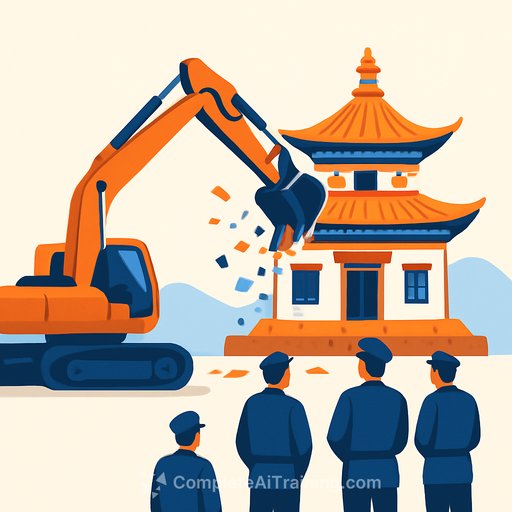
AI-Generated Video Falsely Claims Chinese Temple Demolition
A widely shared video purporting to show Chinese authorities destroying a Tibetan temple is artificial intelligence-generated content, not documentation of an actual demolition. The 15-second clip spread across social media in late April, coinciding with Tibetan diaspora voting for the government-in-exile.
The video shows an excavator operator attempting to destroy a Buddha statue while officials give instructions. Mandarin-speaking voices say, "Smash harder! Yes, don't hit the pillar behind you." An X post in simplified Chinese claimed it showed "the Chinese Communist Party's government's use of heavy machinery to destroy Tibetan temples and destroy Tibetan culture."
Technical Analysis Reveals AI Origin
The Hive Moderation AI detection tool identified the video as "likely to contain AI-generated or deepfake content" and traced it to Sora 2, OpenAI's now-defunct generative video tool. That platform allowed users to generate clips up to 15 seconds long.
Multiple visual inconsistencies mark the clip as synthetic. The excavator drops the statue, but debris beneath it shows no reaction to impact. Text on the men's jackets appears blurred and illegible. A Buddha statue fragment in the foreground displays a single leg with two feet attached - a logical impossibility.
The voices instruct the operator to avoid a pillar behind the building, yet the structure sits in front of it in the actual footage.
No Match to Documented Cases
The International Campaign for Tibet, a US-based advocacy group, told fact-checkers it did not recognize the building as distinctly Tibetan. The organization noted that the Central Tibetan Administration reported demolitions of Buddhist stupas in 2025, but the building in the AI video does not match structures shown in photographs of those affected monasteries.
China has a documented history of destroying Tibetan religious and cultural structures. During the 1966-76 Cultural Revolution, temples and monasteries were reduced to ruins. Rights groups say demolitions have continued in subsequent decades and that repression has increased in recent years.
Context for Government Officials
This case illustrates how synthetic media can spread misinformation about geopolitical situations, particularly in regions where independent reporting is restricted. China exercises tight control over information flow from Tibet, and state-owned media maintains narratives focused on national unity.
For government officials evaluating information security and misinformation threats, the incident demonstrates that AI for government contexts extends beyond policy applications to detection and verification challenges. The clip's rapid spread across multiple languages and platforms shows how synthetic content can scale quickly without coordinated distribution.
The earliest version appeared on an X account that frequently posts anti-China content using AI-generated images to illustrate genuine news events. This pattern - mixing real reporting with fabricated visuals - complicates public understanding of actual human rights concerns.
Your membership also unlocks: