AI Governance Vendor Report 2026
Published: 28 Jan. 2026
Public-sector AI adoption is accelerating. With it comes pressure to put practical guardrails in place - not just policies on paper. This report lays out a clear way to assess AI governance vendors so agencies can procure with confidence and prove oversight in audits, hearings and to the public.
AI governance is not a single function, discipline or technology. It spans policy, technical evaluation, assurance and organizational change. Vendors began offering these services as early as 2010, but demand in the past few years has led to a wave of new entrants and expansions from established firms.
Why this matters for government buyers
Agencies face legal duties, budget limits and scrutiny that private firms do not. You need vendors that deliver traceability, documentation and measurable risk reduction - and that can stand up to oversight bodies. This framework helps you structure RFPs, compare proposals and select partners that meet statutory, security and transparency needs. For CIOs responsible for procurement and program leadership, see AI Governance for CIOs for guidance on governance frameworks and program leadership.
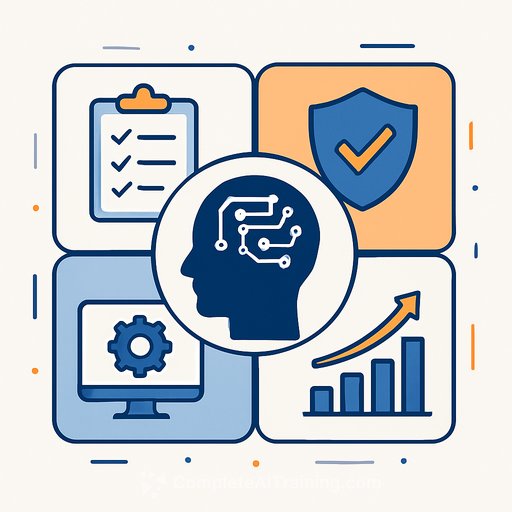
The four categories of comprehensive AI governance
- Policy and Compliance
Internal principles and policy development, governance boards (internal and external), regulatory alignment, documentation, risk identification and management, procurement controls and compliance support. - Technical Assessments and Evaluations
Reviews of data quality, model performance, safety, fairness, security, explainability and stability across development and ongoing monitoring. - Assurance and Auditing
Independent assessments that validate conformance with internal policies, standards and regulatory requirements, plus report-ready evidence. - Consulting and Advisory
Strategy, operating models, readiness, training and hands-on implementation of governance programs.
This is a practical structure, not a rigid taxonomy. Many vendors span multiple categories, and offerings will shift as the market matures. Expect the groupings to evolve in future editions.
How to use this framework in procurement
- Scope your RFP by category
State which of the four categories you need. If you need more than one, separate deliverables and acceptance criteria per category. - Anchor to recognized references
Call out standards like the NIST AI Risk Management Framework (NIST AI RMF) and applicable laws such as the EU AI Act (EUR-Lex). - Ask these vendor questions
Who signs off on risk at your company? How do you document model lineage and data provenance? What metrics do you track for safety, fairness and performance over time? How do you manage incidents and model rollbacks? - Require artifacts
Governance policy library, model cards/system cards, testing protocols, audit reports, DPIAs/PIAs where applicable, risk registers, monitoring dashboards and training records. - Check independence for assurance work
If the vendor built the system, require separate teams or a third party to perform audits. - Verify public-sector readiness
FedRAMP or equivalent where relevant, data residency options, secure enclaves, vendor background checks and records retention alignment. - Watch for red flags
Vague claims without evidence, no documented testing, "black box" answers, missing incident process, or one-size-fits-all tool pitched as a complete program.
Scope and method
This report focuses on comprehensive providers - end-to-end governance capabilities - not single-purpose tools like a standalone evaluation script or a narrow data-quality utility. That distinction matters as governance features show up inside unrelated software. Buyers need to know whether they are getting a full program or a component.
The initial classification relies on public information. Future editions may incorporate fuller public disclosures and direct vendor submissions to strengthen the accuracy of the categories. The intent is to provide an objective view that supports the broader AI governance community, including vendors and public institutions.
Call for contributions
The provider field is active and growing. If you or a partner offers comprehensive AI governance capabilities and are not reflected yet, please share details through the submission form referenced on the report page. Your input helps build a clearer picture across regions and sectors.
CPE credit
This content is eligible for Continuing Professional Education credits. Please self-submit according to your CPE policy guidelines.
Additional resources
- NIST AI Risk Management Framework
- EU AI Act (Official Journal)
- AI Regulatory Compliance Courses
- AI Strategy for Business Units
Your membership also unlocks: