AI-powered lab goggles that help novices perform like experts
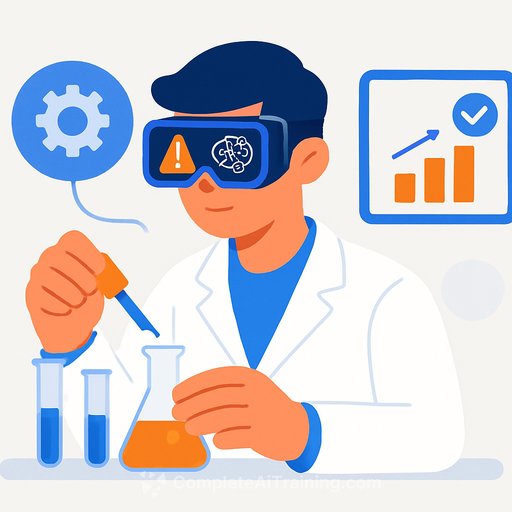
Stand at the bench, complete a step, and your goggles cue the next move. A small frame-mounted camera tracks your hands. Reach for the wrong tube and a warning flashes before the error happens. That's the pitch behind LabOS, a wearable AI system guiding wet-lab work in real time.
Built by the Stanford-Princeton AI Coscientist Team led by bioengineer Le Cong and computer scientist Mengdi Wang, LabOS pairs AR/XR glasses with vision-language models from NVIDIA. The goal: give AI direct visibility into benchwork, link it to written protocols, and reduce the human errors that quietly derail experiments.
What LabOS is
LabOS is an open-source platform and hardware kit that lets AI "see" what scientists see. The glasses stream video to the system, which maps actions against a protocol and provides just-in-time prompts. It tracks sterile technique, flags skipped steps, and records the full run for later review.
The ambition is straightforward: make laboratory work AI-perceivable and AI-operable so that training accelerates, deviation shrinks, and results stick.
Why this matters for reproducibility
Reproducibility is still a bottleneck. A Nature survey found that more than 70% of researchers have failed to reproduce another scientist's results and over half struggled with their own. Much of this isn't fraud-it's human error: a pipette touch, a missed incubation, a reagent at the wrong temperature.
AI that observes the full procedure and outcome can pinpoint fragile steps and update guidance. As Wang puts it, AI advice doesn't mean much unless it's wired into the physical experiment where outcomes are verifiable.
- Continuous oversight reduces silent deviations.
- Full-fidelity records (video + protocol state) enable root-cause analysis.
- Feedback loops turn failures into concrete protocol improvements.
Nature's 2016 reproducibility survey remains a useful baseline for teams tracking improvements.
How it works in practice
- AR/XR glasses stream the bench view to LabOS.
- Vision-language models compare observed actions to the current step.
- On-goggle prompts guide technique and timing; warnings trigger before missteps.
- All context (video, timestamps, prompts, outcomes) is logged.
- A robotic arm can take over repetitive actions such as mixing to reduce variability.
Think of it as a protocol co-pilot. The scientist stays in control. The system catches drift and keeps momentum.
Early results
In a protein upregulation workflow, junior scientists with one week of LabOS training produced outcomes that were indistinguishable from expert results. According to Cong, the outputs were identical by inspection-an early sign that targeted guidance can compress the time-to-proficiency.
What to watch: standards, validation, and interoperability
Outside experts highlight a key gap: shared benchmarks for evaluating AI-in-the-loop experimentation. As these systems move from analytics to active participation, community standards for validation, reporting, and safety will matter. Expect growing discussions around:
- Protocol-level benchmarks and reproducibility metrics
- Model transparency and calibration drift monitoring
- Data governance, privacy, and IP ownership for video logs
- Human factors: cognitive load, ergonomics, and adherence
Practical setup guide for lab leads
- Scope candidate protocols: Start with high-volume or high-failure procedures (cell culture, PCR, Westerns, basic cloning).
- Instrument your SOPs: Convert protocols into step-level checklists with clear criteria for success, timing windows, and hard stop conditions.
- Select AR/XR hardware: Prioritize field-of-view, comfort, battery life, and cleanroom compatibility.
- Integrate data systems: Sync with ELN/LIMS for sample IDs, lot tracking, and time-stamped metadata.
- Define safety rails: Sterility prompts, tip-change rules, contamination checks, and escalation paths.
- Pilot with a small cohort: 3-5 users across skill levels; collect both quantitative outcomes and qualitative friction points.
- Automate selectively: Introduce a robotic arm for the most tedious or variable steps after baseline performance improves.
KPIs to track
- Failed runs per 100 attempts and primary root causes
- Coefficient of variation on key readouts (yield, purity, viability)
- Time-to-proficiency for juniors (hours to hit expert-level metrics)
- Contamination rate and sterile-technique deviations caught
- Inter-operator variability within and across teams
- Throughput per bench-hour and per-reaction cost
Tech under the hood
Vision-language models power the step recognition and context-aware prompts. If you're evaluating platforms or building your own stack, it's worth skimming introductory resources on VLMs to understand their strengths and failure modes.
What are vision-language models? (NVIDIA)
Beyond the bench: MedOS for clinicians
The team has extended the approach to surgery with MedOS, using AI plus AR to assist with anatomical mapping and tool alignment. The same principles apply: verifiable, real-time guidance in high-stakes procedures, with strong requirements for oversight, audit trails, and regulatory compliance.
Bottom line
Labs haven't changed much in decades, but the constraints have: tighter budgets, higher throughput expectations, and pressure for reproducibility. Systems like LabOS meet that pressure where error actually happens-at the bench-by observing, guiding, and learning from every step. If you lead a lab, a focused pilot on one protocol can tell you quickly whether this approach pays off.
Next steps and resources
- AI Learning Path for Research Scientists - practical modules on AI-enabled experimental design, lab automation, and reproducibility workflows.
Your membership also unlocks: