AI health apps are surging. Healthcare can't afford their errors.
AI is accelerating in research and clinical support. It flags subtle findings in images, drafts notes, and reduces low-value admin work. That's good.
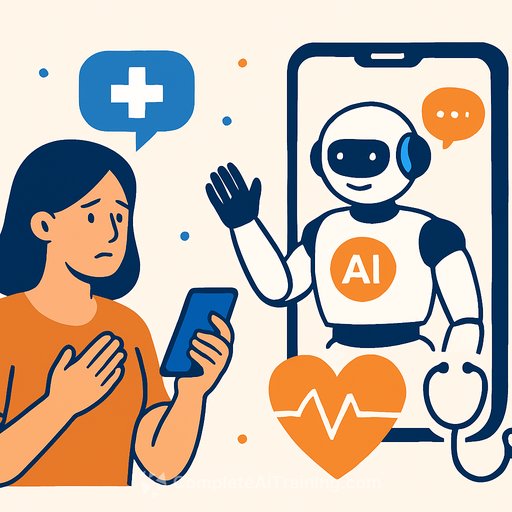
The problem: consumer-facing health chatbots are being pushed to patients with confidence that outpaces their accuracy. In healthcare, "almost right" creates risk - clinical, legal, and reputational.
Where AI is helping - and where it breaks
There's solid evidence of value in focused tasks. Radiology support tools can help catch cancers another reader might miss and free up clinician time when deployed with proper oversight.
But errors are common in open-ended use. One columnist fed 10 years of wearable data to a chatbot and got a dire cardiac warning - later deemed baseless by a cardiologist. Others report "hallucinated" histories appearing in charts, which adds work because every line must be verified.
"Eventually, a lot of this stuff is going to be great, but we're not there yet." That caution isn't anti-AI. It's pro-patient safety.
Evidence worth noting
A study of AI-enabled stethoscopes across ~100 UK practices found better detection of some heart failure signs than standard stethoscopes - yet 40% abandoned the devices due to workflow burden. If it slows clinicians, it won't stick.
In breast imaging, an AI assistant matched the performance of a second reader overall. Still, it missed cancers humans caught and vice versa. Translation: useful as a safety net, not a soloist.
Direct-to-consumer chatbots raise specific risks
- They sound authoritative even when they're wrong, which can trigger anxiety, delay care, or prompt unsafe self-treatment.
- Disclaimers are thinning out just as outputs get more fluent. That's a bad mix.
- Advice is only as good as the data provided - gaps, noise, and bias in uploads can skew outputs.
- Patients may not understand privacy trade-offs or how their data could be reused.
Regulatory reality check
State laws put diagnosis and clinical decisions in licensed clinicians' hands after appropriate examination and history. AI can support, not substitute.
The FDA's policy carves out low-risk, patient-education tools from device regulation when they are not intended for diagnosis. If a bot strays into diagnostic territory, you're in a different regulatory lane fast. See FDA guidance on general wellness devices here.
Insurer uses of AI for coverage decisions are already in court. Even when companies claim clinicians make final calls, perceived overreach by algorithms fuels scrutiny and litigation risk.
How healthcare leaders should act now
Adopt a clinical standard for any AI touching patients - even if it's "just" educational. Set guardrails before pilots, not after incidents.
Guardrails that hold up in practice
- Define the boundary: Education and summarization only; no differential diagnoses, no treatment recommendations, no triage decisions without clinician review.
- Human-in-the-loop by default: Every patient-facing output is reviewed when there's any chance of clinical action, escalation, or alarm.
- Validate locally: Test on your patient mix and workflows. Report sensitivity, specificity, PPV/NPV, and calibration. Compare against clinician benchmarks before go-live.
- Workflow first: Do a time-and-motion study. If documentation or device steps add clicks or minutes, fix it or don't deploy.
- Safety nets: Build clear fallback paths, uncertainty flags, and "don't know" responses. Force handoff to a human for red-flag symptoms.
- Data governance: Treat all inputs as PHI. Require BAAs, data minimization, access logging, encryption, retention limits, and model-update change control.
- Bias monitoring: Audit performance and error rates across age, sex, race/ethnicity, language, and comorbidities. Retrain or restrict if gaps persist.
- Patient communication: Prominent, plain-language disclaimers; instructions on when to seek urgent care; consent for data use; easy opt-out.
- Procurement terms: Insist on transparency (model versioning, training sources), audit rights, incident SLAs, and indemnification for clinical misuse.
- De-adoption plan: If safety or utility degrades, have a clear path to pause or retire the tool quickly.
Frontline guidance for clinicians
- Use AI to prep, not to decide: patient summaries, education handouts, question lists, and coding support.
- Never document unverified AI content as fact. Label AI-assisted text and confirm critical details.
- If a patient brings a bot's "diagnosis," acknowledge it, review the actual data, and correct misinformation on the spot.
What to tell patients
- These tools can explain terms and organize data, but they make mistakes. Treat them like a search assistant, not a clinician.
- Never ignore worrisome symptoms because a bot said "all good." Seek care for red flags and urgent symptoms.
- Be selective about what you upload. If you share data, remove identifiers and understand who can access it.
The bottom line
AI is already useful in focused clinical tasks. But patient-facing chatbots can create false certainty, workflow drag, and legal exposure if deployed without clinical-grade validation.
Healthcare can't normalize AI errors. Hold vendors to the same standards you'd demand of a drug, a device, or a diagnostic - and keep clinicians in control.
Want practical frameworks and training on safe, effective deployments? Explore AI for Healthcare.
Your membership also unlocks: