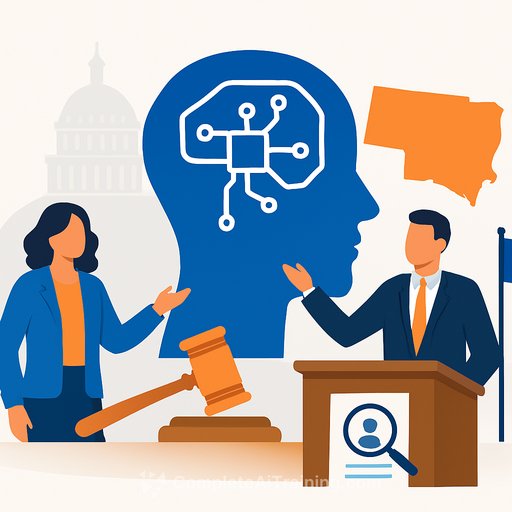
AI in Hiring: Should Congress Act or Let Industry Self-Police?
House lawmakers are weighing a simple question with big consequences for public employers: do we need AI-specific transparency and anti-bias rules for hiring, or can existing civil rights laws carry the load? Congress hasn't passed broad AI legislation, leaving agencies and contractors working through a patchwork of requirements. States like California, Colorado, and Illinois are stepping in with their own measures to curb bias from automated decision tools. That patchwork raises cost, risk, and confusion across multi-state hiring.
What's at stake
- Whether employers must disclose AI use in hiring and give candidates meaningful explanations.
- Whether bias testing, third-party audits, and documented risk assessments become mandatory.
- How far federal rules should go versus letting industry follow current civil rights law and guidance.
- If federal standards preempt state measures-or set a floor that states can build on.
Why existing law may not be enough
Title VII, the ADA, and the ADEA already prohibit discrimination, including disparate impact from tests and tools. But many hiring models are opaque, data-shift can reintroduce bias over time, and vendors often restrict access to testing methods. Enforcement tends to be after-the-fact and case-by-case, which doesn't prevent harm up front. That's why lawmakers are exploring pre-deployment checks, applicant notice, and ongoing monitoring.
States are moving first
California, Colorado, and Illinois have pursued rules targeting bias risks from algorithmic hiring tools. Provisions under discussion or adopted in various states include notice to candidates, impact assessments, and audit requirements. For public employers and contractors, this creates overlapping duties that change by jurisdiction. The result: compliance costs rise, and policy gaps remain where no state rules exist.
Federal signals you can act on now
- EEOC has warned that automated tools can trigger discrimination risks and outlined employer duties under existing laws. See the agency's resources on AI and employment at EEOC.gov/ai.
- OMB's M-24-10 sets expectations for federal agencies using AI, including impact assessments, independent evaluation, and safeguards for rights and safety. Read the memo at whitehouse.gov.
What Congress is considering
- Transparency: clear notice to applicants when AI screens or ranks them, plus summaries of why decisions were made.
- Testing and audits: pre-deployment and periodic bias testing; documentation of methods; potential third-party certifications.
- Risk assessments: written records of data sources, intended use, limitations, and mitigation steps.
- Human oversight: options for human review, appeal paths, and accommodations for people with disabilities.
- Data controls: retention limits, deletion on request where lawful, and restrictions on sensitive attributes and proxies.
- Preemption: deciding whether federal rules override or sit alongside state requirements.
- Liability and safe harbors: clear lines for employer and vendor responsibility, with protections for good-faith compliance.
Practical steps for government teams right now
- Inventory every AI or automated tool influencing hiring, promotions, pay, or discipline. Name an accountable owner for each system.
- Update procurement: require model documentation, bias testing results, validation aligned with selection guidelines, data lineage, and change logs.
- Run disparate impact testing before and after deployment. Set thresholds, remediation triggers, and deadlines.
- Provide clear notice to candidates, an accommodation channel, and a simple process to request human review.
- Keep humans in the loop for high-stakes decisions. Document how final decisions are made.
- Lock down inputs: minimize sensitive attributes, monitor for proxy variables, and set retention and deletion rules.
- Train hiring managers and HR staff on appropriate tool use, limits, and recordkeeping.
- Audit annually. Capture outcomes, adverse action rates, and corrective actions. Report findings to leadership.
What to watch
- Future EEOC enforcement actions testing how civil rights law applies to algorithmic screening.
- State-level implementation timelines and guidance, especially where audits and notices become mandatory.
- Federal movement on baseline standards for transparency, bias testing, and applicant rights.
If you need to skill up your team
If your agency is building internal capacity for AI auditing, procurement, or HR compliance, explore role-based learning paths such as AI Learning Path for Training & Development Managers and AI Learning Path for Regulatory Affairs Specialists.
Your membership also unlocks: