
AI news ·
AI hiring slowdown threatens office demand as data center construction surges
Tech giants are betting big on data centers while cutting office headcount - Meta laid off 8,000 workers the same month it raised data center spending to $125B. Whether office real estate shrinks depends on AI's net effect on hiring.
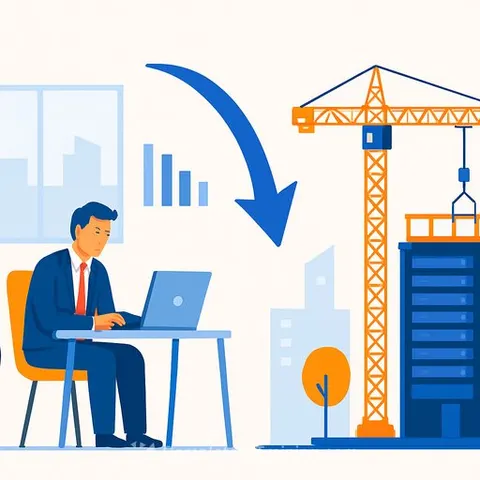
Tech's Data Center Boom Leaves Office Real Estate in Limbo
Major tech companies are pouring capital into data centers while cutting workers. Meta laid off 8,000 employees in May, the same month it raised its 2026 data center spending forecast by 8 percent to $125-$145 billion. Google and Meta have not expanded office space to match these investments, creating uncertainty about whether commercial real estate will shrink or adapt.
Data center construction spending has now matched general office spending, according to U.S. Census Bureau data. This shift reflects where tech companies see their future - in infrastructure for artificial intelligence, not in traditional office real estate.
The question facing landlords and investors is straightforward: Will companies in finance, law, and consulting continue hiring people to manage AI systems, or will the technology itself eliminate those roles?
The Optimistic Case: AI Boosts Office Demand
AI companies themselves occupy real estate at historic levels. The Bay Area alone holds approximately 17 million square feet of AI-occupied space today, with projections of 20 to 35 million additional square feet by 2030.
This growth matters because companies driving AI adoption - hyperscalers, frontier AI labs, and infrastructure builders - are among the largest real estate tenants. The sector often cast as a victim is actually a primary beneficiary of the companies accelerating this change.
Previous productivity tools followed the same pattern. Email and mobile technology transformed how work gets done, but they didn't eliminate office workers. Instead, professionals who adapted early gained market share. AI is the next chapter in that story.
Real estate firms already see this happening. AI handles data-heavy work like tracking comparable sales and synthesizing market trends, freeing professionals to focus on client relationships and complex transactions - work that cannot be automated. This makes advisory services more scalable, not smaller.
New categories of work are emerging: data center siting, specialized portfolio strategy for AI-native companies, and advanced advisory services. Morgan Stanley estimates AI could generate $34 billion in operating efficiencies across the real estate industry by 2030, but efficiency gains tend to unlock new work rather than eliminate it.
The Cautious Case: Job Losses Could Slow Hiring
The real risk depends on job growth. If AI eliminates roles in high-risk categories - software programming, finance, accounting, legal research - office-using job growth could slow from the historical 2-3 percent annually to around 0.5 percent.
Coastal markets like New York, Boston, and San Francisco may face the most exposure. Legal, finance, accounting, and consulting firms on the coasts are precisely the organizations likely to adopt AI quickest and reduce hiring for junior roles in research and analysis.
Warning signs to watch include rising sublease rates, higher lease renewal rates, and increased sublet volumes as companies stop backfilling positions. If free rent and tenant improvement allowances remain elevated, demand may be softening even where vacancy appears tight.
The challenge is timing. Companies are pausing to assess their space needs - similar to what happened during the pandemic - but this could have longer-lasting effects than a temporary disruption. A persistent slowdown in hiring over three to five years would hurt office, retail, and residential real estate.
What Happens Next
The outcome depends on whether AI primarily eliminates jobs or creates new ones. Until companies announce significant hiring for roles like prompt engineering or AI-specialized positions, the displacement risk remains real.
For real estate professionals, the immediate strategy is clear: adapt or fall behind. Those treating AI as a tool to enhance client relationships and streamline operations will define the next version of the business. Those waiting to see what happens will lose ground.
The data center boom is certain. The future of office real estate depends on whether the people who work with AI will need places to work.
Learn more about AI for Real Estate & Construction or explore an AI Learning Path for Real Estate Brokers.