AI Hygiene in Practice Management: Verification at the Point of Care and a Human-on-the-Loop Standard
Michael Clark, president of OnPoint Healthcare Partners, lays out a clear message for healthcare leaders: AI only works in practice management if it's clean, verified and supervised. That starts with AI hygiene, continues with point-of-care verification and is safeguarded by a human-on-the-loop model.
What "AI hygiene" means for managers
AI hygiene is the set of disciplines that keeps models useful, safe and accountable. Think data quality, controlled access, versioning, monitoring, documented workflows and clear escalation paths.
- Data inputs: Define approved data sources, freshness windows and quality checks.
- Model governance: Track versions, training data lineage and change logs.
- Controls: Role-based access, PHI minimization and encryption at rest/in transit.
- Monitoring: Drift alerts, performance dashboards and incident tracking.
Verification at the point of care
Clinical AI cannot be "auto-accept." Recommendations must be verified before influencing care. Put a lightweight verification step in the workflow, not as an afterthought.
- Display rationale: Surface inputs, confidence and key factors used.
- Require acknowledgment: Clinician accepts, modifies or overrides with one click.
- Capture context: Log reason codes for overrides to feed retraining and QA.
- Set thresholds: High-risk outputs demand mandatory second review.
Human on the loop, not hands off
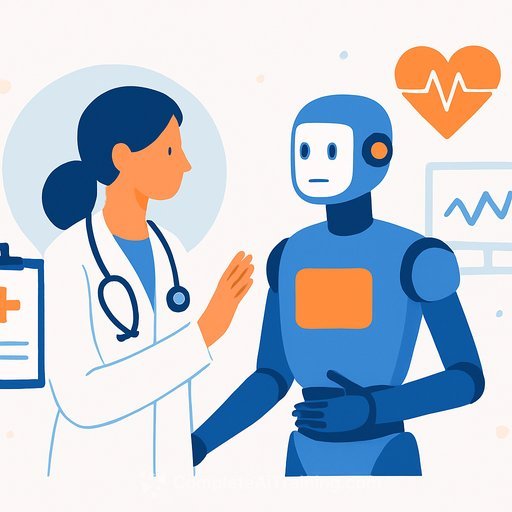
Automation should run, but a human should supervise outcomes and intervene quickly. This is the guardrail against silent errors, workflow jams and bias slipping into production.
- Clear authority: Who can pause, roll back or switch to manual?
- Time-to-intervention SLA: Define response windows for critical events.
- Sampling: Daily random reviews of automated outputs.
- Runbooks: Step-by-step playbooks for common failure modes.
Metrics managers should watch
- Clinical: Override rate, agreement with gold standard, near-miss count.
- Operational: Cycle time reduction, queue backlog, first-pass yield.
- Quality & safety: False positive/negative rates, incident rate, time to detect drift.
- Financial: Cost per encounter, denial rate changes, ROI by workflow.
Implementation rhythm: 30/60/90
- First 30 days: Map processes, select use cases, define verification steps and metrics. Draft governance policy and data standards.
- Days 31-60: Pilot with a small clinical group. Turn on dashboards, collect override reasons, tune thresholds.
- Days 61-90: Expand cautiously. Add sampling reviews, finalize runbooks and train backups for human-on-the-loop coverage.
Vendor and model due diligence
- Evidence: Prospective validation in similar populations; access to test sets and methods.
- Bias checks: Performance by demographic and site; mitigation plan documented.
- Update policy: How often models change, how changes are communicated and rollback options.
- Auditability: Full logs, rationale visibility and export for compliance.
Policy anchors and references
- NIST AI Risk Management Framework for risk controls and measurement.
- FDA resources on AI/ML-enabled medical devices for clinical safety expectations.
Common pitfalls to avoid
- Shadow AI: Unapproved tools using live data without oversight.
- Automation bias: Staff accepts outputs without verifying context.
- Metric blindness: Focusing on speed while missing safety signals.
- Training gaps: No rehearsal for downtime or model rollback.
Manager's checklist
- Written AI hygiene policy with owners and review cadence.
- Point-of-care verification step embedded in the EHR or workflow tool.
- Named human-on-the-loop with 24/7 coverage and clear SLAs.
- Live dashboards for performance, drift and incidents.
- Override reason codes feeding continuous improvement.
- Quarterly bias and safety review with action items.
The formula is straightforward: clean inputs, verified outputs and supervised automation. That's how AI becomes dependable in practice management-and how leaders keep quality, safety and workflow moving in the same direction.
Further learning
- AI Learning Path for CIOs
- AI Learning Path for Regulatory Affairs Specialists
- AI Learning Path for Project Managers
Your membership also unlocks: