The Integration of AI in Education: Opportunities and Challenges
Artificial Intelligence (AI) is increasingly becoming part of education systems worldwide. While the potential benefits are clear, significant concerns around ethics and pedagogy demand attention. International organizations such as UNESCO and UNICEF highlight both these opportunities and risks. In India, stories about robotic teachers are capturing imaginations, but the reality calls for a more cautious approach.
Dangers of Uncritical AI Adoption
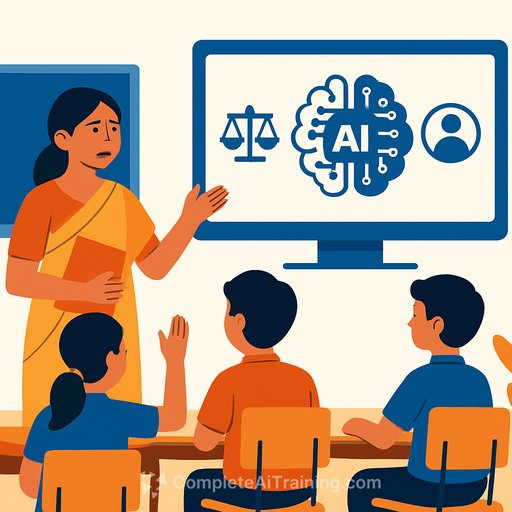
Two main issues stand out: algorithmic bias and data privacy, alongside digital equity and the impact on teaching quality. AI systems often rely on datasets that reflect existing social prejudices. This can lead to unfair outcomes in student evaluations. Many commercial AI platforms operate as “black boxes,” keeping their decision-making processes hidden from educators and students. Without transparency, it’s difficult to spot or fix these biases.
Data privacy is another pressing concern. The vast amounts of student information collected by educational platforms are sometimes treated as commodities. Investigations in 2022 revealed that several EdTech platforms in India shared sensitive data with advertisers, exposing students to profiling and surveillance. Technologies like facial recognition used for attendance or behaviour monitoring can misidentify students and introduce privacy risks, normalizing constant surveillance from an early age.
Digital equity suffers as well. AI tools often assume all students have equal access to devices and reliable internet, which is far from reality. This can deepen existing divides, leaving disadvantaged students further behind.
The Pedagogical Consequences
Relying heavily on AI risks reducing teachers to facilitators who merely oversee pre-set content. This shift focuses on measurable test scores, sidelining critical thinking, creativity, and holistic learning. Many AI platforms ignore cultural and local contexts, which can lead to homogenized education that misses regional relevance.
For example, AI-driven learning platforms may prioritize test-prep materials based on past user interactions or global data patterns. In regions like India, this often means a neglect of conceptual understanding and cultural knowledge—key elements in curricula such as NCERT and SCERT. Instead, students might be pushed towards rote learning and narrow content.
These challenges don’t mean AI should be discarded from education. Instead, the focus should be on thoughtful implementation that ensures transparency, protects data, guarantees equitable access, and empowers teachers. Only then can AI contribute positively without compromising educational values.
KITE’s Public-Centric Approach in Kerala
Kerala offers a promising example through KITE (Kerala Infrastructure and Technology for Education), the technology division of the state’s General Education Department. KITE stresses that AI must prioritize public good and keep teachers at the core of education.
A major step has been training 80,000 teachers from grades 8 to 12 on the ethical and critical use of AI, covering bias detection, privacy, and responsible classroom integration. AI is embedded in the curriculum with a focus on foundational understanding rather than just tool use.
Kerala has implemented Free and Open-Source Software in over 15,000 schools. This ensures transparency and autonomy while aligning with public education goals. The Little KITEs IT Clubs encourage hands-on learning in AI and robotics, fostering digital citizenship among students—an initiative recognized by UNICEF as a global best practice.
The state’s own AI system, Samagra Plus AI, functions as a Learning Management System aligned with local curricula. Unlike generic commercial platforms, it uses datasets curated by expert teachers, ensuring accuracy and relevance to Kerala's educational context. By relying on open-source technologies and bias-resistant AI techniques like Retrieval-Augmented Generation (RAG), Kerala maintains data sovereignty and models responsible AI use in public education.
This approach shows that ethical, high-quality AI solutions can be developed and sustained within public education systems without relying on commercial products.
For educators interested in understanding how AI can be responsibly integrated into classrooms, exploring courses on ethical AI use can provide valuable insights. Resources such as Complete AI Training offer practical guidance tailored to education professionals.
Your membership also unlocks: