Can AI Be Trusted with Decision-Making in Finance?
The honest answer: partially. AI delivers speed, scale, and consistent execution, but trust stalls without transparency and human control. In high-stakes decisions, black boxes won't cut it. The practical path is clear-use AI as a force multiplier, keep people accountable. For teams building real skill and governance around this shift, the AI Learning Path for Vice Presidents of Finance helps anchor both the tech and the risk.
Why AI Is Winning Budget in Finance
Faster and More Efficient
Models process years of transactions in seconds. They detect anomalies in real time, triage alerts, and run portfolio simulations on demand. That speed converts directly into lower loss, better timing, and fewer manual bottlenecks.
Better Risk and Compliance Management
From early fraud flags to credit risk scoring and liquidity monitoring, AI improves signal-to-noise. Supervisors are also experimenting with AI to spot systemic patterns earlier than traditional methods.
Personalized Financial Advice
Generative systems tailor allocations, rebalancing rules, and planning to individual goals and constraints. That brings institutional-grade thinking to a broader client base-without headcount inflation.
If you want to get hands-on with data pipelines and model behavior, see practical resources under AI for Finance.
Risks You Can't Ignore
Data Quality and Bias
Models reflect their training data. Skewed histories can surface as unfair credit outcomes or biased approvals. In regulated contexts, that's not just a bad look-it's a legal and reputational risk.
Black Box Decisions
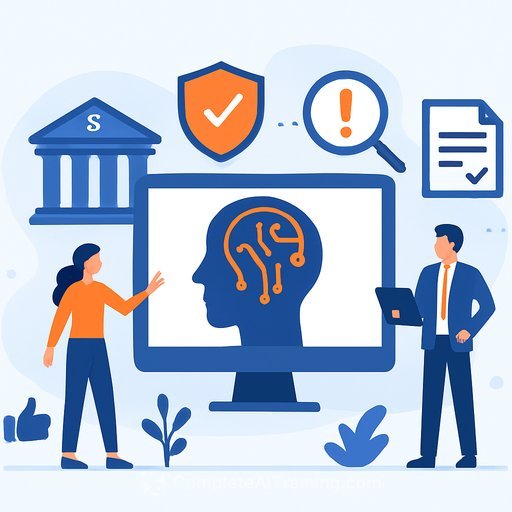
If your team can't explain why the model did X over Y, you don't have control-you have exposure. Explainability isn't a "nice to have" in finance; it's table stakes for audit, regulators, and clients.
Over-Reliance and Systemic Risk
When many firms lean on similar models, shared errors can propagate across markets. Homogeneity increases the odds of correlated failures, especially under stress.
Fragile Trust
People still trust human advisors more, especially under uncertainty. Nearly 1 in 5 Americans who followed AI-generated financial advice lost money-proof that blind trust is expensive.
Pros and Cons at a Glance
- Speed: Faster analysis and execution; errors can spread quickly.
- Risk Detection: Earlier fraud/anomaly flags; biased data can produce unfair outcomes.
- Compliance: Better monitoring and reporting; opacity limits accountability.
- Cost Efficiency: Automates repetitive work; upfront setup and integration are costly.
- Personalization: Advice at scale; explanations may oversimplify or mislead users.
- Consistency: No fatigue or drift; struggles with rare or out-of-distribution events.
- Innovation: New analytical tooling; the trust gap with human advisors remains.
- Market Impact: Stronger modeling and scenario analysis; can amplify systemic risks.
- Accessibility: Wider reach for advice; vulnerable groups may over-trust outputs.
- Oversight: Supports decision-makers; cannot replace ethical or moral judgment.
What Would Make AI More Trustworthy in Finance
- High-quality, representative data that's monitored for drift and bias.
- Explainable AI so decisions can be traced, justified, and audited.
- Human oversight with clear approval thresholds and accountability.
- Strong regulation and model risk governance (think SR 11-7 principles).
- User education so clients and staff know what AI can-and cannot-do.
Useful frameworks worth knowing: the NIST AI Risk Management Framework and the Federal Reserve's SR 11-7 guidance on model risk.
Practical Next Steps for Finance Teams
- Define your AI use cases by risk tier: low-risk automation, decision support, or decision-making.
- Stand up model risk controls: data lineage, versioning, bias testing, backtesting, and challenger models.
- Require explainability for any client-impacting or capital-impacting decision.
- Keep a human in the loop for approvals above defined thresholds or in high-uncertainty states.
- Run adversarial tests: prompt injection, data poisoning, and scenario stress across regimes.
- Train your people-product, risk, compliance, and advisors-to read and question AI outputs.
If you're building a capability roadmap, consider a role-focused path like the AI Learning Path for Regulatory Affairs Specialists to sharpen governance and compliance skills.
Conclusion
Can AI be trusted with financial decisions? Not fully-yet. With explainability, oversight, and solid governance, it becomes an edge, not a liability. The future isn't AI replacing people; it's finance pros using AI for scale and speed while staying accountable for the call.
Your membership also unlocks: