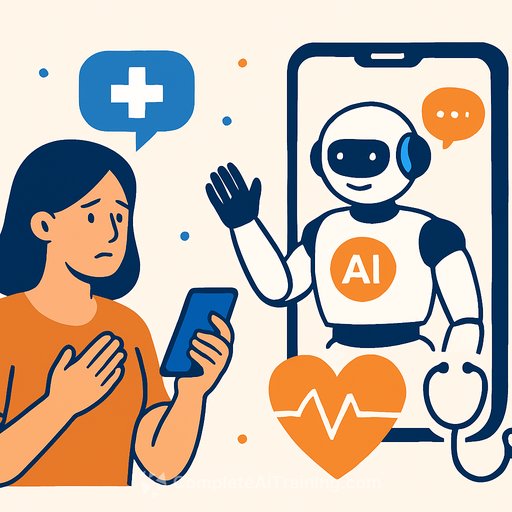
AI in healthcare is accelerating. Compliance pressure is catching up.
AI is already in your workflows: triage chatbots, imaging support, coding assistance, even discharge planning. That speed brings scrutiny. Regulators are asking the same questions you are: Is it safe? Is it fair? Who's accountable when it fails?
The short answer: you need clear governance, rigorous validation, and airtight contracts before AI touches patients or PHI. Here's a practical guide to get there without slowing useful innovation.
What regulators care about (and what your board will ask)
- Patient privacy: lawful basis, minimum necessary, de-identification, data sharing controls.
- Safety and effectiveness: documented validation, known limits, clinician oversight.
- Transparency and explainability: what the model does, where it fails, and how to override it.
- Bias and fairness: measured, monitored, and mitigated across demographics.
- Accountability: clear ownership for incidents, updates, and performance drift.
- Post-market monitoring: continuous checks, not one-and-done testing.
Data protection: get the basics right first
- Map data flows: what PHI leaves your environment, who processes it, and where it resides.
- Minimize and de-identify: use the least data needed; apply de-ID or pseudonymization when possible.
- Contracts: BAAs, DPAs, and purpose limits for all vendors and sub-processors.
- Patient rights: consent/notice where required; accessible opt-outs for non-essential use.
- Security: encryption, access controls, audit logs, key management, and breach workflows.
Is your AI a medical device?
If the tool informs diagnosis, therapy, or clinical decisions, you may be in medical device territory (SaMD). That triggers quality management, risk controls, and market authorization in many regions.
- US: FDA's approach to AI/ML SaMD and change control expectations are essential reading. FDA AI/ML SaMD
- EU: High-risk AI systems face strict obligations under the AI Act (risk management, data governance, transparency, and monitoring). EU AI Act overview
Clinical validation and monitoring: make it repeatable
- Pre-deployment: test on local data, run shadow mode, compare against standard of care.
- Bias testing: report performance by age, sex, race/ethnicity, language, and site.
- Human-in-the-loop: define decision boundaries and mandatory overrides.
- Change control: approve model updates; re-validate material changes before production.
- Post-market: monitor drift, false positives/negatives, clinician feedback, and safety events.
Contracts that protect you
- Use and purpose limits: no training on your data without explicit approval.
- Data rights: your data stays yours; no commingling with other clients.
- Performance warranties: target metrics, supported indications, and safe-use constraints.
- Audit and access: security audits, incident reports, and model version history on request.
- Liability and insurance: cap and carve-outs aligned to clinical risk; vendor carries adequate coverage.
- Update transparency: release notes, change logs, and rollback plans for each model update.
Procurement checklist (use before pilot)
- Intended use statement and clinical claims.
- Validation reports on local or similar populations.
- Bias, explainability, and failure mode documentation.
- Security posture (SOC 2/ISO 27001), data residency, and sub-processor list.
- Integration plan: EHR/FHIR, PACS, API rate limits, and downtime behavior.
- Support model: SLAs, escalation paths, and versioning cadence.
- Regulatory status: FDA/CE or rationale for non-device classification.
Clinical workflow and training
- Clear roles: AI suggests; clinicians decide. No auto-accept without review.
- Context cues: show confidence scores, data freshness, and known limitations at the point of use.
- Fallbacks: safe degradation if the service is down; never block core care.
- Documentation: chart when AI informed a decision, especially for high-risk calls.
- Upskilling: baseline training for clinicians and compliance teams on safe AI use. If you need structured courses for compliance teams, see AI Learning Path for Regulatory Affairs Specialists.
Interoperability and IT fit
- Use standards: FHIR, DICOM, HL7 where applicable.
- Latency and throughput tested under real load.
- Role-based access and SSO; no shadow databases of PHI.
- Version pinning and rollback to handle breaking API changes.
- Development teams should follow secure Coding practices for auditable, maintainable integrations.
A 90-day compliance rollout plan
- Days 0-30: inventory AI use, map data flows, gap-check policies, identify high-risk use cases, and freeze unapproved pilots.
- Days 31-60: set the AI governance committee, approve standard documents (DPIA template, validation protocol, bias test plan, incident response), update procurement terms.
- Days 61-90: run one controlled pilot with shadow mode, complete validation, train end users, stand up monitoring dashboards, and schedule a post-implementation review.
Common pitfalls to avoid
- Letting vendors train on your PHI by default.
- Skipping local validation because "it worked in a paper."
- Relying on disclaimers instead of real governance and monitoring.
- Treating AI as IT-only; clinical leadership must co-own it.
- Neglecting change management when the model updates itself.
Bottom line
AI can reduce friction in care, but only if you treat it like clinical technology from day one: prove it works, control the risks, and write the rules before go-live. Do that, and compliance becomes a forcing function for safer, more effective adoption-not a blocker.
If you want help training teams on safe use and oversight, consider curated programs such as the AI Learning Path for CIOs.
Your membership also unlocks: