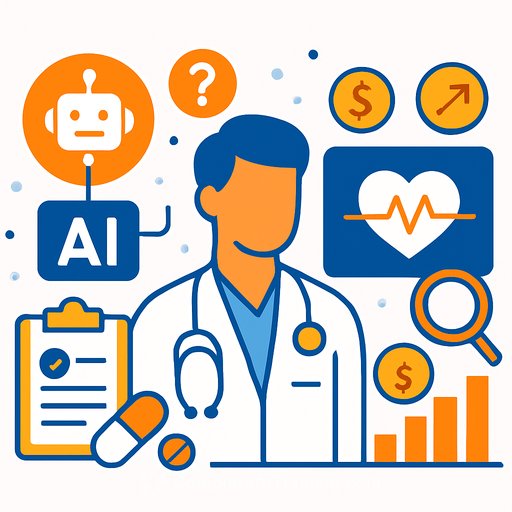
AI in Healthcare: Market Overview
The global market for AI in healthcare is growing fast, expected to reach $187.69 billion by 2030. This growth is driven by the need for more precise and efficient care delivery. Healthcare leaders are clearly aware of this shift. Over 80% of health system executives anticipate generative AI will have a significant (26%) or moderate (55%) impact on their organizations by 2025.
More than 70% of healthcare providers, payers, and tech companies have already launched proofs-of-concept or live AI use cases. These range from AI chatbots to automated documentation, making generative AI an operational standard rather than a future trend. Enterprises use AI for predictive analytics, while startups deploy chatbot-driven apps to reduce emergency room bottlenecks.
Integration with electronic health records (EHRs) requires strong APIs to ensure smooth workflows for hospital networks and startups alike. AI adoption also brings cost savings, especially by automating claims processing in hospital administration. Emerging trends include blockchain for secure data sharing and IoT devices for remote monitoring of patient vitals, enabling more personalized care.
AI growth in healthcare focuses on solving systemic challenges at scale, with patient care and safety as top priorities.
Key Questions for Smart AI Investment in Healthcare
For AI to deliver real value, healthcare leaders need to ask practical, focused questions rooted in clinical realities, data readiness, and scalability. Below is a strategic guide to help evaluate whether an AI solution fits your organization’s current and future needs.
Compliance and Regulatory Considerations
Healthcare compliance is essential for trust and impact. Since 2003, more than 369,000 HIPAA violation complaints have been filed, and the protected health information (PHI) of over 276 million individuals was exposed in 2024 alone. These statistics highlight how critical it is to ensure regulatory compliance.
- How does the AI solution comply with HIPAA, GDPR, and other regional data protection laws?
- How does the vendor manage data access and control?
- What is the vendor’s approach to maintaining compliance with healthcare regulations?
Technology Infrastructure and Integration
Successful AI adoption depends on seamless integration into existing healthcare systems without disrupting operations.
- How well does the AI solution integrate with current health information systems like EHR, EMR, and telemedicine platforms?
- What are the expected timelines and potential workflow disruptions during integration?
- Is the AI solution scalable for multi-site or multi-region healthcare operations?
Cost Considerations and ROI
About 64% of healthcare organizations using AI technologies report increased ROI. However, strategic planning is essential to maximize investment value.
- What are the initial and ongoing costs for AI implementation and maintenance?
- Which departments (e.g., diagnostics, customer service, administration) will see the most ROI?
- How long before tangible outcomes appear from AI investments?
Data Strategy and Management
Healthcare data comes in many forms. Managing it effectively is critical for AI success.
- How does the AI system handle structured and unstructured healthcare data?
- What are the procedures for data quality assurance, cleansing, and validation?
- What ethical considerations are addressed when building AI solutions?
Ethical Considerations in AI-Based HealthTech
Ethical implementation is crucial as AI takes on roles in diagnostics, decision-making, and patient communication.
- How does the vendor address algorithmic bias in AI models?
- What frameworks ensure fairness and explainability in AI decisions?
- How are patients informed about AI involvement in their care?
Security and Patient Privacy
With increasing cybersecurity threats, protecting sensitive patient data is vital.
- How does the AI solution secure patient data?
- What capabilities does it have to detect and respond to cybersecurity threats?
- What is the biggest current challenge for AI implementation in healthcare security?
Use Cases and Business Impact
AI is changing how patient care is delivered and how organizations operate.
- Which AI use cases will generate the most value for your organization?
- How can AI improve efficiency and reduce costs in non-clinical functions like scheduling and administration?
- What are the strengths and limitations of applying AI in healthcare?
Leveraging Large Language Models (LLMs) in Healthcare AI
LLMs like ChatGPT and Gemini are increasingly used for patient engagement, clinical decision support, and medical transcription.
- How accurate are LLMs in understanding and generating clinical content?
- How do LLMs handle sensitive patient data in compliance with HIPAA and GDPR?
- What measures prevent hallucinations or inaccurate outputs from LLMs?
Vendor Expertise and Support
The vendor’s healthcare experience and ongoing support are key to AI success.
- What healthcare AI experience and case studies does the vendor offer?
- What level of support is provided after implementation?
- How is customer success managed during deployment?
Performance Monitoring and Model Optimization
Maintaining AI model accuracy requires continuous monitoring and optimization.
- How will AI model performance be monitored in real time?
- What is the process for ongoing improvement post-deployment?
- How will AI adapt to changing regulations and emerging trends?
Scalability and Future-Proofing
AI solutions need to grow alongside healthcare organizations and adapt to new technologies.
- How scalable is the AI solution for expanding organizations?
- What technological advancements and healthcare trends does the solution support?
- What does the future hold for AI in healthcare?
Real-World Impact: AI-Powered Healthcare Success
With over a decade of experience, top healthcare AI developers have created more than 1,000 AI-powered applications for major brands and startups. Combining behavioral tracking with AI-generated insights, these platforms transform chronic care into continuous, personalized wellness.
Healthcare software development services are HIPAA-compliant and integrate smoothly with EHRs. Scalable architectures also support IoT patient monitoring. Continuous model retraining and dedicated support help healthcare enterprises manage regulatory risks and achieve lasting results.
FAQs
Q. How does AI ensure compliance with healthcare regulations?
A. AI solutions must use end-to-end encryption and regular audits to meet HIPAA and GDPR requirements.
Q. What ROI can healthcare organizations expect from AI?
A. ROI depends on clear KPIs in areas like diagnostics, operations, and patient engagement.
Q. How does AI integrate with existing healthcare systems?
A. Effective AI integration connects with EHRs such as Epic or Cerner via robust APIs.
Q. What expertise should we seek in an AI vendor?
A. Look for vendors with proven healthcare AI experience and case studies showing improved hospital triage and diagnostics.
Q. Can AI scale with our organization’s growth?
A. Scalable AI solutions support growth from single clinics to global healthcare networks.
Your membership also unlocks: