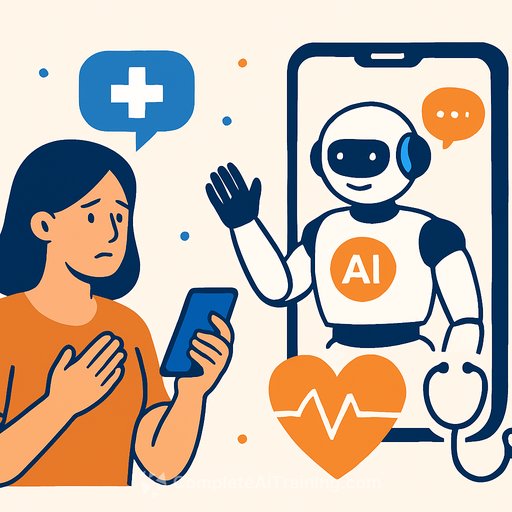
AI in Healthcare Market: What Healthcare Marketers Need to Know (2026-2033)
The AI in healthcare market is set for strong growth through 2033, with major momentum across clinical, operational, and patient engagement use cases. Names you know-GE Healthcare, Cerner, Optum, Medtronic-sit alongside IBM, Microsoft, Google Health, AWS, NVIDIA, Siemens Healthineers, Philips, and Epic Systems.
If you lead healthcare marketing, this isn't a tech footnote. It reshapes budgets, buying committees, and the stories you tell patients, clinicians, and payers. Here's the practical readout and how to act on it.
Why growth is accelerating
- Clinical demand: Decision support and imaging AI cut time-to-diagnosis and reduce variability in care.
- Workforce pressure: Staffing shortages push automation in admin workflows, triage, and patient support.
- Cloud + compute: Mature GPU stacks and managed services lower build and deployment friction.
- Value-based care: Payers and providers seek earlier risk detection and lower total cost of care.
- Interoperability gains: Tighter EHR, claims, and device data connections = better model inputs.
- Regulatory clarity: Guidance for AI/ML in medical devices is improving, helping procurement move faster (FDA, WHO).
- Patient expectations: Virtual care, proactive outreach, and personalized experiences are now table stakes.
Where the budget is flowing (key segments)
- Clinical Decision Support - Triage, risk scores, and care pathway guidance.
- Medical Imaging - Detection, prioritization, and workload orchestration.
- Patient Management - Intake, scheduling, education, and engagement.
- Drug Discovery - Target ID, trial optimization, and biomarker discovery; see AI Learning Path for Biochemists.
- Personalized Medicine - Companion diagnostics and tailored therapy selection.
- Virtual Health Assistants - Symptom checkers, FAQs, and navigation support.
- Administrative Workflow Automation - Coding, prior auth, and revenue cycle.
- Remote Patient Monitoring - Alerts, adherence, and care-team escalation.
Who's building the stack
- IBM, Google Health, Microsoft, Amazon Web Services
- Siemens Healthineers, Philips Healthcare, GE Healthcare
- Cerner Corporation, Optum, Epic Systems
- Medtronic, NVIDIA
Regional outlook
- North America: Strongest adoption curves, mature reimbursement experiments, and deep cloud partnerships.
- Europe: Solid hospital adoption with tighter privacy rules and country-by-country procurement nuances.
- Asia-Pacific: Fast growth in imaging, RPM, and hospital automation; diverse regulatory timelines.
- South America: Select deployments focused on access, imaging backlogs, and cost reduction.
- Middle East & Africa: Targeted investments in flagship systems and national health programs.
What this means for healthcare marketing teams
Your message will meet a buyer team that now includes clinical leadership, IT, compliance, finance, and operations. You'll need proof, precision, and clear ROI-without overselling.
- Map use cases to P&L: Connect claims, denials, readmissions, cycle times, and bed turnover to the story you tell.
- Lead with outcomes: Time-to-read reduction, triage accuracy, appointment throughput, or cost-per-resolution.
- Be specific about data: EHR integrations, device feeds, PHI handling, and de-identification workflows.
- Address risk upfront: Bias testing, human-in-the-loop, failure modes, and model update cadence.
- Explain deployment: On-prem, cloud, or hybrid; change management; training plans; and go-live timelines.
- Patient trust: Plain-language explanations of how AI is used in care and who oversees it.
Vendor evaluation checklist (share with your buyers)
- Clinical validation: Peer-reviewed studies, real-world evidence, and performance vs. standard of care.
- Workflow fit: EHR integration (HL7/FHIR), single sign-on, and minimal clicks for clinicians.
- Security & compliance: HIPAA, SOC 2, HITRUST; audit trails and role-based access.
- Explainability: Transparent outputs and confidence levels where clinically relevant.
- Governance: Model monitoring, drift detection, and documented update processes.
- Economic case: Baseline metrics, projected impact, and time-to-value under 6-12 months.
- Support: Training, adoption services, and measurable SLAs post go-live.
- Total cost: License, implementation, integration, and maintenance in one view.
Quick wins you can launch this quarter
- AI-assisted triage FAQs for service lines with high call volumes; measure deflection and patient CSAT.
- Backlog alerts in imaging with proactive messaging to set expectations and reduce no-shows.
- RPM engagement sequences triggered by risk scores; track adherence and escalation rates.
- Revenue cycle automation pilots for prior auth or coding; report on days in A/R and denial rates - consider the AI Learning Path for Medical Billers to align clinical and billing workflows.
- Clinical content co-pilot with medical review; speed up content ops while maintaining accuracy.
Market scope and methodology note
Recent industry research covering 2026-2033 points to broad adoption across providers, payers, and life sciences. Findings blend secondary data and interviews with market participants, with segment-level analysis across clinical, operational, and patient-facing use cases. Treat any forecast as a scenario: validate assumptions with your own volumes, payer mix, and tech constraints.
Resources
- Regulatory context for AI/ML in medical devices: FDA guidance hub
- Ethics and governance framework for AI in health: WHO report
- Upskilling for marketing teams: AI Learning Path for Business Unit Managers
The bottom line: AI is moving from pilot to line item. If your messaging quantifies impact, addresses risk clearly, and shows how the tech fits clinical workflows, you'll win the room-and the budget.
Your membership also unlocks: