
AI news ·
AI in Logistics and Supply Chain Management Market Set to Soar to $742 Billion by 2034: Key Trends and Growth Strategies
The AI logistics and supply chain market is set to grow from $24.19B in 2024 to $742.37B by 2034, driven by machine learning and cloud-based solutions. Key sectors include automotive and healthcare, with North America leading growth.
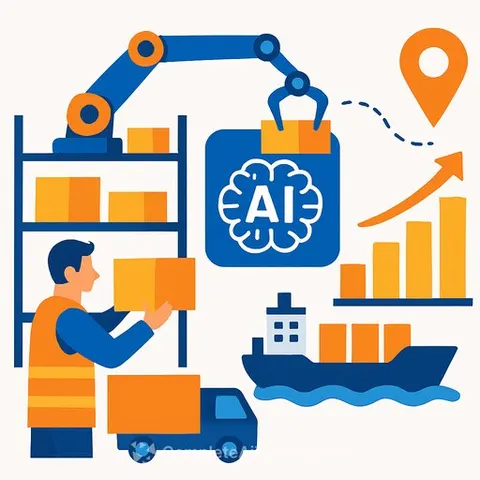
AI in Logistics and Supply Chain Management: Market Opportunities and Strategies to 2034
The AI in logistics and supply chain management market is on track for significant growth, expanding from $24.19 billion in 2024 to an expected $742.37 billion by 2034. This surge reflects a compound annual growth rate (CAGR) of around 40.8%, driven by innovations that streamline operations and improve decision-making across the supply chain.
This market is fairly fragmented, with many small players scattered globally. The top ten competitors held just 17.5% of the market in 2023, highlighting opportunities for new entrants and smaller firms to grow. Leading companies include GEP, Blue Yonder, and Infor, among others.
Market Segmentation Overview
- By Offering: Solutions dominate with 79.95% of the market share ($19.34 billion in 2024), while services are expected to grow fastest with a CAGR of 44.12% from 2024 to 2029.
- By Type: Machine learning leads, accounting for 43.08% of the market ($10.42 billion in 2024). Context-aware computing is the fastest growing segment, projected to expand at 46.94% CAGR.
- By Deployment: Cloud-based solutions hold 62.39% of the market ($15.09 billion in 2024) and are set to grow at 44.22% CAGR through 2029.
- By Application: Supply chain planning represents the largest segment with 32.5% market share ($7.86 billion in 2024). Warehouse management is the fastest growing, expected to grow at 50.5% CAGR.
- By End User: Automotive leads with 27.28% ($6.6 billion in 2024). Healthcare is growing fastest, at 51.56% CAGR.
Regional Market Insights
North America remains the largest market, accounting for 41.85% or $10.12 billion in 2024. Asia Pacific and Western Europe follow, with Asia Pacific expected to grow at 47.44% CAGR and Western Europe at 44.39%. Middle East and Africa are also showing strong growth potential with CAGRs above 42%.
Emerging Strategies in AI for Logistics and Supply Chain
Companies are focusing on:
- Developing AI-driven order allocation and fleet optimization tools.
- Creating SaaS platforms to improve logistics and supply chain operations.
- Leveraging AI-powered platforms for real-time inventory and risk management.
- Forming strategic partnerships to expand distribution networks.
- Targeting growth sectors such as healthcare and automotive with tailored AI solutions.
Key Market Opportunities
- Solution Segment: Expected to add $84.76 billion in annual sales by 2029.
- Machine Learning: Projected to reach $49.83 billion in sales by 2029.
- Cloud-based Deployment: Anticipated to gain $79.09 billion by 2029.
- Supply Chain Planning Applications: Forecasted to hit $38.86 billion by 2029.
- Automotive End User: Expected to add $31.37 billion by 2029.
- Geographic Growth: The U.S. market alone will see the largest gains, with $31.21 billion added.
Important Market Trends
- AI-driven order allocation and optimization enhance supply chain efficiency.
- Fleet optimization powered by AI improves logistics operations.
- AI platforms streamline inventory management and operational workflows.
- Route optimization SaaS solutions support better logistics planning.
- AI-based supply chain management platforms reduce risks and improve responsiveness.
Notable Mergers and Acquisitions
- Demand Chain AI Inc. acquired Replan.
- Exiger acquired XSB and Versed AI.
- Singing Machine Company acquired SemiCab.
- Accenture Plc acquired Flo Group and Trancom ITS.
For managers looking to enhance supply chain performance, investing in AI solutions can unlock substantial efficiency gains and cost savings. Cloud-based platforms offer scalability, while machine learning and context-aware computing improve forecasting and decision-making accuracy.
To stay competitive, companies should focus on developing AI-powered tools that optimize order fulfillment, fleet management, and warehouse operations. Strategic partnerships will also be key to expanding market reach and accelerating innovation.
For those interested in building expertise in AI applications for logistics and supply chain management, Complete AI Training offers a range of courses tailored to different skill levels and roles.