AI in Rural Healthcare: Promise, pitfalls, and a practical path forward
AI can extend care into places where clinics are thin, clinicians are stretched, and patients travel hours for basic services. But without transparency and unbiased algorithms, the same tools meant to help can widen gaps.
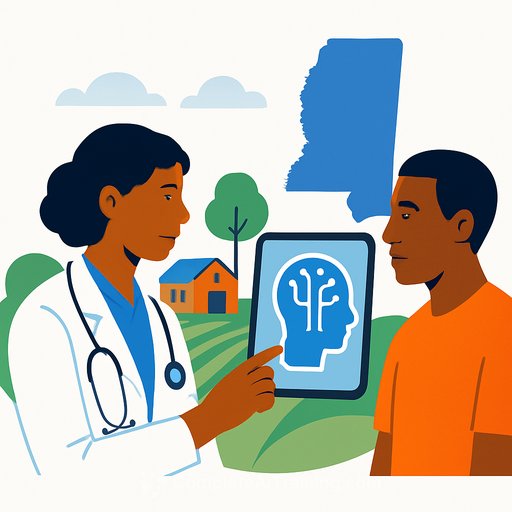
Rural communities, including many across Mississippi, face financing constraints, staffing shortages, and limited access to specialists. Telemedicine helped during the pandemic and still has room to grow; AI can support it-if we build it with guardrails.
Why rural teams are exploring AI
- Workforce gaps: automate documentation, triage, and patient education to free clinician time.
- Distance barriers: remote monitoring and decision support for chronic disease between visits.
- Language and literacy: consistent education materials and translation at a patient's level.
- Mental health access: expanded virtual touchpoints with careful safety controls.
Bias already exists-AI can inherit it
Health outcomes vary by income, education, location, insurance status, and more. Minority communities carry a heavier burden across many of these drivers, which shows up in outcomes and experience of care.
We've also learned that devices and calculators can encode bias. Pulse oximeters have shown reduced accuracy for patients with darker skin tones (NEJM letter). And the eGFR race adjustment delayed referrals and transplants for Black patients; guidelines now remove race and rely on biologic markers (NKF/ASN).
AI trained on biased data will repeat those errors at scale. That makes dataset composition, subgroup performance, and ongoing auditing non-negotiable.
Data transparency and model provenance
Experts flag blind spots: low-resolution imaging, inconsistent documentation, and regional practice variation. If those gaps inform models, outputs will skew-often against the very patients rural clinicians serve.
Ask vendors to disclose data sources, time ranges, geographies, and demographics. If they can't, you can't trust the claims.
Practical guardrails for clinicians and health systems
- Governance: Stand up a multidisciplinary AI committee (clinicians, quality, IT, legal, community reps) with approval authority.
- Bias checks: Require subgroup performance metrics and independent validation before go-live; recheck quarterly.
- Data stewardship: Verify HIPAA compliance, PHI handling, encryption, retention, and de-identification processes.
- Procurement basics: Get model versioning, audit logs, and clear off-ramps if safety signals emerge.
- Consent and transparency: Notify patients when AI is used (e.g., scribe, triage), and give an opt-out path.
- Human in the loop: Require clinician review for any recommendation that can alter diagnosis, treatment, or disposition.
- Fallback plans: Keep clear criteria for in-person evaluation, transfer, or airlift; tech augments, it doesn't replace hands-on care.
- Measure impact: Track equity, safety, cost, and experience-not just throughput.
Use cases worth piloting now
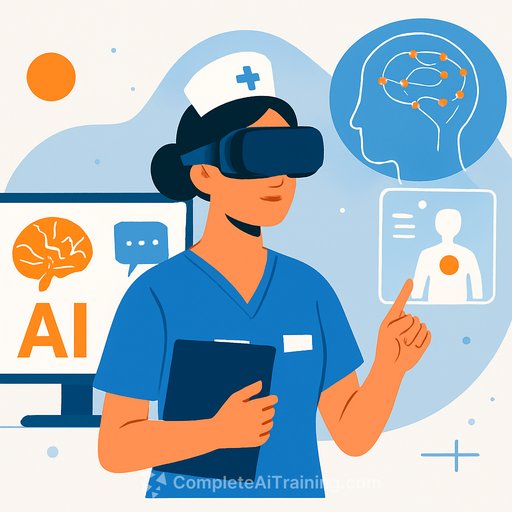
- Virtual nurse education: Avatars or guided videos that explain meds and self-care at the patient's reading level, available 24/7.
- Chronic disease support: Remote monitoring plus nudges for blood pressure, diabetes, COPD-with escalation rules to clinicians.
- Language services: Real-time translation paired with human interpreter backup for consent and critical conversations.
- Documentation scribe: Ambient notes with explicit patient notice, clinician verification, and PHI safeguards.
- Predictive flags: Readmission and no-show risk to prioritize outreach, audited for fairness.
Mental health: move, but with strict safeguards
General-purpose chatbots are not built as clinical tools and are not regulated as therapists. Reports have shown unsafe responses leading to severe harms; that is unacceptable in care settings.
- Use only clinically developed, safety-tested tools with crisis protocols and escalation to licensed professionals.
- Block self-harm instructions, log safety events, and integrate with local resources and 988.
- Never substitute a generic chatbot for clinical judgment; keep clear supervision and documentation.
Rural implementation playbook
- Infrastructure first: Broadband, device access, and IT support for clinics and patients.
- Team training: Short, role-based modules for clinicians, nurses, front desk, and community health workers.
- Workflow fit: Pilot in one clinic and one service line, then scale with lessons learned.
- Reimbursement: Map CPT/HCPCS codes for telehealth, RPM, CCM, and new AI-assisted services.
- Community partners: Libraries, schools, churches for digital literacy and private spaces for telehealth.
What to ask every AI vendor
- What data trained the model? Which hospitals, timeframes, imaging specs, and demographics?
- How does performance differ by age, sex, race/ethnicity, language, insurance type, and clinic site?
- Is it FDA-cleared or registered as Software as a Medical Device? If not, why is it safe for this use?
- Where is PHI stored and processed? Is data used to retrain? Can we opt out?
- Do we get audit logs, version control, and a way to disable features quickly?
- What is the documented failure mode and our mitigation plan?
Measuring equity impact from day one
- Segmented outcomes: Track accuracy, time to treatment, referrals, and adherence by demographic and site.
- Process markers: Patient consent rates, AI overrides, escalation frequency, and documentation quality.
- Experience: Patient and staff feedback, especially from underserved groups.
- Continuous updates: Retire features that underperform; improve models with diverse, high-quality data.
Bottom line
AI won't replace the need for hands-on exams, surgeons, or air transport. But used wisely, it can extend scarce staff, reduce friction, and close gaps-especially in rural clinics.
Start small, prove safety and equity, earn trust, and scale what works. That's how we improve access without leaving anyone behind.
Need to upskill your team on AI basics and safety? Explore role-specific options at Complete AI Training.
Your membership also unlocks: