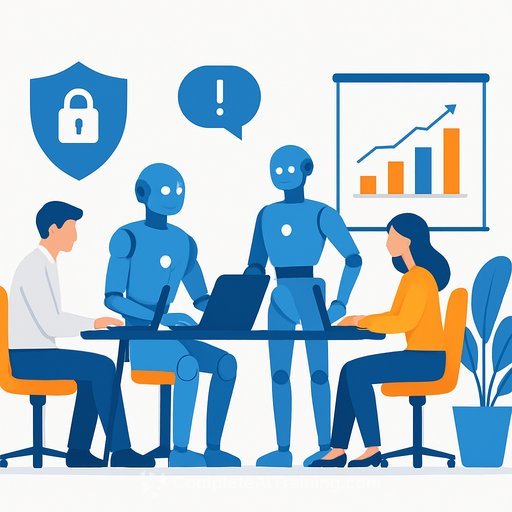
Generative and agentic AI in security: What CISOs need to know
AI now sits inside nearly every security tool you buy. That's useful-until the gap between promised autonomy and what you can actually govern puts the business at risk. The issue isn't adoption; it's control.
When "AI-powered" becomes a liability
Vendors are racing to wire generative and agentic AI into detection, response, and remediation. The pitch is speed and scale; the risk is opaque logic, model drift, and actions taken without clear accountability. Agentic systems can block users, flip configs, or launch workflows in seconds. Without guardrails, small errors compound into outages and incidents.
Why traditional buying criteria fall short
Detection accuracy, features, and price still matter. But they don't answer how decisions are made, how data is protected, how behavior is monitored over time, or how automation is constrained when risk spikes. That's black-box risk.
AI Trust, Risk and Security Management (TRiSM) shifts focus from policies on paper to controls in code. It's continuous, enforceable, and designed for systems that learn, adapt, and act on their own.
From policy to enforceable control
Policies, training, and ethics committees help, but they don't scale to real-time decisions. Put controls in the path of action. Validate data before use, monitor model and agent behavior as it evolves, enforce policies contextually, and log everything for audit and response. If the system can act, the system must also be stoppable.
Guardian capabilities: an independent control layer
Think of a "guardian" as a separate layer that watches, rates, and can stop AI behavior-without asking the AI for permission. It sets hard limits, approves or rejects actions, and maintains an audit trail you can trust. Separation of duties is the point.
- Pre-execution checks: risk scoring, policy evaluation, least-privilege validation.
- Runtime controls: rate limits, scope boundaries, output filters, allow/deny lists.
- Kill switch: immediate rollback and isolation if drift or abuse is detected.
- Full traceability: prompts, inputs, decisions, actions, and human overrides captured.
Keep AI smaller, safer, and scoped
Resist the urge to grant broad autonomy. Use narrow, task-specific agents with clear objectives, limited permissions, and time-bound sessions. Start in "read/alert" mode, graduate to "recommend/approve," and only then to "act/rollback." Make safe defaults the norm and require explicit promotion to higher-risk states.
Procurement questions that expose risk
- How is decision logic traced end-to-end, and can we replay it for audit?
- What triggers human-in-the-loop, and how are thresholds tuned over time?
- How are training, fine-tuning, and inference data separated and protected? What's retained?
- How are model and agent versions managed, tested, and rolled back?
- What red teaming and safety evaluations are run continuously (e.g., prompt injection, data exfiltration, jailbreaks)?
- How are automated actions authorized (RBAC/ABAC), and can we enforce policy-as-code externally?
- Can we stage, canary, and gradually expand autonomy by asset or group?
- What third-party models and services are used, and how are their risks monitored?
- Is there a safe mode that only alerts and a hard stop if error costs exceed a set threshold?
- How are AI-caused incidents detected, declared, contained, and reported?
Controls to implement now
- AI inventory and owners: who is accountable, what it does, where it runs, what it can touch.
- Autonomy classes: alert-only, recommend/approve, act/rollback-mapped to risk tiers.
- Policy-as-code: central guardrails that check identity, data sensitivity, and action scope.
- Data hygiene: allow/deny sources, PII masking, DLP on prompts and outputs.
- Prompt governance: templates, signed prompts, and secrets stripped by default.
- Observability: telemetry for prompts, decisions, actions, drift, and user overrides.
- Segregation of duties: independent guardian layer with kill switch and immutable logs.
- Change control: staging, canaries, rollback plans, and blast-radius limits.
- Adversarial testing: continuous red teaming against agents and integrations.
- Runbook parity: a human path for every automated action.
Metrics that matter
- Automation success rate vs. rollback rate, by autonomy class.
- Mean time to detect and correct AI error (MTTD/MTTC).
- % of automated actions with human approval vs. post-action override.
- Drift alerts acknowledged and resolved per period.
- Incidents triggered or amplified by AI vs. incidents prevented.
- Data egress and policy violations blocked by guardian controls.
Culture and accountability
Assign ownership for every AI system: a product owner, a security owner, and a risk owner. Make risk thresholds explicit and visible. Reward teams for safe rollbacks and near-miss reporting, not just for automation rates. Accountability turns ambiguity into process.
Useful external references
For structured guidance, review the NIST AI Risk Management Framework and the OWASP Top 10 for LLM Applications. Use them to standardize assessments, testing, and guardrails across vendors.
Bottom line
Speed without oversight is risk disguised as progress. The advantage goes to teams that install enforceable controls, insist on transparency, and run an independent guardian layer. Keep agents small, permissions tight, and autonomy earned-not assumed. That's how AI becomes a security asset, not another incident waiting to happen.
Your membership also unlocks: