College education still pays in the AI era-UHERO analysis highlights why
January 22, 2026 * Reading time: 2 minutes
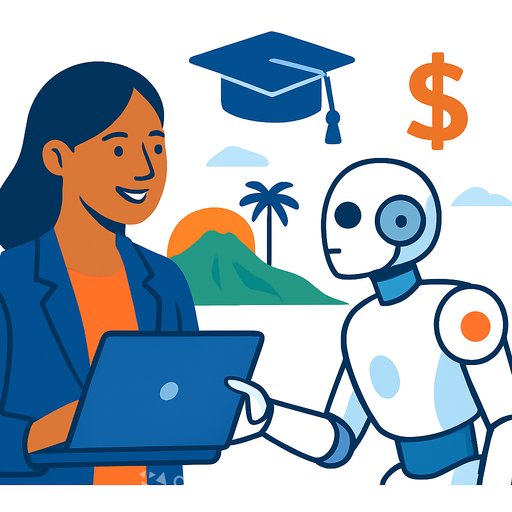
AI is changing the nature of work, but a college education still gives workers a clear edge. New analysis from University of Hawaiʻi at Mānoa economists (UHERO) finds persistent advantages for degree holders: higher wages, broader career options and better adaptability as tools roll into day-to-day tasks.
Jobs with the highest AI exposure tend to be knowledge-intensive and higher paying-often requiring a bachelor's degree. In Hawaiʻi, roles with the most exposure show median wages above $80,000, compared with under $60,000 for jobs with the lowest exposure.
The takeaway isn't mass replacement. AI is more likely to change how work gets done by automating routine tasks and complementing work that relies on judgment, problem-solving and decision-making-the kinds of skills cultivated in postsecondary education. That shift can raise productivity and, in many cases, increase demand for workers who can use these tools well.
About 39,000 workers in Hawaiʻi-roughly 7% of total employment-are in occupations within the top 10% of AI exposure, below the national share of 11%. This reflects the state's industry mix, with a larger footprint in tourism and service roles that tend to have lower exposure. A recent U.S. Treasury analysis ranks Hawaiʻi 32nd among states for AI exposure.
Why this matters for education, science and research
- AI favors skills that colleges already cultivate: critical thinking, domain expertise, and the ability to frame and solve open-ended problems.
- Degree pathways continue to connect learners to higher-wage, more adaptable roles-especially in professional, scientific and technical fields.
- Program design now matters more: graduates need both theory and tool fluency to keep pace as task mixes shift.
Signals from the labor market
Job postings that list AI skills are rising nationally and in Hawaiʻi, with the strongest growth in professional, scientific and technical services. Projections indicate that education beyond high school will be required for about 70% of jobs in Hawaiʻi by 2031, reinforcing the long-term value of postsecondary training.
What institutions and research teams can do next
- Embed AI literacy across majors: data basics, prompt quality, validation, ethics and privacy.
- Prioritize judgment-heavy work: case studies, open-ended projects and cross-disciplinary problem sets.
- Pair theory with tools: require hands-on labs where students apply AI to real datasets and workflows.
- Co-design with employers: refresh advisory boards; source live projects from local firms and agencies.
- Offer stackable options: short microcredentials that sit alongside degrees and refresh skills quickly.
- Invest in faculty development: shared resources, teaching playbooks and small grants for course redesign.
- Track exposure: use occupation-level task data to identify where curricula need the biggest updates.
- Keep equity front and center: ensure access to tools, build support for first-gen and adult learners.
Bottom line
AI is changing tasks unevenly across sectors, but it isn't reducing the value of higher education. If anything, it raises the premium on adaptable skills and the capacity to learn new tools over time.
Read the entire blog on the UHERO website. UHERO is housed in UH Mānoa's College of Social Sciences.
Looking to upskill teams quickly? Explore practical, up-to-date AI coursework and certifications: AI Productivity Courses, AI Research Courses, and an AI Learning Path for Primary School Teachers.
Your membership also unlocks: