AI-forged art paperwork is flooding claims: what insurers need to do now
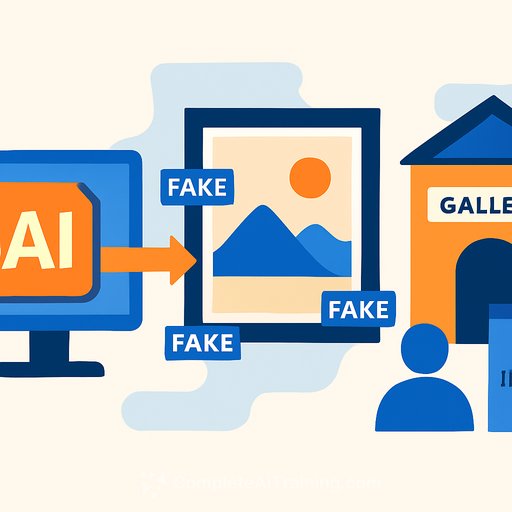
AI is accelerating a familiar fraud. Forgers are producing sales invoices, valuation letters, certificates of authenticity, and provenance files that look clean, read smoothly, and pass a quick glance. Loss adjusters are now finding identical descriptions across "different" works, fake signatures, invented provenance, and doctored stamps inside claim packs.
The volume is rising fast. And it's changing how people file claims, seek valuations, and defend ownership. If your team still relies on vibe checks and brand letterheads, you're exposed.
What's actually happening
Fraudsters are using chatbots and large language models to draft the paperwork. Some cases are intentional. Others start with a bad prompt that "hallucinates" archives or sales that never happened-and those errors get printed as fact.
Provenance-the chain of ownership-is the fulcrum for value. Corrupt it, and value collapses. That's why forged stamps, ledger numbers, and staged photos remain common. The playbook isn't new; AI just makes it faster and more convincing.
Signals from the field
Loss adjusters report batches of "valuation certificates" with identical descriptions for different artworks. That single pattern is enough to question the entire pack.
Broker insights echo the same theme: AI makes drafting fakes easier, and the text reads cleaner. Experts have seen AI-fabricated signatures added to images to prop up a story. Historical tactics still show up too-think staged photography and fake Nazi-era stamps, the kind exposed in the Wolfgang Beltracchi case.
Why this matters for insurers
AI removes the bottleneck of inventing a fake expert. It produces credible text on demand. That means more claim volume, better-looking paperwork, and fewer obvious tells.
Text-level "weirdness" is fading. As one adjuster put it, we're close to the point where you can't just read a document and sense something's off. You need structured checks.
Red flags to train into your triage
- Repeated phrasing: identical or near-identical descriptions across multiple works.
- Inconsistent specifics: medium, dimensions, dates, or condition notes that don't align with images.
- Perfect layout, zero texture: clinical language, no typos, no marginalia on "old" documents.
- Missing third-party anchors: no auction records, no catalogue raisonné references, vague gallery names.
- Odd metadata: creation dates that predate referenced events, PDF producers tied to AI tools, missing edit history.
- Image anomalies: signatures that look copy-pasted, uniform lighting on "archival" photos, mismatched paper aging.
A practical claims playbook
1) Intake and structure
- Require a standardized provenance pack: invoices, ownership chain, expert opinions, exhibition history, and publication references.
- Demand original-resolution images of the work, labels, backs, signatures, stamps, and frames.
- Capture source details for each document: issuer, date, contact, and verification method.
2) First-pass screening
- Run text similarity checks across all documents in the claim file to spot templated language.
- Inspect PDF properties and image metadata for tool signatures, inconsistent timestamps, and batch generation.
- Cross-check artist, title, and sale claims against public databases and catalogues. Use negative confirmation: "absence of record" is a finding, not a greenlight.
3) Provenance verification
- Contact issuing galleries, experts, and dealers directly. Confirm ledger numbers and letterheads.
- Validate auction claims against sale catalogues and price databases. Require page scans, not just text.
- Escalate to provenance researchers for high-value or historically sensitive periods (e.g., war-era transfers). See Research for methods and case studies on AI forensics and provenance verification.
4) Digital forensics
- Check for incremental saves in PDFs and image edit layers that conflict with claimed dates.
- Look for cloned patterns in signatures or stamps; compare across known exemplars.
- Require original file containers when possible; ask for RAW images for new documentation.
5) SIU and documentation hygiene
- Route claims with 2+ red flags to SIU for deeper review and recorded interviews.
- Maintain a library of trusted exemplars: genuine COAs, dealer letterheads, museum labels, and stamp styles by era.
- Record every verification touchpoint and outcome. You'll need the audit trail for declinatures and recoveries.
Underwriting and policy language to update
- Disclosure and documentation warranties: misrepresentation voids coverage; require source-verifiable provenance.
- Pre-bind due diligence: for schedules over a threshold, require third-party valuations and independent provenance checks.
- Endorse AI-generated documents: carrier may request originals or confirm with issuers; failure to comply affects coverage.
- Conditions precedent for high-value items: catalogue raisonné listing or recognized expert opinion where applicable.
- Fraud clauses: clarify use of artificial means to fabricate documents as fraud, with recovery rights.
Controls for galleries, brokers, and custodians
- Adopt content provenance tech (cryptographic signing for images and PDFs) to create verifiable trails. See the open standard by the C2PA.
- Centralize records and issue digitally signed COAs. Maintain chain-of-custody logs for movements and condition checks.
- Train staff to spot AI "confidence wording" and fabricated references. Require contactable issuing parties for all third-party documents.
Where to verify provenance claims
- Catalogue raisonnés and publisher archives for the artist.
- Auction house records and sale catalogues; ask for page scans.
- Stolen art databases, such as the Art Loss Register.
What to watch next
Text will keep getting harder to flag. Expect more convincing images, better fake stamps, and "expert letters" that read perfectly. Your edge will come from process, not gut feel-structured intake, metadata checks, third-party confirmations, and clear policy terms.
If your team needs sharper skills on AI red flags and document forensics, consider targeted training. A practical starting point: AI courses by job function.
Bottom line
AI didn't invent art fraud. It removed the friction. Build a repeatable verification playbook now-or expect higher loss ratios and messier disputes later.
Your membership also unlocks: