AI In Canadian Healthcare: Practical Wins, Real Risks, and What To Do Next
AI is showing up across Canadian healthcare in ways that actually help. Used well, it buys back time, reduces missed risk, and supports better decisions. Used poorly, it adds noise and risk. The difference is in the implementation.
Where AI Already Helps: Medical Scribes
One of the most effective tools in clinics today is the AI scribe. It listens to the patient-clinician conversation, drafts structured notes, and frees doctors from typing while trying to maintain eye contact.
As Dr. Muhammad Mamdani explains, documenting during the visit is distracting for everyone. With AI scribes, physicians can focus on the person in front of them and review the note after. Practices using scribes report saving roughly three to four hours per week.
Is it perfect? No. Mishears happen. But most clinicians find the time saved is worth the quick review. The workflow is simple: enable the scribe, confirm the note, sign off.
Clinical Impact: Early Risk Detection On The Wards
At Unity Health in Toronto, an AI model monitors general internal medicine and general surgery patients hourly. It ingests 150-170 parameters and flags those at high risk of ICU transfer or death within 48 hours. When the threshold is hit, the medical team is paged and must assess the patient within an hour.
According to a study published in the Canadian Medical Association Journal, the program has been linked with a 26% reduction in unexpected mortality. These tools don't replace clinical judgment-they surface risk earlier so teams can act sooner.
Canadian Medical Association Journal
Chatbots Are Not Care
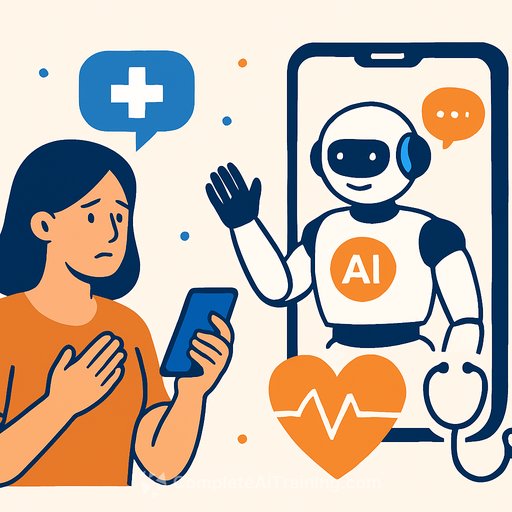
Patients are using tools like ChatGPT to self-diagnose. That can be helpful for general information, but it's no substitute for an assessment by a trained clinician. As Dr. Margot Burnell of the Canadian Medical Association notes, care depends on trust, empathy, and understanding a patient's goals-things a chatbot can't provide.
There's another issue: people turn to online advice when they don't have access to a primary care provider. Surveys show many Canadians use social media or AI for guidance, and a subset report harm-delayed diagnoses, complications, and conflict at home. The fix isn't better bots. It's access to trusted care teams.
The System Problem AI Can Ease
Wait times are long. Many people can't find a family doctor. Millions miss needed mental health support. And 15% of emergency visits in 2023-24 were for issues that could likely be managed in primary care. Clinicians are stretched thin and doing the work of multiple roles.
Used carefully, AI can reduce administrative drag, improve triage, and surface risk earlier. That's not hype. It's matching tools to bottlenecks.
Canadian Institute for Health Information (CIHI)
Guardrails That Matter: Privacy, Bias, Equity
Healthcare data is sensitive. Any AI rollout must clarify data ownership, consent, storage, retention, and vendor use. If the data doesn't have appropriate consent or governance, stop and fix that first.
Bias is another risk. Models trained on narrow populations will miss patterns in others. That can widen inequities if left unchecked. Monitor performance by demographic group, audit regularly, and give clinicians a simple way to override or correct model output.
What You Can Do This Quarter
- Start with administrative wins: trial an AI scribe in a few clinics, measure time saved, and track physician/patient satisfaction.
- Define review workflows: notes drafted by AI are clinician-edited, then signed. Keep it under two minutes per note.
- Pick one clinical signal: deploy a vetted early-warning model on a single ward with clear escalation protocols and ownership.
- Lock down privacy: ensure compliance with provincial privacy laws and PIPEDA, data residency in Canada if required, and explicit consent where applicable.
- Stand up governance: create an AI oversight group with clinicians, data leads, privacy, and patient reps to approve, monitor, and retire tools.
- Measure outcomes: track time saved, patient throughput, admission-to-assessment times, and hard outcomes like ICU transfers or unexpected mortality.
- Train your teams: short, role-specific upskilling on prompt use, bias, and safe workflows beats long generic training.
Bottom Line
AI won't replace clinicians. It can help them do the work they want to do: be present with patients, spot risk earlier, and move faster on the things that matter. Start small, measure everything, and protect privacy and equity at each step.
If you're building internal capability, this curated list can help you find role-specific upskilling options: AI courses by job.
Your membership also unlocks: