AI and Systematic Reviews: Faster Evidence Without Lowering the Bar
Systematic reviews sit at the top of evidence hierarchies. They guide treatments, vaccine policies, and environmental rules. The issue: they're slow, manual, and easy to outpace as literature grows.
New AI tools promise serious speed. If we keep standards tight, we can get timely answers without weakening trust. That tradeoff is the whole game.
What a Systematic Review Actually Involves
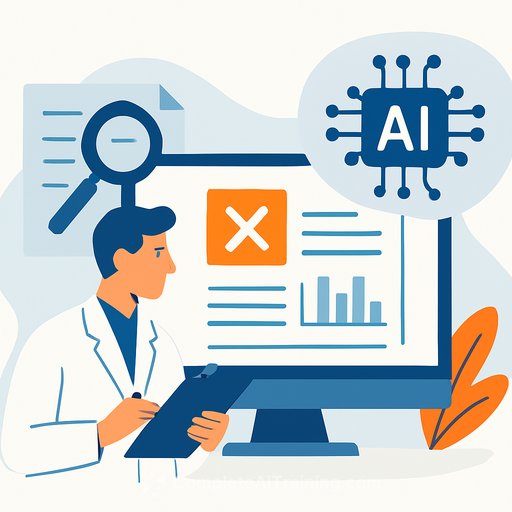
Teams define a precise question, search across databases, screen thousands of titles and abstracts, then extract and synthesize data from the final set. Every step is pre-specified and documented to limit bias and maximize reproducibility.
In medicine, this typically takes 10-14 months-sometimes years. During Covid-19, many reviews were outdated by publication. The literature is growing faster than our ability to summarize it.
Where AI Helps Today
Existing software already prioritizes likely-relevant abstracts to the top of the queue. Humans still decide inclusion; the model just orders the stack.
Generative tools go further. Systems like Elicit and SciSpace try to search, screen, and summarize. Others-such as Nested Knowledge-embed AI inside more controlled review workflows. The pitch: months of work in hours.
Standards Are Catching Up
Cochrane, the Campbell Collaboration, JBI, and the Collaboration for Environmental Evidence released RAISE (Responsible Use of AI in Evidence Synthesis) in November 2025. The message: use AI, but validate each use and keep humans accountable.
The guidance is intentionally cautious. It gives a green light to integrate AI while reminding teams to prove performance before trusting outputs.
Real Risks You Need to Manage
Reproducibility is shaky. The same prompt can return different studies on different days, and small wording tweaks can alter results. Black-box behavior makes auditing hard.
Coverage is incomplete. Many tools lean on open-access papers and don't reach paywalled databases, which skews evidence. If public repositories are altered or datasets are removed, the problem compounds.
Access is uneven. Some tools are geo-restricted or expensive, creating a gap between well-funded teams and everyone else. That gap can produce confident-sounding syntheses built on partial evidence.
A Pragmatic Workflow for Research Teams
- Lock a protocol first. Pre-register eligibility criteria, outcomes, and analysis plans.
- Use AI for prioritization and de-duplication; keep dual human screening for inclusion/exclusion.
- Version everything. Pin model versions, log prompts, seed values, and timestamps so runs are auditable.
- Benchmark before adoption. Test recall/precision on a known set; document false negatives rigorously.
- Track provenance. For every included study, retain database, search string, query date, and tool used.
- Expand coverage. Combine AI with licensed databases; add manual searches of conference abstracts and registries.
- Handle Translation with care. Use AI to translate titles/abstracts; verify key details with a bilingual reviewer.
- Keep humans on critical steps. Risk-of-bias assessments and data extraction need verification by trained reviewers.
- Plan for updates. Schedule living review cycles; rerun searches and document deltas in included evidence.
- Report limits. State model constraints, data access gaps, and any validation results in Methods.
What Changes If We Get This Right
Reviews could move from static snapshots to living summaries that refresh as new trials land. Funders are already thinking about near real-time aggregation of scientific data.
Language barriers would shrink, bringing more global evidence into scope. Researchers could spend less time triaging and more time interpreting.
Where Caution Is Warranted
High-stakes claims demand clear, verifiable evidence trails. Large systematic reviews have consistently found no link between vaccines and autism. That kind of conclusion should be auditable and reproducible-no mystery steps in the pipeline.
Policy decisions made on top of opaque, inconsistent syntheses will invite scrutiny and erode trust. Speed without transparency is a bad trade.
Signals to Watch in 2026
- Top journals publishing AI-assisted reviews with detailed validation and reproducibility appendices.
- Shared benchmarks for screening recall and error rates across tools and domains.
- Better access to databases and registries, plus stronger requirements for audit trails in Methods sections.
Bottom Line
AI can compress the slowest parts of evidence synthesis. Keep human judgment on the high-impact steps, validate each tool in context, and document everything. Faster and trustworthy can coexist-if rigor leads.
References and Useful Links
Build Team Capability
If you're evaluating tools for screening, translation, or literature triage, a curated view helps. See current options and ecosystems here: AI tool databases.
Your membership also unlocks: