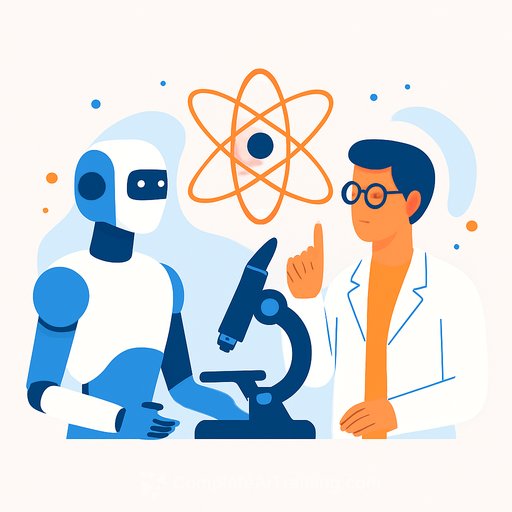
AI won't automate science - it can only amplify it
AI is moving into every lab and policy memo. Projects like the Genesis Mission, announced in late 2025, promise AI agents trained on federal datasets to test hypotheses and speed up discovery. The results so far are mixed: models can scan oceans of data and flag patterns, yet they also suggest experiments that miss context or feasibility. Useful? Yes. A full substitute for scientists? No.
Models learn from the worlds we build for them
AI doesn't learn from nature directly. It learns from datasets, benchmarks, and objectives created, cleaned, and judged by humans. The scientific "world" a model sees is a curated slice, and that curation sets its limits.
Take AlphaFold. Its protein-structure predictions changed how labs prioritize targets and run simulations, accelerating loops in biomedicine. But the model's value rests on decades of human-generated structures, methods, and theory that trained and validated it. No dataset, no breakthrough. And its outputs still need human interpretation and experiment to become knowledge.
As philosopher Emily Sullivan argues, model predictions must stay anchored to established findings. That anchor depends on two things you control: how much is already known in your field, and how well that knowledge is translated into code, features, and evaluation. Without that link, you get correlations without explanation.
Science is social, value-laden, and deeply human
Discovery isn't just data plus a model. It's judgment, disagreement, and alignment on standards across communities over time. The double-helix idea, for instance, began as expert reasoning long before decisive tests were possible-work later honored with a Nobel Prize. The point: inference, taste, and debate guide the path from hunch to evidence to consensus.
Scientists don't simply record facts; they build them through skilled practice, critique, and shared norms. Methods are chosen, thresholds are set, and trade-offs are weighed-all shaped by human aims and values. AI has no stake in those choices. You do.
Where AI actually helps your workflow
Used well, AI can reduce friction across the research cycle. Think: triaging literature, ranking hypotheses by plausibility and payoff, drafting experimental variants, checking code for edge cases, and spotting anomalies in streams of measurements. The gain is throughput and optionality-not automatic insight.
- Start with a precise scientific question and causal theory. Force the model to work within your assumptions, not beside them.
- Keep a strong empirical link: train and evaluate on gold-standard, documented datasets. Track provenance and known failure modes.
- Demand interpretability where decisions matter. Prefer features and prompts tied to mechanisms, not just predictive performance.
- Use models to propose, humans to dispose: prefilter ideas with AI, then apply domain judgment and feasibility checks.
- Treat model outputs as claims requiring replication, not results.
Guardrails for "AI scientists"
- Human-in-the-loop by design: require expert sign-off for hypotheses, protocols, and conclusions.
- Pre-registered benchmarks: fix tasks, metrics, and error budgets before model training; report ablations and negative results.
- Data governance: document curation, biases, and coverage; separate training, validation, and real-world evaluation.
- Mechanism checks: prefer hypotheses that make testable, risky predictions and connect to known mechanisms.
- Societal review: align research priorities with community standards and ethical constraints.
Replace scientists with agents and you get a caricature of science-fast outputs with weak accountability. Keep scientists in charge, and AI becomes a strong assistant that expands your search space while you control standards and meaning.
Further reading and tools
If you work with protein structure, start here: AlphaFold overview. For a deeper look at how social practice shapes knowledge, see the Stanford Encyclopedia of Philosophy: Social Dimensions of Scientific Knowledge.
If you want structured upskilling on applying AI to analysis and automation in research workflows, explore: AI courses by job and AI certification for data analysis. For protein-focused practitioners, see the AI Learning Path for Biochemists.
Bottom line
AI can speed up parts of science, but it cannot replace the human craft of forming questions, arguing about methods, and deciding what counts as evidence. Keep the models close to data and closer to theory. Let them extend your reach, not your judgment.
Your membership also unlocks: