Courts Are Raising the Bar on AI Evidence
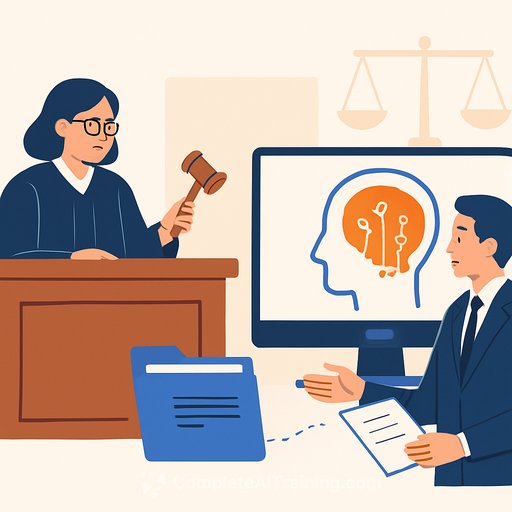
AI outputs are entering courtrooms, but judges aren't treating them like traditional evidence. They want reliability, transparency, and a clear trail from prompt to output. If your team relies on AI without those safeguards, expect pushback, limits on admissibility, or outright exclusion.
What judges are signaling
- AI outputs are not self-authenticating. You need foundations, not screenshots.
- Explainability matters. If you can't explain how the tool works and why it's trustworthy, you have a problem.
- Validation counts. Courts want testing data, error rates, and reproducibility, not marketing claims.
- Provenance is essential. Who prompted it, with what settings, and what changed along the way?
- Bias and fairness are live issues. If rights are on the line, expect scrutiny of training data and impact.
The evidentiary frame: treat AI like scientific or technical evidence
Assume your AI-derived material will be evaluated under the same logic as other expert-driven evidence. That means competent experts, proven methods, and a transparent basis for opinions. See the expert testimony standard for reliability and helpfulness to the trier of fact.
Federal Rule of Evidence 702 is the model here. If your expert can't defend the tool's method, limits, and error rates, your evidence is exposed.
Admissibility hurdles you should plan for
- Authentication (think FRE 901): Identify the system, version, and the exact process used. Show that the output is what you claim it is.
- Hearsay: Explain whether the AI output is an assertion, a machine-generated result, or part of an expert's opinion basis.
- Rule 403 balancing: If the AI looks authoritative but isn't validated, the risk of misleading the jury spikes.
- Confrontation and due process: In criminal cases, you'll face questions about the ability to challenge the source and method.
Build your AI evidence foundation: a practical checklist
- Disclose the tool: provider, model name, version, release date, and any fine-tuning or customizations.
- Capture the full context: system prompts, user prompts, temperature/top-p and other settings, seeds, and any attachments fed into the model.
- Preserve logs: timestamps, user IDs, hash values of inputs/outputs, and any post-processing steps.
- Validation file: test cases, ground truth comparisons, error rates, reproducibility steps, and limitations.
- Bias testing: describe datasets, fairness tests, and mitigation steps relevant to the case facts.
- Expert support: sponsor the output through a qualified expert who can explain method and reliability in plain language.
- Corroboration: pair AI outputs with traditional evidence-witness testimony, documents, or forensic data.
Authentication and chain of custody for AI outputs
Treat AI like a lab instrument. Document who did what, when, and with which configuration. Lock the record with verifiable logs and hash values. If you edited the output, show the edits.
Courts will ask for provenance. Be ready to walk through the exact steps that produced Exhibit A, including prompts, settings, and any filtering or summarization layers.
Reliability and validation: what judges want to see
- Method transparency: how the model generates answers and known failure modes.
- Representative testing: test data that matches the dispute context, not cherry-picked demos.
- Error analysis: false positive/negative rates and what that means for your claims.
- Reproducibility: a documented process that yields the same or materially similar results.
Anchoring your approach to recognized frameworks helps. The NIST AI Risk Management Framework offers a practical structure for measurement, monitoring, and documentation.
Bias, fairness, and due process
If the output affects liberty, status, or substantial rights, expect fairness questions. Be prepared to show why the system is suitable for the population at issue and how you checked for skewed results. In criminal cases, factor in disclosure duties and the ability of the defense to test the model's basis.
Discovery and disclosure: set expectations early
- Scope: agree on what metadata, logs, and settings will be exchanged.
- Protective orders: balance transparency with trade secrets; consider neutral expert access.
- Format: produce prompts, outputs, and logs in usable, searchable formats with hashes.
- Versioning: lock the model version for the matter; document any updates or patches.
Where AI works-and where it doesn't
- Useful: triage, lead generation, summarization with human verification, and quality checks that are later confirmed by independent evidence.
- Risky: standalone conclusions with no expert explanation, unverifiable classifications, or outputs that you can't reproduce and authenticate.
Vendor contracts: tighten the essentials
- Audit trail by design: prompt logging, version stamps, and exportable evidence packages.
- Testing rights: the ability to validate performance on your data and use cases.
- Support for testimony: access to technical docs and qualified witnesses if needed.
- Risk allocation: warranties about data handling and error handling, plus clear responsibility for defects.
A simple disclosure template you can adapt
- Tool and version: provider, model, release date, and customizations.
- Use case: the specific task performed (classification, translation, extraction, analysis).
- Inputs: data sources, prompts, settings, and any preprocessing.
- Outputs: the exact text or artifacts relied upon, with hashes and timestamps.
- Method: how results were generated, tested, and reviewed by humans.
- Limitations: known issues, error rates, and steps taken to reduce them.
- Expert: name, qualifications, opinions, and basis under Rule 702.
For judges and court staff
Expect more requests for neutral experts and structured disclosures. Consider standing orders that require parties to identify the AI system, provide configuration details, and supply validation summaries. Clear expectations upfront reduce motion practice and wasted hearings.
Bottom line
AI can help you work faster, but courts are asking a simple question: can we trust this, and why? Treat AI outputs like any other technical evidence-explain the method, show the testing, and preserve the paper trail. If you do that, your AI can support your case instead of becoming the fight.
Resources
Want your team fluent in AI basics?
If you need a quick way to level up staff on prompts, validation, and audit trails, see curated options here: AI courses by job.
Your membership also unlocks: