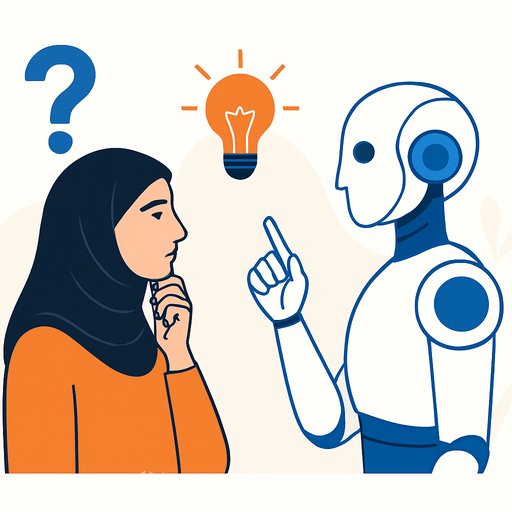
Questions About AI Arab Higher Education Should Be Asking
AI in higher education sparks excitement, anxiety, and everything in between. Some want to integrate it everywhere. Others would rather ignore it. Most sit in the middle-curious, cautious, and unsure where to draw the line.
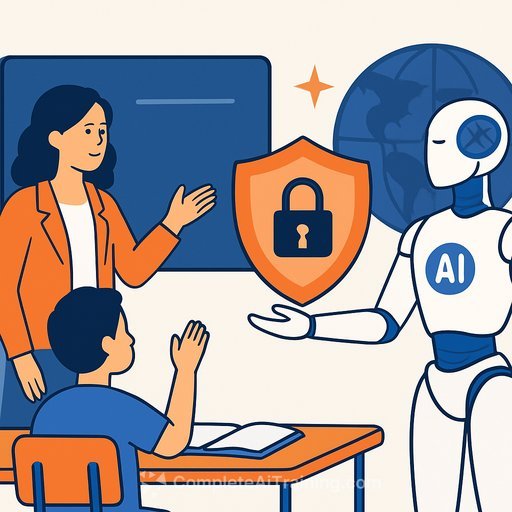
Here's a useful starting point: the European Union's AI Act classifies several education uses as "high risk," including systems that determine access, evaluate learning outcomes, assign students to levels, or monitor test behavior. If governments are flagging risk, institutions should slow down and ask better questions before rolling AI into classrooms and systems. See the EU AI Act and Unesco's reflection on AI's role in education here.
Is AI really inevitable?
AI exists. Students can access it. That doesn't make its influence on learning automatic or mandatory. Educators and administrators still set boundaries.
Adoption should follow investigation, not hype. It's reasonable to pause or even resist on principle, given the ethical trade-offs. No one should be shamed for drawing a hard line where values are at stake.
What risks do biases in AI pose for our context?
Bias is baked in. Training data skews toward English and western sources. Models are tuned with human feedback that reflects those same biases. And because LLMs predict "average" responses, minority perspectives get washed out.
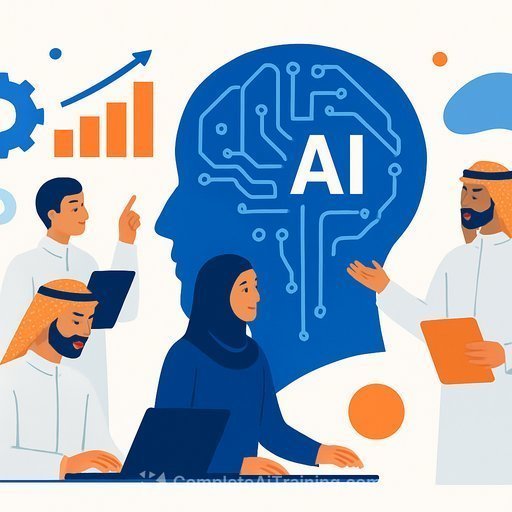
Evidence shows outputs align more with WEIRD cultures. That means responses will often mismatch contexts across the Arab region. Western-trained systems can also reproduce Islamophobic framings-even if they avoid direct stereotyping-while regionally trained models can respond differently.
There's another layer: feeding local or sacred knowledge into these systems raises sovereignty concerns. Once ingested, that knowledge can be reinterpreted through hidden fine-tuning and presented back as authoritative-without our consent or nuance.
Where bias matters most
- Students using AI: Over-trusting outputs leads to imported assumptions, subtle bias, and a quiet colonization of thought. Critical AI literacy is essential, because sources inside models are opaque.
- Teachers using AI: Lesson plans, examples, and feedback often presume western norms. Expect gaps, hallucinations, and a default to language that erases locality.
- Administrators using AI: Admissions filters and analytics can reproduce bias inside black boxes. Human accountability must stay in the loop.
What ideologies sit behind AI platforms?
These tools are built by companies with profit incentives, not by groups focused on student growth or public goods. Some visions pushing toward "general" systems also borrow from troubling ideologies that treat people as optimization problems.
Agentic AI raises further concerns. Tools that operate your browser or LMS can complete quizzes and assignments for students. That's convenient for cheating and surveillance, not for learning.
What do we lose with AI tutors?
AI tutors are fast and always available. They also hallucinate, even when trained on course materials. Speed is not the same as accuracy or care.
There's more at stake. Teaching assistantships fund graduate study and build future faculty capacity. Replacing them with bots removes income and vital teaching experience. Undergraduates also lose mentorship, empathy, and the social fabric that our collectivist cultures value.
Instant answers train impatience. Waiting, wrestling with a problem, and asking a human for help are part of how people grow. Remove that, and you shrink the learning experience to transactions.
Does using AI truly result in benefit?
Productivity claims are mixed. Oversight and correction often cancel out the time saved. And education isn't a factory line-productivity is not the point.
Personalization has been promised for years. What usually shows up is categorization, where software steers students based on averages from past users. That tightens control instead of giving learners agency. It also ignores social learning and dialogue, where deeper growth happens.
Adopt only with evidence. Pilot, measure, and look for unintended effects. If AI will be used in the workplace, then focus on critical AI literacy first-skills to question when to use a tool, how to validate outputs, and how to spot bias.
A practical decision framework for Arab higher education
Before adopting any AI tool
- Purpose: What learning or administrative outcome improves in clear, measurable terms?
- Risk level: Does this touch admissions, assessment, or student monitoring? If yes, treat as high risk.
- Evidence: What independent studies support claims of benefit in contexts like ours?
- Alternatives: Can a human process or simpler tool solve this with fewer trade-offs?
Data, bias, and context
- Data origin: Where was the model trained? How likely are western biases to dominate?
- Local fit: How will you adapt for language, culture, faith, and local law?
- Knowledge sovereignty: What data are you giving the vendor? Is sacred or community knowledge involved?
- Red-teaming: Who will test for Islamophobia, cultural erasure, and harmful stereotypes before rollout?
Governance and accountability
- Human oversight: Who is responsible for decisions the AI influences?
- Transparency: Will students know when AI is in use and how outputs are generated?
- Opt-outs: Can students and staff choose human-only pathways without penalty?
- Procurement: Do contracts cover data retention, model retraining, and local compliance?
Teaching and assessment
- Assessment design: Adjust tasks so AI cannot do the learning for students (e.g., oral defenses, iterative drafts, in-class creation).
- AI literacy: Teach verification, bias detection, citation, and when not to use AI.
- Equity: Avoid tools that advantage students who can pay for premium access.
- Community: Protect time for human mentorship, discussion, and peer learning.
Security and operations
- Agentic controls: Block tools that can act inside LMS or email without strict safeguards.
- Incident response: Define what happens when AI harms, leaks, or discriminates-and who fixes it.
- Continuous review: Set quarterly audits for accuracy, bias, and unintended consequences.
What to implement this semester
- Publish a short, plain-language AI policy for students and staff.
- Run a small, low-stakes pilot with clear success metrics and a bias checklist.
- Offer a 90-minute workshop on critical AI literacy for faculty and TAs.
- Redesign one major assessment to surface original thought and process, not just polished outputs.
- Maintain human-led office hours and peer tutoring to protect community and mentoring.
The core choice
AI doesn't decide how we teach. We do. Treat it as optional, context-dependent, and accountable to human values-especially in our region, where culture, faith, and community are core to learning.
Adopt with intention. Or don't adopt at all. Both are valid if they serve students.
Further reading
EU AI Act: high-risk uses in education
Unesco: AI and the Future of Education
If your team needs structured upskilling in critical AI use for academic settings, explore curated learning paths by role at Complete AI Training.
Your membership also unlocks: