AI isn't ready to be your doctor - here's what healthcare teams should do instead
AI is racing into clinics, radiology suites, and now directly into patients' phones. Some of it helps: image triage, documentation support, and back-office automation show promise. But medicine has a low tolerance for error, and today's systems still produce confident nonsense at the worst possible times.
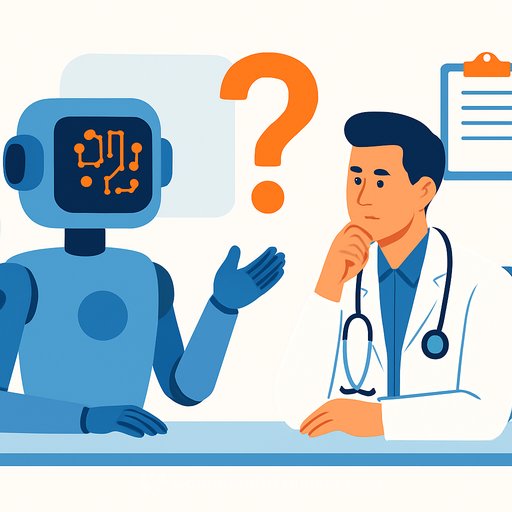
If you work in healthcare, the takeaway is simple: use AI as a tool, not an authority. Deploy it where it reliably reduces friction. Keep a human in charge everywhere else.
What's working (and where it breaks)
Radiology is seeing real gains. Studies show AI can flag cancers a human might miss and vice versa, enabling safer double-reads and selective workload reduction. Yet performance is inconsistent across cases and populations, which means blind trust is a risk.
On the device side, "smart" tools often add steps. A recent stethoscope study found clinical signal in heart failure detection, but 40% of practices abandoned the devices due to workflow burden. A tool that slows clinicians isn't progress, no matter the promise on paper.
Consumer chatbots are a special risk
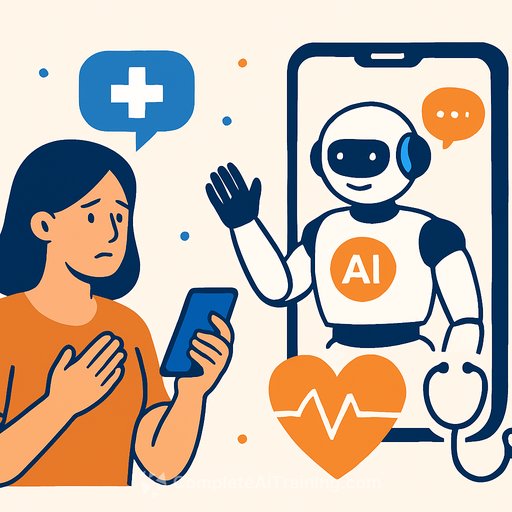
Direct-to-consumer apps like ChatGPT Health and Claude for Healthcare have been pitched to the public as helpful guides. The problem: users often treat fluent language as expertise. One tech columnist fed a decade of wearable data into a chatbot and got a dire cardiac warning; his cardiologist later confirmed he was in excellent health.
Vendors frame outputs as "general information," not medical advice. In practice, anxious users treat them as diagnoses. That gap can trigger unnecessary visits, delayed care, or misplaced confidence in a wrong answer.
Error rates aren't a nuisance in medicine - they're a hazard
Even AI optimists in cardiology and digital medicine agree: we need tighter testing, safety anchoring, and consistency before patient-facing use. Hallucinations, confident confabulations, and sycophantic agreement are common failure modes. Healthcare can't absorb those without downstream harm.
TV is picking up the pattern: an ER show recently portrayed an AI charting tool that fabricated an appendicitis history. Fiction aside, that dynamic is familiar to anyone who has had to proofread autogenerated notes line by line. Sometimes the "time-saver" adds work.
Regulatory and legal signals you shouldn't ignore
Most states still expect diagnoses to come from licensed clinicians after appropriate exams and histories. AI can inform decisions, but it shouldn't make them. The FDA's current stance exempts certain software aimed at education rather than diagnosis, and sets expectations for clinical decision support where clinicians remain in control.
FDA guidance on Clinical Decision Support is worth a read before any rollout. Also note pending litigation around payer use of algorithms for coverage determinations - a reminder that "assistive" can blur into "decisive" in ways that trigger real-world harm and liability.
Privacy, bias, and disappearing guardrails
Patients are uploading histories and lab results into chatbots without knowing how that data is stored, shared, or used against them later. Gaps or errors in what they share can skew outputs. Training data can also reflect cultural and clinical biases, which then show up in recommendations.
Meanwhile, disclaimers are vanishing from many tools. As language gets smoother, users over-trust it. That's a human-factors problem as much as a technical one, and it belongs on your risk register.
A practical playbook for clinical leaders
- Start with narrow, boring wins: Ambient scribing, eligibility checks, prior-auth packet assembly, and inbox triage with human review.
- Define non-negotiables: No autonomous diagnosis. No treatment plans without clinician sign-off. Clear escalation triggers for uncertainty or high-risk terms.
- Validate like a diagnostic: Prospective and retrospective tests, strong baselines, subgroup analysis for equity, and predefined safety thresholds.
- Keep a human in the loop: Name the accountable reviewer, document sign-off, and require second checks for high-stakes decisions.
- Make uncertainty visible: Force confidence estimates, show sources, and prohibit absolute language in patient-facing views.
- Minimize workflow friction: Pilot with time-and-motion studies. If clicks or cognitive load climb, rethink or retire the tool.
- Governance and audit: Create an AI safety board, maintain audit logs, track incidents, and rehearse rollback procedures.
- Data protection by default: Limit PHI exposure, de-identify where possible, set retention policies, and secure BAAs with vendors.
- Training and drills: Give clinicians scripts for explaining AI outputs to patients. Run tabletop exercises for failure scenarios. See AI for Healthcare for structured upskilling.
- Procure with proof: Demand peer-reviewed evidence, real-world references, and transparency on model updates and monitoring.
- Measure what matters: Safety signals, diagnostic quality, equity impact, patient experience, clinician time saved, and ROI.
Guidelines for any patient-facing tool
- Set the scope: Education and organization only. No diagnoses, no treatment instructions, no emergency guidance.
- Design for safety: Prominent disclaimers, clear handoffs to clinicians, and one-click escalation to care teams or 911 guidance where appropriate.
- Throttle risk: Trigger human review for red-flag terms (chest pain, suicidal ideation, stroke symptoms). Log and audit every interaction tied to care.
- Communicate limits: Simple, plain-language explanations of what the tool can and can't do. Encourage verification, not trust.
Bottom line
AI will keep getting better, and parts of healthcare will benefit a lot. But until error rates are consistently low, unbiased, and proven in your setting, it's a copilot at best. Treat it like any high-stakes clinical technology: validate, monitor, and keep clinicians firmly in control.
If you're evaluating consumer chatbots for patient use, proceed slowly. Pilot with clear guardrails, measure outcomes, and be ready to shut it down if safety or workload slips. The goal is simple: fewer errors, less friction, better care - in that order.
Want a deeper look at model behavior and safe prompts in clinical contexts? Explore ChatGPT resources for healthcare teams.
Your membership also unlocks: