AI's Neanderthals Are Stuck in the Past - And That Skews Public Memory
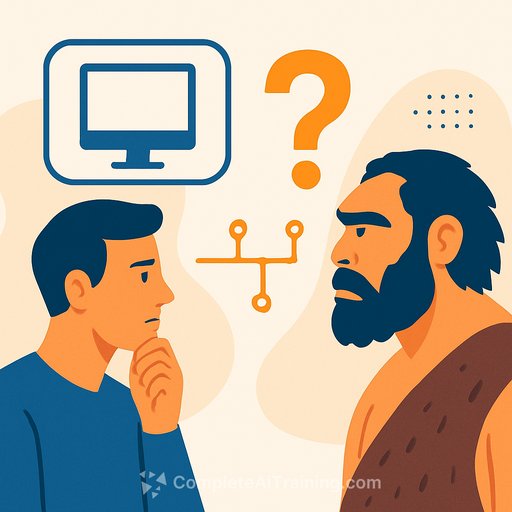
On museum walls, in textbooks, and across social feeds, generative AI is recreating Neanderthals with cinematic detail. It looks convincing. But a new study shows much of it pulls from yesterday's science, not today's.
Published in Advances in Archaeological Practice, researchers compared AI-generated depictions of Neanderthal life to a century of scholarship. The result: a consistent lag of decades between AI outputs and modern archaeological consensus.
What the study did
Researchers Dr. Matthew Magnani (University of Maine) and Dr. Jon Clindaniel (University of Chicago) generated hundreds of images and text passages about Neanderthals using DALL.E 3 and ChatGPT. They then compared those outputs to 2,063 scholarly abstracts (1923-2023) from major databases.
Text from AI lined up best with literature from the early 1960s. Images matched scholarship from the late 1980s to early 1990s. That temporal drift explains why so many AI scenes feel familiar-because they echo outdated narratives.
What AI gets wrong
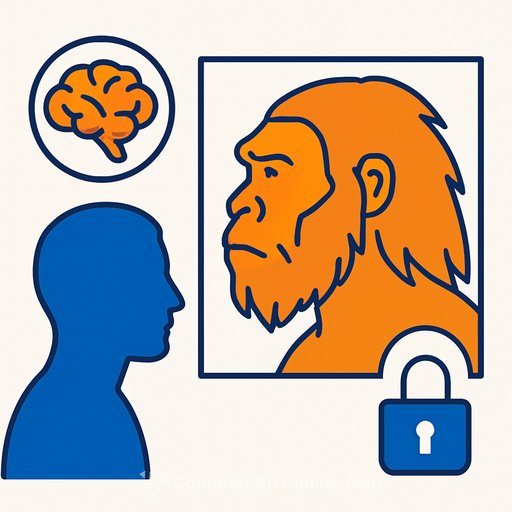
Common misfires included hunched, fur-covered bodies with exaggerated "primitive" features-visual tropes scientists have long abandoned. Some images inserted outright anachronisms: glass vessels, metal tools, or architecture that didn't exist for tens of millennia.
Gender bias was just as clear. AI leaned heavily into muscular male hunters while sidelining women, children, and cooperative social roles that recent research emphasizes.
Why models skew old
Generative systems learn from what's most reachable at scale. Older books, public-domain texts, and widely scraped websites are overrepresented. Recent research is often paywalled and harder to crawl, so it shows up less in training data.
That visibility gap doesn't just miss new findings; it amplifies past biases and cultural stereotypes. The result is a polished remix of the past-credible on the surface, inaccurate underneath.
Why this matters
AI is quietly becoming the first pass at science communication for students, educators, and the public. If its defaults lean on outdated or biased material, those errors can normalize fast.
Over time, high-fidelity fabrications risk blurring into "fact." Once those images and narratives saturate feeds and classrooms, correction gets harder.
What you can do now (researchers, educators, curators)
- Pair generation with retrieval: Use retrieval-augmented workflows that ground outputs in up-to-date, peer-reviewed sources.
- Constrain the prompt: Specify "align with post-2015 peer-reviewed consensus" and name key topics (e.g., cooperative care, tool repertoires). Add negative constraints (no metal, no glass, no fur-coats).
- Demand citations or evidence trails: For text, require linked references or source snippets. Reject outputs that can't be verified.
- Human-in-the-loop review: Establish expert review checklists for anachronisms, gender skew, and phenotype exaggeration before publishing visuals.
- Bias audits for visuals: Sample outputs at scale and quantify representation across age, sex, activity, and technology. Adjust prompts and datasets accordingly.
- Provenance and disclaimers: Label AI-generated assets, note known uncertainties, and include the date and source scope used to produce them.
- Curate your own corpora: Build local, rights-cleared datasets of current papers and reconstructions. Fine-tune or condition models on these sets.
- Prefer open resources: Publish preprints and open-access summaries so modern findings are more discoverable to both people and models.
Practical prompts that help
- "Depict Neanderthal daily life using consensus findings from 2015-2023 peer-reviewed archaeology; avoid metal, glass, or permanent architecture; represent mixed-age, mixed-sex group activities; no exaggerated brow ridges or body hair."
- "Generate a summary grounded in these sources [paste abstracts/snippets]; include inline citations; flag any claims with low agreement across sources."
The bigger lever: access
The study's core message: availability shapes output. If modern research sits behind paywalls, models will keep leaning on what's free and old. That's a policy problem as much as a technical one.
Improving open access, dataset transparency, and documentation standards will move the needle faster than clever prompting alone.
Where to go deeper
For model behavior, training data issues, and grounded workflows, explore Generative AI and LLM. For background on Neanderthals from a trusted public source, see the Smithsonian overview Homo neanderthalensis.
Bottom line
AI can render the past with stunning fidelity, yet miss the science by decades. If we want accurate public memory, we need grounded generation, expert oversight, and better access to current research.
Realism isn't accuracy. Make the pipeline prove it.
Your membership also unlocks: