AI labmates supercharge LED light control
Publication Date: January 20, 2026
Location: Albuquerque, N.M.
Physicists at Sandia National Laboratories report a fourfold improvement in steering LED light, achieved by a trio of AI "labmates" that designed and ran 300 experiments in roughly five hours. The work, published in Nature Communications, narrows the gap between basic optics research and practical LED-based alternatives to lasers for UPC scanners, holographic projection, and autonomous systems.
Why this matters
LEDs are cheaper, smaller, and more energy-efficient than lasers, but their spontaneous emission has been hard to steer with precision. The team's AI-augmented approach improves control on average by 2.2x across a 74-degree angle, with peak improvements up to 4x at specific angles. This level of control moves LEDs closer to laser-like utility for real systems.
How the self-driving lab works
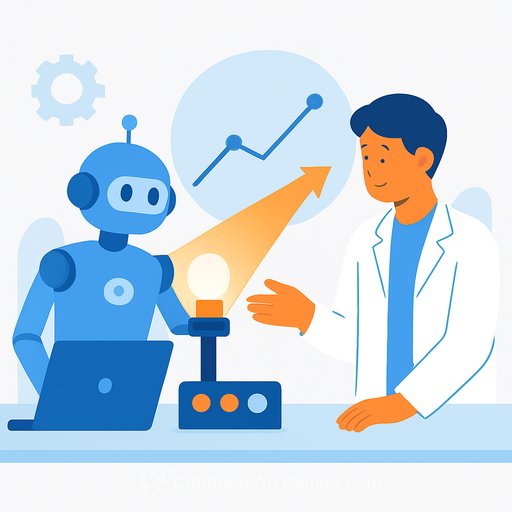
The team combined three AI roles into a single, closed-loop workflow. Each role reduces friction from data to experiment to insight. This architecture emphasizes experiment Design as a first-class workflow concern.
- Data simplifier: A generative model learns structure in complex optical data, distilling it into a compact representation.
- Active learner: An agent designs an experiment, runs it on the optical setup, analyzes results, then iterates. It executed 300 runs in about five hours.
- Equation finder: A symbolic regression model fits equations to the evolving dataset, making the agent's findings interpretable and testable.
From black box to equations
Handing a lab to an AI agent raises a fair concern: it could run countless pointless trials. The team addressed this by coupling the active learner with an equation-learning AI to explain trends as they emerged.
That feedback loop produced immediate, human-checkable formulas describing how to steer spontaneous emission more effectively. It also surfaced a path the researchers hadn't considered - a fresh way of thinking about light-matter interactions at the nanoscale.
Results in hours, not years
What the group previously expected to refine over years, the AI platform improved in a single afternoon. Average steering efficiency rose 2.2x across a 74-degree sweep, with fourfold gains at certain angles. Crucially, the equations arrived alongside the results, so the findings weren't just numbers - they were explanations ready for peer scrutiny.
Compute notes
The learning pipeline ran on a Lambda Labs workstation with three NVIDIA RTX A6000 GPUs. Not every lab will have this setup, but the architecture - compress data, actively explore, enforce interpretability - is portable. Models and infrastructure can scale down with careful experiment design and smaller search spaces.
What you can apply in your lab
- Start with a learned representation of your data; it speeds up search and reduces noisy dimensions.
- Use active learning to propose the next best experiment, not just the next experiment.
- Pair every optimization agent with a symbolic regressor or physics-informed model to keep results explainable.
- Constrain the agent's action space to physically meaningful operations and safe device limits.
- Log equations and parameters per iteration so you can reproduce and audit the path to the "best" result.
People and collaboration
The effort grew out of a cross-disciplinary pairing: optics expertise from Prasad Iyer and machine learning experience from Saaketh Desai. Their collaboration modernized the lab and set guardrails for interpretability from day one.
Funding and facilities
Research was supported by the Department of Energy's Office of Basic Energy Sciences and Sandia's Laboratory Directed Research and Development program. Portions of the work were performed at the Center for Integrated Nanotechnologies, a DOE Office of Science user facility jointly operated by Sandia and Los Alamos national laboratories. Learn more about DOE Basic Energy Sciences here.
What's next
The team is exploring interpretable optimization schemes that keep decisions explainable while pushing performance. They're applying the approach to LED steering and to broader materials problems where closed-loop experimentation and transparent models can shorten cycles from idea to insight.
Further reading and upskilling
- Journal reference: Nature Communications
- Interested in building AI-first experiment workflows? See curated training by job role: Complete AI Training
- Methodology and experiment workflows: Research
Your membership also unlocks: