AI Language Models: Balancing Equity in Marine Policymaking
Artificial Intelligence Large Language Models (LLMs), such as GPT, are increasingly influencing international environmental policymaking. These tools offer the ability to assist with time-consuming tasks like analyzing policy documents, drafting instruments, and supporting public consultations. Particularly, they hold promise for helping developing countries overcome capacity challenges that often limit their participation in negotiations.
However, while LLMs present opportunities, they also carry risks that may deepen existing inequalities. For example, they can introduce biases favoring perspectives from Western economic centers, potentially overlooking the voices of developing nations. This article examines these dynamics through the case study of an AI chatbot designed for the Biodiversity Beyond National Jurisdiction (BBNJ) Agreement under the United Nations Convention on the Law of the Sea.
Emerging Role of LLMs in Marine Policy
Recent advancements in generative AI have equipped LLMs with an unprecedented capacity to process and engage with complex documents and topics. These developments have led to their adoption in various policy-related activities, including drafting speeches and conducting background research at the UN. Some governments have even established guidelines for official AI use.
Specialized AI tools are already applied in sectors like medicine and law to analyze large document databases. Marine policy is beginning to see similar integration, with LLMs aiding in economic impact analyses, legislative summaries, and information retrieval during negotiations.
LLMs can reduce burdens on policymakers by helping interpret legal jargon, drafting formal statements, and quickly answering research questions. This capability is especially valuable for developing countries, where limited resources and smaller teams often hamper effective participation.
Challenges and Equity Concerns with LLMs
Despite their potential, LLMs come with significant limitations and biases. Their training data primarily consists of internet text, academic publications, and books, which are predominantly produced by developed countries. This results in an overrepresentation of Western viewpoints, potentially marginalizing the perspectives of developing States.
In marine governance, which is inherently transboundary and marked by power imbalances, these biases can reinforce systemic inequities. The marine environment involves complex social, cultural, and economic factors that are often overshadowed by ecological priorities, further complicating equitable policy development.
Sources of Bias
- Training Data Bias: The lack of transparency around LLM training datasets makes it difficult to assess the full extent of embedded biases. However, it is clear that content from developed nations dominates, skewing AI outputs.
- Document Database Bias: AI tools rely heavily on curated databases of policy documents, where the voices of developed countries are often amplified due to greater institutional capacity. Developing countries’ concerns may be underrepresented or expressed in subtler diplomatic language that AI struggles to interpret.
- Application Design Bias: The manner in which prompts are structured and how users interact with AI influences outputs. Slight changes in phrasing or tone can lead to vastly different responses, which may unintentionally favor certain perspectives.
- Overtrust and Overreliance: The human-like interaction style of chatbots can lead users to overestimate their accuracy and reliability. This misplaced trust risks policymakers accepting AI recommendations without sufficient scrutiny, potentially reinforcing existing power imbalances.
Impact on Capacity Building
Capacity building in international environmental policy depends heavily on cooperation, knowledge transfer, and expert assistance. Overdependence on AI tools might reduce the incentive for direct human collaboration and skill development, especially in under-resourced governments.
For example, officials might prefer quick AI-generated answers over engaging with experts or diplomatic partners, which can lead to a loss of institutional knowledge and weaken negotiation capabilities. Additionally, the hype around AI could tempt some developed countries to reduce support programs, assuming technology alone can fill the gap.
Opportunities for Improving Equity
Despite these risks, LLMs offer practical benefits that can help level certain playing fields in marine policymaking. Developing countries often face staff shortages, limited financial resources, and rapidly changing portfolios. AI tools can assist by quickly summarizing complex legal texts, drafting responses, and supporting public consultations.
LLMs excel at parsing voluminous documents and providing explanations suitable for different expertise levels, making them useful for officials who must get up to speed on unfamiliar topics quickly. These capabilities can improve participation and help retain institutional memory despite high staff turnover.
Supporting Legal and Policy Understanding
Implementing agreements like the BBNJ requires detailed knowledge of obligations and procedures, which can be daunting for under-resourced governments. LLMs can help by clarifying legal language and highlighting key provisions, such as environmental impact assessments and mechanisms related to marine genetic resources.
This assistance could reduce barriers to effective domestic implementation and compliance, ensuring that developing countries can engage more confidently in international marine governance.
Conclusion
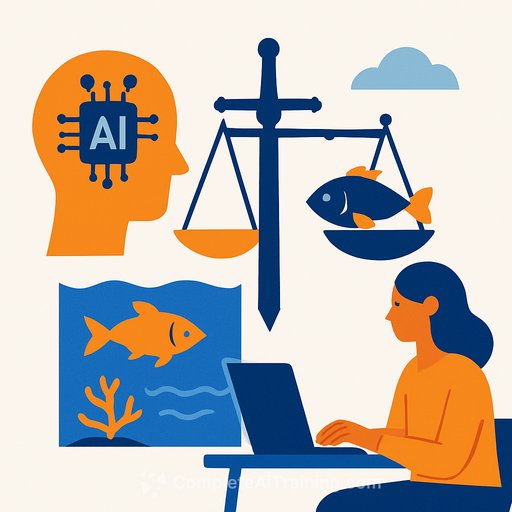
AI language models have the potential to both enhance and hinder equity in marine policymaking. Their ability to process complex information rapidly can support developing countries facing capacity constraints. However, inherent biases in training data, application design, and institutional contexts may perpetuate existing inequalities.
To maximize benefits and minimize harms, it is critical to develop trustworthy, transparent, and fair AI tools. Additionally, AI should complement—not replace—essential capacity-building efforts involving human expertise and international cooperation.
For professionals interested in exploring AI’s role in policy and legal contexts, resources and courses on AI applications can be found at Complete AI Training.
Your membership also unlocks: