State AI Leaders Convene at Princeton to Enhance Public Services
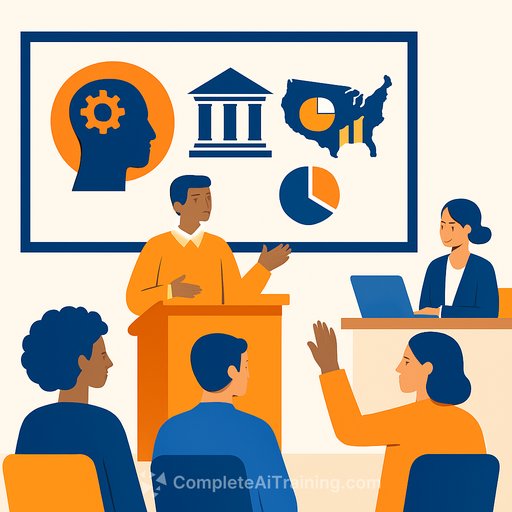
In June, over 100 AI leaders from 25 states gathered at Princeton University to explore how artificial intelligence can improve government services. The event focused on making public services more efficient, effective, and transparent while addressing the challenges AI presents.
With budgets tight and economic uncertainty affecting hiring, governments are looking for ways to optimize operations. This conference, hosted by Princeton’s Center for Information Technology Policy (CITP), the NJ AI Hub, and several national organizations, provided a platform for sharing practical AI applications in the public sector.
Balancing Innovation and Accountability
Participants expressed optimism about AI’s ability to reduce manual tasks for government employees and enhance citizen engagement. However, they also emphasized the importance of using public data responsibly to promote equity rather than undermine it.
Arvind Narayanan, CITP Director and computer science professor, highlighted the focus on real-world AI implementations rather than media-driven debates. He noted that while internal government use of AI is advancing, public-facing deployments require careful attention to accountability and fairness.
Practical AI Applications in Government
- Employees saving one to two hours weekly by using AI to draft grant applications, assess legislation, and review procurement policies.
- A city automating the summarization of council oral votes, producing 20 years of records quickly and at minimal cost, improving voter access to information.
These examples show how AI can streamline government workflows and strengthen transparency.
New Jersey’s Collaborative Approach
Governor Phil Murphy of New Jersey discussed the state’s proactive steps, including partnering with Princeton and companies like Microsoft and CoreWeave to launch the NJ AI Hub. This initiative aims to foster AI innovation while acknowledging challenges such as the risk of misuse, impact on jobs, and equitable access.
Murphy posed critical questions about AI’s role in wealth distribution and access: “Is this going to be something that is a huge wealth generator for the few, or are we going to be able to give access to this to everybody?”
Building Public AI Infrastructure
Conference attendees considered creating AI infrastructure as a public good. They argued that AI should remain open-source and publicly accessible, similar to roads and broadband, with built-in accountability mechanisms. This approach could prevent private monopolization and promote transparency.
Looking Ahead: Transparency and Trust
Anne-Marie Slaughter, former Princeton SPIA dean and current CEO of New America, emphasized that AI can transform not just how government operates but also what government does. She highlighted the potential for AI to enable co-creation and co-governance with citizens, reinforcing public trust and democratic engagement.
This gathering reflects a growing movement within state governments to adopt AI thoughtfully, balancing efficiency gains with equity and accountability. For public sector professionals interested in AI applications and governance, ongoing education and collaboration will be key.
For those looking to deepen their understanding of AI tools that can enhance public service delivery, resources are available at Complete AI Training.
Your membership also unlocks: