UVic researchers use AI to decipher fish sounds | EurekAlert!
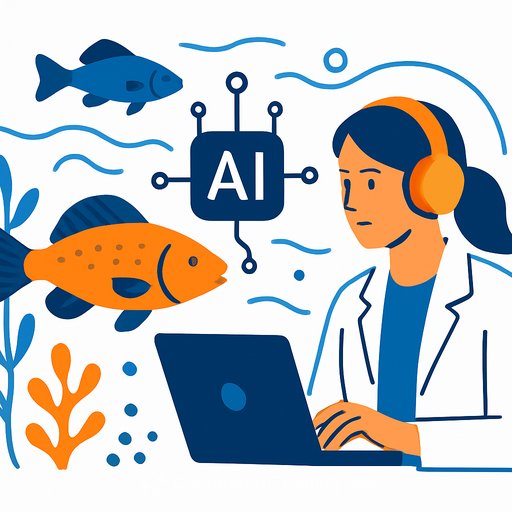
Underwater ecosystems are full of acoustic signals most of us never hear. A University of Victoria team is applying AI to those signals to identify fish species, track behavior, and monitor habitats at scale.
For people in science and Research, this is about turning hours of noisy hydrophone recordings into clean, decision-ready data. Less manual labeling, faster insight, and stronger baselines for ecology and management.
Why fish sounds matter
Many fish are soniferous. They produce pops, grunts, and drumming calls for courtship, spawning, and territory.
Those calls give you non-invasive indicators of presence, timing, and habitat use. With enough coverage, you can build seasonal patterns, detect shifts in phenology, and support stock assessments without constant trawl or visual surveys.
How AI makes this practical
- Acoustic capture: Continuous hydrophone streams from moorings or cabled observatories enable long-term monitoring. Cabled arrays also provide stable power and bandwidth for real-time analysis.
- Preprocessing: Band-pass filtering, noise profiling, and spectrogram conversion (Mel/constant-Q). Normalize carefully to keep call structure intact at low SNR.
- Annotation: Start with expert-labeled exemplars. Use weak labels from literature or catalogs, then iterate with active learning to focus expert time on uncertain clips.
- Models: CNNs on log-Mel spectrograms remain strong baselines. Audio transformers and self-supervised embeddings (e.g., wav2vec-style) help when labeled data are scarce.
- Training tactics: SpecAugment, time shift, mixup, and background-noise mixing improve robustness. Calibrate thresholds per species; calls vary widely in duration and frequency.
- Evaluation: Report per-class precision/recall, call-level F1, and detection at low SNR. Validate across sites to check domain shift.
- Deployment: Batch in the cloud for archives; stream on edge devices for alerts (e.g., spawning aggregations). Keep a feedback loop to catch drift as noise profiles change.
What researchers can do now
- Define use-cases: Species presence, spawning timing, or habitat status. Your target metric should match the decision you need to support.
- Stand up a baseline: librosa + PyTorch/TensorFlow for spectrograms and a small CNN. Start with 5-10 minutes of clean, labeled calls per class.
- Standardize labels: Short, consistent call snippets (e.g., 1-5 s) with clear metadata: site, depth, temperature, hydrophone model, and gain.
- Iterate with active learning: Review the top-uncertain clips each week. This usually doubles your effective label value.
- Track drift: Ship noise and weather change background conditions. Log false positives by site and season; retrain quarterly.
Applications that move the needle
- Spawning windows: Use call rates to time closures and reduce bycatch risk.
- Habitat health: Long-term acoustic indices flag degradation or recovery in protected areas.
- Impact assessment: Before/after soundscapes for construction, seismic surveys, or shipping lane changes.
- Automated presence/absence: Supplement trawl, eDNA, and visual surveys with continuous acoustic data.
Data, tools, and ops
- File handling: Use lossless formats (WAV/FLAC) and keep raw archives. Store derived spectrograms for speed, but never discard originals.
- Annotation tools: Audacity and Raven Pro are common; ensure exports include exact time bounds and channel IDs.
- MLOps basics: Version data, code, and models. Save inference configs with thresholds and class maps. Reproducibility keeps field teams aligned.
- Governance: Adopt FAIR principles, document sampling biases, and share model cards so others can reuse your pipeline responsibly.
Limitations to plan for
- Acoustic overlap: Species share bands; shipping and rain mask calls. Expect confusion without site-specific models.
- Label scarcity: Few clean exemplars for many species. Self-supervised pretraining and synthetic augmentation help.
- Domain shift: Models trained in one region often degrade elsewhere. Cross-site validation is mandatory.
- False positives at scale: Even 1% error yields many alerts. Use multi-threshold logic and event clustering before notifying field teams.
What success looks like
- Recall above 0.8 for target species at SNR near detection limits.
- Stable precision across seasons and sites after calibration.
- End-to-end latency under minutes for real-time monitoring.
- Clear link from acoustic metrics to management actions or published analyses.
Helpful references
- Ocean Networks Canada - cabled observatories and acoustic data that often support UVic research.
- NOAA Fisheries: Passive Acoustic Technology - methods, hardware, and QA considerations for underwater sound monitoring.
Upskill your team
If you're building or maintaining an audio ML pipeline for field research, structured practice helps. Curated tracks on model building, Data Analysis, and deployment can shorten the path from prototype to production.
- Research-focused materials and case studies help align academic methods with operational monitoring needs.
Bottom line: AI can turn continuous underwater audio into reliable ecological signals. With the right data discipline and model evaluation, you get faster cycles from recording to insight-and better evidence for decisions in the water.
Your membership also unlocks: