AI Is Reshaping Music. Here's What Creatives Need To Know Now
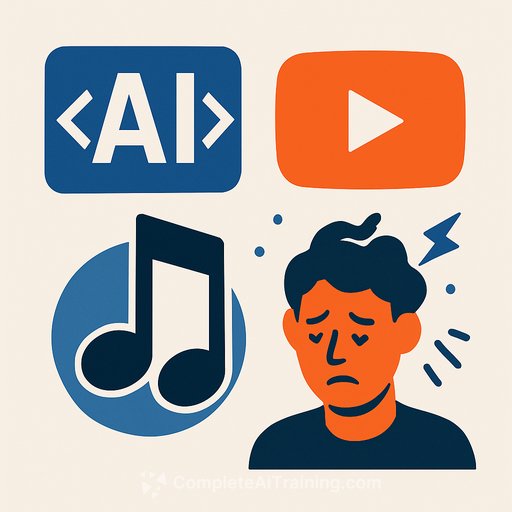
The music industry is at an inflection point. AI platforms are cutting deals with major labels, and the money model looks a lot like early YouTube: train on catalogs, share revenue, keep the traffic flowing.
That pragmatism is splitting the industry. Artists worry about consent and compensation, while labels and tech companies race to set the rules before regulators do.
The YouTube playbook, updated for AI
Labels like Universal, Sony, and Warner are signing licensing frameworks with AI platforms. The idea: if models train on catalogs or output songs that reference recognizable works, rights holders get paid.
This echoes the YouTube era, where Content ID turned legal chaos into steady income for rights owners. You can see that system's blueprint here: YouTube Content ID.
Where the comparison breaks
YouTube dealt with humans uploading known recordings. AI composes new tracks after learning patterns from huge datasets. That blurs ownership and makes "who gets paid and how much" far harder to sort out.
A recent example: the folk-pop track "I Know, You're Not Mine" hit No. 1 on Spotify in Sweden. Listeners chose the song, not the process, and that's the uncomfortable truth for many insiders.
Why artists are pushing back
Many creators argue labels are licensing away legacies without clear consent. Master rights are one thing; moral and creative rights are another.
Even if revenue gets shared, the pie can be spread so thin that individual payouts turn trivial. Meanwhile, AI platforms get legitimacy and scale.
What AI platforms gain (and what they don't)
Licenses offer legal cover and cleaner data for training. Better inputs usually mean better outputs.
But the risk isn't gone. Independent artists and publishers outside the deals can still sue. And the scope-training data only, or outputs too-remains a moving target.
The economic squeeze
If AI delivers commercial tracks at near-zero marginal cost, a lot of the traditional production chain feels the heat: session players, producers, engineers.
Streaming services face a tradeoff. Infinite AI catalog at low cost sounds great on paper, but drowning listeners in synthetic tracks could hurt trust and brand. The Swedish chart story suggests many listeners won't filter for human vs. AI unless prompted.
Regulation is lagging-and deals are setting de facto rules
Lawmakers are catching up, slowly. The EU's AI Act adds transparency rules but leaves core music copyright questions open. See the overview here: EU AI Act.
Until courts or new laws land, private agreements will set expectations. Given global AI development and cross-border distribution, those early terms may stick.
What this means for working creatives
The market is moving with or without consensus. You need a plan that protects your catalog and builds leverage-with or without AI in your toolkit.
Protect your rights and your future catalog
- Contract check: add clauses for AI training, style cloning, and synthetic vocals. Spell out consent, scope, and ongoing royalties.
- Register everything: split sheets, ISRCs, PRO registrations. If you can't prove ownership, you're invisible in revenue models.
- Set your default: decide now if you want your catalog licensed for training. Push for an opt-in/opt-out pathway in label and distributor agreements.
- Metadata discipline: embed accurate credits and identifiers. It strengthens any claim when models or platforms trace influence.
Use AI on your terms
- Prototype faster: ideate melodies, harmonies, and arrangements, then humanize. Keep your taste in the driver's seat.
- Create reference packs: stems, vocal takes, style guides. If a platform wants your "sound," that's a paid product, not a free scrape.
- Credit your process: if you use AI, say how. Transparency builds trust with fans and collaborators.
Diversify income before per-stream rates thin out further
- Own direct channels: mailing list, fan memberships, limited drops. Reduce dependence on a single platform's economics.
- Licensing and commissions: custom work for brands, games, and creators. Position yourself where human taste is the brief.
- Education and assets: sell sample packs, presets, and workshops. Package your style as a product.
Negotiate smarter with labels, distributors, and platforms
- Ask for transparency on AI deals: what's covered (training, outputs, voice), how payouts are calculated, and audit rights.
- Minimums over vibes: push for floor payments per training inclusion, not just "share of share."
- Style and voice rights: keep control of name, likeness, and vocal timbre. Synthetic clones should require explicit permission and premium rates.
What's next: likely scenarios
- Hybrid creation becomes normal: human-led concepts, AI-assisted production, human finishing. Speed goes up; taste decides.
- Catalog segmentation: some artists opt out of training; others license at a premium. Market stratifies on consent and quality.
- New royalty math: influence-weighted payouts or tokenized credits could emerge to avoid dilution. Expect experimentation.
- Listener labels matter: platforms may add "Human," "Hybrid," or "AI" tags if trust becomes a selling point.
The takeaway
AI is already part of music's business model. Either your rights are priced into it-or they're treated as free inputs.
Protect consent in writing, keep your data clean, and build revenue streams that value your taste and reputation. Use the tools, but don't give away your voice-literal or artistic-without a premium and a paper trail.
Level up your AI workflow (for creatives)
- Generative AI and LLM resources to understand model training, data practices, and technical tradeoffs.
- AI for Creatives guides and case studies tailored to artists protecting rights while using AI tools.
- Generative Art coverage on creating and packaging AI-generated assets like stems, presets, and reference packs.
Your membership also unlocks: