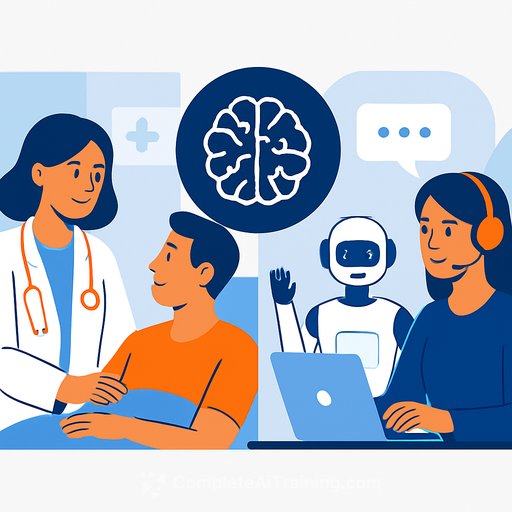
AI is moving healthcare from population playbooks to "segments of one"
Artificial intelligence is changing how health systems engage patients - shifting from broad campaigns to one-to-one interactions. Speaking at Reuters' Total Health in Chicago, AdventHealth Chief Digital Officer David Oakley said the next edge in care will come from deeply personal experiences across every touchpoint.
For years, we grouped patients by age, condition, or visit type. That's losing its edge. "We'll move from broad segments into segments of one. That's the intent," Oakley said.
From population care to individual precision
You can see the early version of this on hospital sites and EHR portals. Patients using Epic's MyChart already get reminders and recommendations based on their history.
AdventHealth is pushing further with a personalization engine that adapts experiences even for visitors who aren't logged in. The goal: meet people based on what they actually need in the moment - and go beyond clinical data to include emotional, social, and lifestyle factors that drive real outcomes.
Beyond the portal: trust is the product
Personalization isn't just convenience. Done well, it builds credibility between patients and care teams. As Oakley put it, this work should create deeper relationships - the kind that keeps patients engaged and following through on care plans.
Why this matters for outsourcing and contact centers
As health systems adopt AI-led personalization, BPO partners can't just process tasks. They need to know preferences, communication styles, and well-being needs - and reflect that in every interaction, whether it's scheduling, care navigation, or telehealth support.
This shift turns contact centers into extensions of the care team. It's how outsourced operations contribute to experience, outcomes, and loyalty - not just volume.
What to build now
- Unify data sources: EHR, CRM, contact center logs, patient feedback, SDoH, device data (where consented).
- Identity and consent: strong patient identity resolution, granular permissions, clear opt-in/opt-out flows.
- Real-time decisioning: a rules + AI layer that updates content, offers, and next best actions on the fly.
- Context-aware content: messages that adjust by channel, literacy level, language, and care plan status.
- Cross-channel orchestration: web, app, SMS, email, IVR, agent assist - all reading from the same playbook.
- Agent augmentation: surface patient context, tone guidance, and suggested responses inside the console.
- Bias and safety checks: monitor models for fairness, drift, and clinical safety; add human review for high-risk use cases.
- Privacy-first analytics: measure without exposing PHI; use de-identified data where possible.
- EHR integration: write back key outcomes and preferences so insights don't live in a silo.
Metrics that prove it works
- Engagement: portal logins, message open rates, schedule completion, waitlist conversions.
- Access: time to appointment, show rates, post-discharge follow-through.
- Clinical: care gap closure, med adherence, preventable ED visits.
- Experience: CSAT/NPS, complaint reduction, trust signals in feedback.
- Operations: handle time, first-contact resolution, agent assist adoption.
Guardrails that keep you out of trouble
- Consent and transparency for any data used to personalize.
- Clear boundaries: no sensitive predictions without clinical oversight.
- Content governance: medical review for anything that could influence care decisions.
- Continuous monitoring: fairness audits by demographic slices; retrain or roll back if drift appears.
The takeaway for providers and BPO partners
Personalization is becoming both a care strategy and a competitive differentiator. Systems that move first - and do it safely - will earn patient trust and build stronger, more consistent outcomes across every channel.
If your teams need practical upskilling on AI workflows and orchestration, explore role-based programs at Complete AI Training.
Your membership also unlocks: