AI Mapping Shows How One Labor Law Change Can Affect Dozens of Provisions
A change to a single labor rule can ripple through an entire legal system, affecting provisions tied to wages, workplace safety, social protection, immigration, and commercial activity. Researchers at Sultan Qaboos University discovered this by using artificial intelligence to map hidden connections inside Oman's Labor Law of 2023.
The study, published in The Journal of Engineering Research, found that legal systems function as interconnected networks rather than isolated articles. Some provisions carry far more structural weight than others, and lawmakers often miss these links when drafting amendments.
Treating Law Like a Network
The research team used natural language processing tools to analyze the labor law's 2023 version, a major piece of legislation tied to Oman's Vision 2040 modernization plans. The law covers employment contracts, wages, working conditions, occupational safety, and dispute resolution.
The researchers processed Arabic legal text using Python's Natural Language Toolkit and custom regular expressions. They built specialized Arabic stopword lists combining standard tools with legal terminology specific to labor law. They also designed patterns to detect references between articles, accounting for Arabic numerals and grammar structures common in legislation.
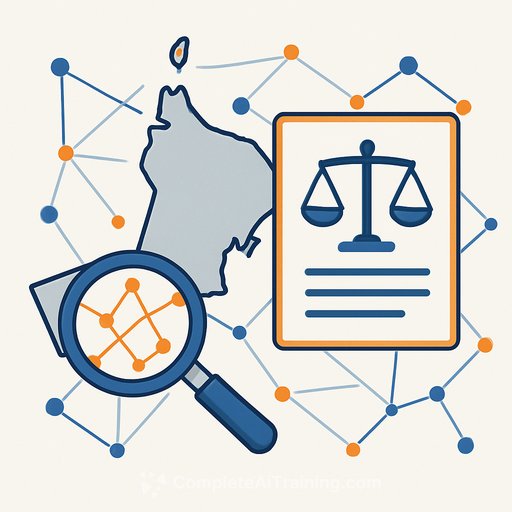
Once the text was processed, the team mapped relationships between articles using shared words and semantic analysis. They converted those links into network graphs, heat maps, and tables designed to make legal structure visible to lawmakers.
Which Articles Matter Most
Article 147 emerged as a key node in the network, with links to multiple other provisions. Changes to Article 147 would spread through the broader legal framework more than changes to less connected articles.
Articles 71 and 72 shared significant terminology, pointing to a close thematic relationship. The heat maps showed that most article pairs had limited overlap, but several zones marked places where language and concepts were strongly shared.
These overlaps can signal redundancy, tight coordination, or areas where reform in one article could unsettle another. The visualizations help lawmakers spot those patterns before drafting amendments.
Laws Don't Stand Alone
Oman's labor law does not exist in isolation. It interacts with commercial law through workplace compliance and employment contracts. It ties into social security rules through benefits, health insurance, and pensions.
The labor law also intersects with immigration policy, especially because Oman has a large expatriate workforce whose legal status depends on work permits and residency requirements. Occupational health and safety rules add another layer, connecting to broader public health and regulatory standards.
Legal review cannot rely only on reading articles one by one. Cross-domain ties mean that changes in one area can affect multiple legal domains.
Validation From Legal Experts
The researchers brought in legal experts from the Legislative Chamber, State Council, and Shura Council to test whether the AI-generated outputs made legal sense. Their feedback was used to validate the simplified texts, relationship maps, and visualizations.
This validation step was crucial. The study frames the work as a way to support evidence-based reform and reduce the risk of unintended conflicts inside a legal system under pressure to modernize.
Practical Value for Lawmakers
If a proposed amendment touches a highly connected article, officials can now check in advance which other provisions may be affected. That could help reduce legal gaps, overlaps, and contradictions.
For legal professionals, the approach offers a faster way to navigate dense statutory material, especially in systems where laws interact across labor, business, social welfare, and immigration domains. For Oman, the researchers present it as one tool that could support Vision 2040 by making legal reform more coherent.
The study suggests the model could scale beyond Oman to other GCC legal systems. The main limitation is that this was a case study centered on one law using adapted existing NLP methods rather than newly developed ones.
Even so, the work makes a clear case that AI for Legal professionals can help lawmakers see the legal system less as a stack of documents and more as a living structure of connections. The AI for Research methods used here-network mapping, semantic analysis, and text processing-demonstrate how existing tools can be applied to legislative analysis in ways that surface relationships human readers might miss.
Your membership also unlocks: